


The Major Impact of Leveler Political Ideas Upon America’s Founding Fathers Leading to the American Revolution and the Declaration of Independence
June 21, 2026
The Major Impact of Leveler Political Ideas Upon America’s Founding Fathers Leading to the American Revolution and the Declaration of Independence.
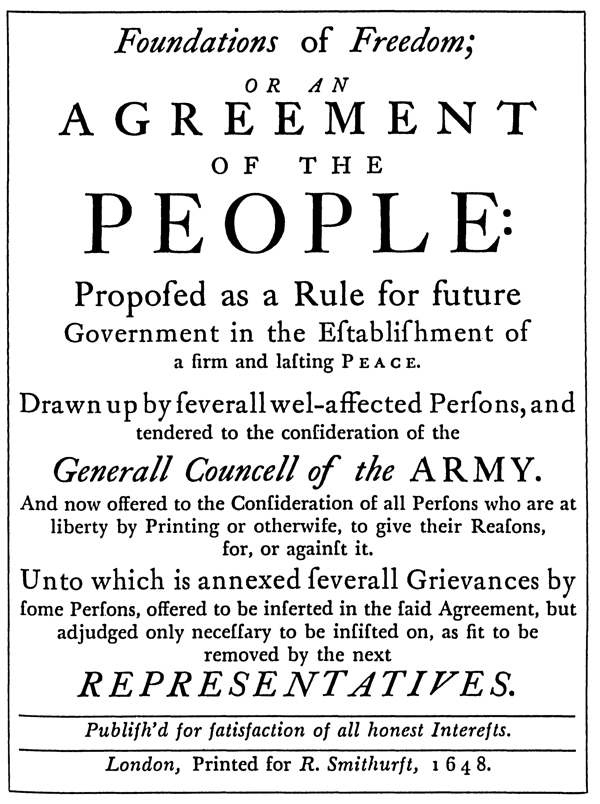
The Levelers were a radical, democratic movement that emerged within the New Model Army during the 1640s English Civil War. Led by figures like John Lilburne and Richard Overton, they championed universal male suffrage, religious tolerance, legal equality, and a written constitution (The Agreement of the People).
The Transmission of Radical Ideas
The Levelers’ core ideas did not die with the movement’s suppression by Oliver Cromwell. Instead, they were inherited, modified, and amplified by later 17th- and 18th-century thinkers known as the “Commonwealthmen” or Real Whigs.
Caroline Robbins, in her foundational work The Eighteenth-Century Commonwealthman, traces how the anti-authoritarian philosophy of the English Civil War survived through generations of radical writers.
These ideals were popularized in the 1720s by John Trenchard and Thomas Gordon, who wrote under the pseudonym “Cato”.
Cato’s Letters and the American Revolution
As thoroughly documented by Bernard Bailyn in The Ideological Origins of the American Revolution and The Origins of American Politics, Trenchard and Gordon’s Cato’s Letters became the most quoted and esteemed political texts in the American colonies.
Bailyn demonstrated that the American revolutionary mindset was heavily shaped by these radical Whig tracts, which adapted the Leveler suspicion of concentrated power into a specific American context:
Popular Sovereignty & Natural Rights: Leveler claims that legitimate government arises solely from the consent of the governed were expanded into the natural rights theories embraced by the American Founders.
Distrust of Standing Armies and Executive Power: The Levelers’ initial opposition to tyrannical kings and standing armies was adopted by colonists who felt threatened by British military occupation in the 1760s and 1770s.
Freedom of Speech & Press: The Leveler fight for open public debate evolved into the American conviction that a free press is the ultimate bulwark against political corruption and tyranny.
John Lilburne, a leader of the 17th-century Leveler movement, was a prolific pamphleteer whose writings laid the foundations for modern democratic ideas like popular sovereignty, universal male suffrage, and religious tolerance. His radical works, largely penned from prison, shaped constitutional debates during the English Civil War.
Core Leveler Writings by John Lilburne
England’s Birthright Justified (1645): Written while he was imprisoned, this pamphlet is considered one of the earliest foundational Leveler texts. It demanded equal rights, due process, legal reform, and an end to Parliamentary corruption.
An Agreement of the People (1647–1649): A foundational constitutional manifesto written alongside other Leveler leaders. It called for a written constitution, equal electoral districts, religious freedom, and the assertion that ultimate power resides with the people, not the King or Parliament.
The Free-mans Freedom Vindicated (1646): A passionate defense against arbitrary arrest and imprisonment, arguing that all Englishmen possess inherent “freeborn” rights that the government cannot legally violate.
England’s New Chains Discovered (1649): A blistering critique of the newly established Rump Parliament and Oliver Cromwell’s military regime, arguing that they had merely replaced royal tyranny with a new form of oligarchy.
Where to Find the Texts
Many of Lilburne’s tracts are preserved and available for digital reading:
Browse a wide collection of original pamphlets on the Online Library of Liberty Leveler Tracts catalog.
Cato’s Letters is a collection of 144 influential essays on liberty, government, and civil and religious freedom, written by John Trenchard and Thomas Gordon under the pseudonym “Cato” and published in the London Journal and British Journal between 1720 and 1723. The essays argued for limited government, the consent of the governed, and the necessity of free speech to check power, profoundly influencing American colonists and the Founding Fathers, who incorporated many of its ideas into the U.S. Constitution and Bill of Rights.
Key themes and ideas
Liberty as a natural right: The letters asserted that liberty is the unalienable right of all mankind, and government’s primary purpose is to protect these pre-existing rights.
Consent of the governed: They argued that legitimate rule requires the consent of the people, a radical idea at the time, and that government can be changed if it fails to protect rights.
Distrust of power: Trenchard and Gordon expressed a deep distrust of those in power, viewing government as a potential threat to liberty and advocating for constant vigilance.
Freedom of speech: They championed the right to criticize the government, arguing that public grievances must be heard for a free society to function.
Opposition to standing armies: Trenchard, in particular, was famous for his opposition to peacetime professional armies, seeing them as a tool for executive tyranny.
Influence
American Revolution: The letters were widely read and cited by American colonists, providing a philosophical foundation for their arguments against British rule.
Founding Fathers: Key figures like Benjamin Franklin, John Adams, and Thomas Jefferson were heavily influenced by Cato’s Letters.
U.S. Constitution: Ideas from the essays, particularly regarding the separation of powers and the importance of free speech, are reflected in the U.S. Constitution and Bill of Rights.
Murray Rothbard viewed Cato’s Letters (the 1720s essays by John Trenchard and Thomas Gordon) as the vital “missing ingredient” that transformed abstract Lockean natural rights theory into a radical, revolutionary force. He argued these writings were the single most important ideological shaper of the American Revolution.
Rothbard’s Core Interpretations:
Bridging the Theory-to-Action Gap: Rothbard noted that while John Locke’s philosophy was widely read, it was too abstract to stir men to revolt on its own. The fiery, anti-statist rhetoric of Cato’s Letters provided the necessary practical spark to motivate the American colonists to action.
Exposing State Power: Long before modern public choice theory, Rothbard appreciated how Cato’s Letters analyzed government based on how it actually operated—heavily attacking self-interested bureaucrats, politicians, and the inherent tyrannical nature of the State.
Roots of Modern Libertarianism: He highlighted the texts as the seminal foundation of eighteenth-century radical Whig or Commonwealthman ideology, which championed freedom of speech, freedom of conscience, and relentless suspicion of government power
Murray Rothbard analyzed early American historians in his essay “Modern Historians Confront the American Revolution” (originally published in The Journal of Libertarian Studies). You can read the complete essay text in the Rothbard Modern Historians PDF above.
Rothbard’s historiographical breakdown covers several key schools of thought
The Constitutional/Imperial School: These historians viewed the Revolution as a conservative, defensive reaction against British violations of traditional colonial liberties (led by historians like Charles McIlwain).
The Progressive Historians: Led by scholars like Charles Beard, this group emphasized class conflict and economic divisions within the colonies, arguing that the Revolution was not just a fight against England, but a domestic struggle for democratic power.
The Consensus School: Post-WWII historians like Daniel Boorstin, who Rothbard strongly critiqued. This school claimed the Revolution wasn’t really a revolution at all, but rather a conservative, homogenous defense of established rights.
Bailyn’s Ideological Breakthrough: Rothbard praised Bernard Bailyn’s work on pamphlets, which highlighted the radical, anti-authoritarian, and libertarian ideological origins of the Revolution.
Rothbard’s complete magnum opus on the era is his multi-volume Conceived in Liberty, Volumes 1-4. Volume 5, which details the revolution and founding through a similar libertarian and individualist lens.
250 Years Ago, on April 19, 1775, the American Revolution Began

 US To Buy Iranian Oil - First Time In Decades!