


Pearl Harbor — December 7, 1941 — “A Date Which Will Live In Infamy”
December 6, 2025

Pearl Harbor Historiography: A Lesson in Academic Housecleaning, By Gary North
This authoritative and suspenseful documentary takes you inside the secret activities of the Americans, the British and the Japanese as each nation moved fatefully toward the “date that will live in infamy.” For nearly 84 years, the world has believed President Franklin D. Roosevelt’s declaration that the Pearl Harbor attack was a completely unexpected assault on a neutral nation. Sacrifice at Pearl Harbor tells another, hidden story – using actual recording of intercepted diplomatic communications, declassified government documents, archival footage and interviews with diplomats and spies from around the world. We now know that intelligence operatives from the US and three Allied nations monitored the Japanese fleet’s progress on its deadly mission to Oahu in late 1941. Yet neither Admiral Kimmel nor General Short received a word of warning that might have allowed them to avert the sacrifice of 4,000 American casualties in less than 90 minutes.
I have always believed that the shocking information revealed in the interview with reporter Joe Leib is “the smoking gun” in the Pearl Harbor story, even more so than the McCollum Memorandum, the “East Wind Rain” (“Higashi no kaze ame”) radio message, or the pre-attack decoding of JN-25 transcripts.
“Court Historians” are the intellectual bodyguards of the State. They shape and defend the “official line” or interpretation on the State’s wars, its presidential regimes, or other key historical events and public policies. As a result, they enjoy high esteem and recognition in the mainstream media and academia. As defenders of the status quo, they frequently attack and label their critics as “conspiracy theorists,” “revisionists,” “isolationists,” “appeasers,” “anti-intellectuals,” or other boogie men, rather than engage in civil discourse or discussion.
As the late economist/historian Murray N. Rothbard noted:
All States are governed by a ruling class that is a minority of the population, and which subsists as a parasitic and exploitative burden upon the rest of society. Since its rule is exploitative and parasitic, the State must purchase the alliance of a group of “Court Intellectuals,” whose task is to bamboozle the public into accepting and celebrating the rule of its particular State. The Court Intellectuals have their work cut out for them. In exchange for their continuing work of apologetics and bamboozlement, the Court Intellectuals win their place as junior partners in the power, prestige, and loot extracted by the State apparatus from the deluded public. The noble task of Revisionism is to de-bamboozle: to penetrate the fog of lies and deception of the State and its Court Intellectuals, and to present to the public the true history of the motivation, the nature, and the consequences of State activity. By working past the fog of State deception to penetrate to the truth, to the reality behind the false appearances, the Revisionist works to delegitimize, to desanctify, the State in the eyes of the previously deceived public.
December 7, 1941 . . . a Day of Deceit, By Robert B. Stinnett
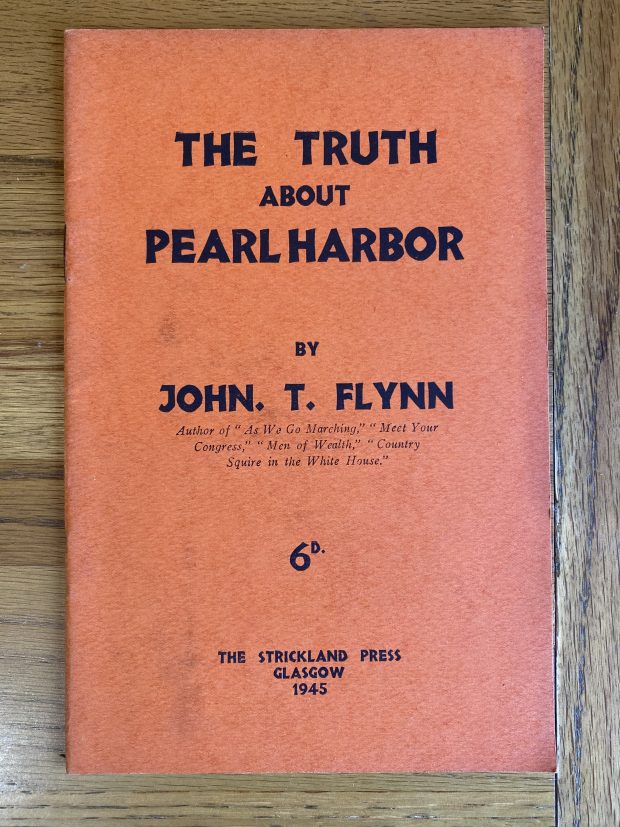
THE TRUTH ABOUT PEARL HARBOR, By JOHN T. FLYNN (1945)
John T. Flynn on Roosevelt and Pearl Harbor, By Laurence M. Vance
Pearl Harbor and the Engineers of War: How FDR lied us into World War II,
by Justin Raimondo
Did FDR Provoke Pearl Harbor? by Patrick J. Buchanan
The American and British Governments Knew – Down to the Day – of the Coming Japanese Attack on Pearl Harbor … and Let It Happen To Justify American Entry Into WWII
The Pearl Harbor Myth: Rethinking the Unthinkable
It’s Pearl Harbor Day – Trot Out the Official Fable, by Robert Higgs
Pearl Harbor Revisited, by William R. Tonso
Perpetual War for Perpetual Peace: A Critical Examination Of The Foreign Policy Of Franklin Delano Roosevelt And Its Aftermath, by Harry Elmer Barnes
A collection of nine revisionist essays edited by American historian and writer Harry Elmer Barnes, originally published in 1953, this intriguing volume offers a critical survey and appraisal of the development and implementation of American foreign policy of during the Presidency of Franklin D. Roosevelt; the FDR Administration’s deliberate manipulation of events in Europe and Asia to bring the US—against the wishes of the majority of its citizens—into World War II; and its resultant aftermath in the course of world history.
Why We Need Revisionist History, by Llewellyn H. Rockwell, Jr.
My New Book “American Memory Hole” How the court historians promote disinformation,
by Donald Jeffries
FDR, Pearl Harbor and the U.N., by John V. Denson
December 7, 1941, A Day of Deceit as Well as Infamy, by Fr. Emmanuel Charles McCarthy
War: Organized Murder and Nothing Else, by Donald Jeffries
The Truth About World War II, by Llewellyn H. Rockwell, Jr.
More Truth About World War II, by Llewellyn H. Rockwell, Jr.
More Falsehoods of World War II, by Ron Unz
The True History of World War II — Ron Unz video
Pearl Harbor Facts and Proof, by Carl Herman
Pearl Harbor: The Seeds and Fruits of Infamy –– Book by Percy L. Greaves, Jr.
Pearl Harbor: The Story of the Secret War — Book by George Morgenstern
George Morgenstern’s Pearl Harbor: The Story of the Secret War has to be one of the bravest books ever written. It’s a wonder it came out at all, but it did, in 1947, just as the war ended and FDR had died. It argues that the bombing was not unexpected, but provoked—and even wanted—by the administration as a “backdoor to the war” that FDR really desired as a means to rescue his presidency.
The McCollum Memorandum: A Story of Washington, D.C. in 1940-41: Franklin D. Roosevelt’s Journey from Deterrence to Provocation on the Road to Pearl Harbor, by Douglas P. Horne
The McCollum Memorandum: A Story of Washington, D.C. in 1940-41, is the most accurate and complete account yet published about how the United States truly entered the Second World War. It is the story of President Franklin D. Roosevelt’s gradual journey from deterrence to provocation—from October 7, 1940 through December 11, 1941—on America’s road to Pearl Harbor. The author utilizes official memoranda, state documents, the diary entries and sworn testimony of the principal actors in the story, and the documented results of the remarkable American and British codebreaking efforts in 1940 and 1941, to tell the dramatic story. In numerous scenes reminiscent of the best historical novels, the inner thoughts and private conversations of many of the key historical figures of the day are presented as dramatic reenactments, based faithfully on the hard kernels of truth in the documentary record.
Over 75 years after the Japanese attack on Pearl Harbor that launched America’s entry into the Second World War, one persistent question remains unanswered: “Did President Franklin D. Roosevelt have foreknowledge of the attack—and did he (and his senior military leadership) then withhold that knowledge from his overseas commanders in Hawaii?” Douglas P. Horne, a former Naval Officer who recently completed 40 years of combined military-and-civilian service to the Federal Government, deals directly with this most difficult of all questions about World War II, in the first major “Revisionist” work about Pearl Harbor written in the last decade. Contrary to recent assertions by mainstream historians that the Revisionist hypothesis is now dead, Horne finds it to be more robust than ever. In the first known work that studies FDR’s foreign policy “on the road to Pearl Harbor” as a timeline, or chronology (which assesses numerous factors—including codebreaking, diplomacy, military strategy, the unfolding events in Europe, and the personality and words of FDR himself), the author compellingly presents his own unique findings regarding the longstanding allegation by Revisionists that FDR used the impending Japanese attack on Pearl Harbor as a “back door to war.” Horne concludes there is, indeed, persuasive evidence that once FDR’s undeclared naval war against Hitler in the north Atlantic failed to provide the desired casus belli (which would have allowed him to request a declaration of war against Nazi Germany), then consequently, permitting the Imperial Japanese Navy to attack Pearl Harbor—without providing any specific advance warning to the Hawaiian field commanders (i.e., allowing the Japanese to “fire the first shot” and commit “an overt act of war”)—became the last, best chance for FDR to get a united America into the Second World War. FDR’s overriding goal throughout 1940-41 was the imperative to get America involved, as a belligerent, in the war against Hitler’s Germany, and the Japanese attack accomplished that goal, as Roosevelt knew it would. Both the timing of when FDR apparently received his foreknowledge of the impending attack, and the mechanism by which it was likely delivered, are thoroughly considered in this work. Author Douglas Horne also provides a critical assessment of the most recent Revisionist works, and using a new approach to the “big question” about Pearl Harbor, provides a bold new interpretation of events that will surprise most readers.
Horror in the East — Documentary
Horror in the East: Japan and the Atrocities of World War II (2000) is a two-part BBC documentary film that examines certain actions, including atrocities, and attitudes, of the Imperial Japanese Army in the lead up to and during World War II. The film also examines attitudes held by the British and Americans, toward the Japan
Japanese War Crimes and Trials
A shocking in-depth look at the extreme inhumanity and atrocities committed by the fascist Japanese military during World War II. The horrific conduct of the Japanese rival if not exceed the brutality of Hitler’s SS
The Looting of Asia — Chalmers Johnson review article

 CDC Advisory Panel Votes To End Hepatitis B Shot Recommendation For Newborns
