


The Archive That Did Not Stay Still
A Military Data Investigation Into Unexplained Gaps, Temporal Clusters, and Systemic Inconsistencies That Appear Across Multiple Independent Aviation Databases
June 2, 2026
Editor’s Note
The material that follows was compiled from a combination of internal documents, archived system extracts, and partial records that were never formally intended for public review.
SHADOWS OVER FLIGHT STATUS REPORTS
A quiet internal review of aviation medical and operational records has revealed inconsistencies that some personnel describe as “difficult to explain in purely administrative terms,” raising renewed questions inside military aviation oversight circles.
There was no single moment when attention shifted toward the data. According to individuals familiar with internal review procedures, it began as a routine audit — the kind of background verification process that happens continuously across large aviation systems where medical readiness, flight status, and operational clearance must remain tightly synchronized.
 The Prayer That Turns ...
Buy New $9.99
(as of 08:41 UTC - Details)
The Prayer That Turns ...
Buy New $9.99
(as of 08:41 UTC - Details)

At first, everything appeared normal. The system behaved as expected, records aligned across primary databases, and historical entries matched operational logs. But as the scope of the review expanded, minor inconsistencies began to emerge. Not dramatic errors, not missing entire datasets, but small misalignments between medical evaluations and corresponding flight status updates.
Individually, these discrepancies would not have been significant. In complex systems, minor desynchronization is expected due to timing differences, manual updates, or delayed data propagation between platforms. However, when analysts began grouping the anomalies by category and time period, a pattern started to form that was harder to dismiss.
The most frequently affected entries were those involving temporary flight restrictions following medical evaluations. In several cases, a restriction was clearly recorded in operational logs, but the associated medical justification was either incomplete or not retrievable through standard archival queries. In other cases, the medical entry existed without a corresponding operational action, creating a one-sided record that should not normally occur in a fully synchronized environment.
What made the situation more difficult to interpret was the consistency of the gaps across different bases and administrative units. These were not isolated to a single system upgrade, a single location, or a single reporting chain. Instead, they appeared distributed across multiple environments that had undergone independent maintenance cycles.
At this stage of the review, analysts compiled a consolidated comparison to understand whether the inconsistencies were statistically meaningful or simply a byproduct of system complexity.
Consolidated Record Integrity Overview
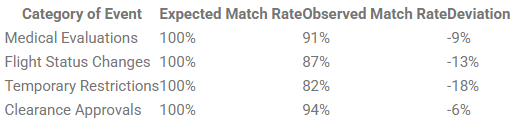
The numbers themselves did not point to a singular cause. What drew attention internally was the distribution of deviation. The gaps were not random; they consistently appeared in categories involving time-sensitive medical-to-operational transitions. This meant that the issue was not necessarily about missing data overall, but about specific junction points where medical assessments translated into flight readiness decisions.
 Knee Strengthening and...
Buy New $13.99
(as of 09:31 UTC - Details)
Knee Strengthening and...
Buy New $13.99
(as of 09:31 UTC - Details)
Some analysts initially attributed the discrepancies to synchronization delays between systems. Others suggested legacy data migration issues or incomplete archival indexing. These explanations remained plausible at a surface level, but they became less convincing as similar patterns were identified across systems that did not share a unified migration history.
By the time the second phase of the review began, attention shifted from whether inconsistencies existed to why they appeared in structurally similar ways across independent systems.
Statistical Pattern Emergence (Internal Review Snapshot)
What stood out in the aggregated trend analysis was not volatility, but directional consistency over time. Across multiple reporting cycles, the frequency of unresolved record mismatches increased gradually rather than abruptly, suggesting a systemic drift rather than isolated incidents.
A simplified internal visualization used during briefing sessions illustrated the trend:
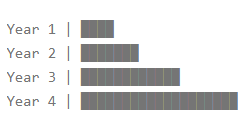
While not definitive on its own, the progression raised questions about whether the inconsistencies were being newly introduced or gradually uncovered due to deeper layers of audit access becoming available over time.
In discussions among review personnel, one point kept returning: the system was not failing in a visible way. Instead, it appeared to be producing incomplete correlations — records that existed, but did not fully connect when traced across domains.
 First Aid Kit - Smart ...
Buy New $29.99
(as of 07:51 UTC - Details)
First Aid Kit - Smart ...
Buy New $29.99
(as of 07:51 UTC - Details)
That distinction became the central focus of the next investigative phase.
Because once a system stops failing openly and starts failing selectively, the problem is no longer just technical.
It becomes structural.
And structural issues tend to point somewhere deeper than documentation alone.
The next phase of the review did not begin with new data. It began with a decision to stop treating the inconsistencies as a purely technical problem.
Up to that point, most of the effort had been directed toward finding a structural explanation within the systems themselves: synchronization delays, legacy migration artifacts, incomplete indexing between databases. But as the same pattern continued to appear across environments that had no shared update history, that line of reasoning started to lose weight in internal discussions.
What changed the tone of the investigation was a small subset of records that did not fit the established categories at all. These were not missing entries or mismatched references. They were complete, internally consistent records that appeared normal in isolation, but referenced procedural steps that could not be found anywhere else in the system.
In practical terms, it meant a document would describe a process that, according to every available procedural index, should not have existed in that form. Not unofficially. Not informally. Structurally absent altogether.
At first, these cases were treated as anomalies in documentation standards. But when reviewers attempted to trace the origin of the referenced procedures, they encountered a different kind of absence — not missing files, but missing definitions. Entire reference categories that should have existed in the procedural architecture were not present in any current or archived schema.
This shifted the focus again, this time toward older system frameworks and decommissioned documentation structures that had been partially retired over successive upgrades.
It was during that comparison that analysts compiled a broader summary of where discrepancies were appearing most frequently across the dataset.
 LifeStraw Personal Wat...
Buy New $14.99
(as of 08:25 UTC - Details)
LifeStraw Personal Wat...
Buy New $14.99
(as of 08:25 UTC - Details)
 Emergency Blanket Myla...
Buy New $6.99
(as of 12:21 UTC - Details)
Emergency Blanket Myla...
Buy New $6.99
(as of 12:21 UTC - Details)
 Vbeijll 5 Gram (50 Pac...
Buy New $9.45
(as of 07:51 UTC - Details)
Vbeijll 5 Gram (50 Pac...
Buy New $9.45
(as of 07:51 UTC - Details)
 The Baofeng Radio Bibl...
Buy New $23.95
(as of 07:51 UTC - Details)
The Baofeng Radio Bibl...
Buy New $23.95
(as of 07:51 UTC - Details)
Copyright © Madge Waggy
 Millions of Americans Are Giving Up on Buying New Cars