


Project Vault—Corrupt Trumpian Socialism of the Worst Kind
February 13, 2026
When it comes to cockamamie Big Government Socialism, the Donald and his MAGA minions surely give the idea of drunken sailors a whole new definition. They are now pushing an utterly ridiculous and unnecessary $12 billion crony capitalist boondoggle for stockpiling so-called critical minerals and REEs (Rare Earth Elements) called Project Vault.
Well, let’s cut to the chase: Telsa, General Motors, Google, Boeing, Lockheed Martin Corp, GE Vernova and the rest of the corporate vultures circling this boondoggle don’t need no stinkin’ help from the US taxpayers!
If they are worried about price stability or supply disruptions in the global market for REEs that is currently substantially sourced in China—albeit only to about 69% of supply rather than 80% for children’s’ toys—they can stockpile this stuff until their heart’s content. And pay for the carry cost with their own cold cash.
BTW, that’s what the free market was invented to accomplish and what millions of business already do as a matter of course: To wit, they stockpile raw materials, work-in-process and finished goods based on their own best assessment of availability, operational needs, costs and risks. This is calledinventory management 101 out there in the land of free enterprise—yet these nincompoops in the Trump Administration think we need a government program to do what Mr. Market has been doing since time immemorial.
 The Great Deformation:...
Best Price: $4.26
Buy New $8.99
(as of 05:50 UTC - Details)
The Great Deformation:...
Best Price: $4.26
Buy New $8.99
(as of 05:50 UTC - Details)

Obviously, there’s a passel of corporate crooks slithering around the Trump White House peddling the time-worn excuse that “national security” requires an “exception” to the free market. As usual, however, national security is just a beard to obfuscate crony capitalist maneuvers to fleece the taxpayers and escape the costs and disciplines of the free market. But when it comes to stockpiling REEs, the perpetrators are wearing masks so transparent that you can practically see their nostril hairs showing right through.
Stated more politely, a five-year stockpile of all 17 REEs that go into the Pentagon’s annual procurements could be stuffed into a slightly oversized broom closet. That is, one which would occupy only 1.6% of the Donald’s spanking new 900,000 cubic foot Ballroom where the late East Wing once stood!
That’s right. As shown in the table below, Pentagon use of all 17 types of REEs amounts to 300,000 kilograms (kg) per year or 1.5 million kgs for a five-year stockpile. But this stuff is comprised of really dense molecules, weighing in at about 119 Kg per cubic foot or nearly in the league of iron ore density, which weighs in at 223 kg per cubic foot.
A five-year Pentagon inventory even in storable “oxide” form (which is not as dense as the actual metals) would therefore require only about 12,612 cubic feet of storage space. So, yes, we are talking about an alleged national security threat that could be protected against in a storage closet that is just 23 feet wide, 23 feet high and 23 feet long. Or as we said, a secondary maintenance closet in the Donald’s swell new Ballroom.
Moreover, stuffing this closet with 5-years’ worth of Pentagon REEs wouldn’t cost a fortune, either. In fact, as shown in the spiffy table ginned up by Grok 4 below, the acquisition cost of 5-years’ worth of the REE stockpiles needed to make everything from F-35s to Apache helicopters and THAAD missiles at current procurement rates would be just $17.3 million.
For anyone who’s counting, that’s the equivalent of the operating cost of four round-trips of Air Force One to Mar-a-Lago.
The truth is, DOD already stockpiles many of these REEs. So the teenzie-weenzie needs of the Pentagon in this area should not remotely be used as a cover story for civilian users of REEs attempting to fob off their inventory carry costs on Uncle Sam, who is flat broke, anyway.
US Defense Needs For Rare Earth Elements (REEs) and 5-Year Storage Requirements And Costs
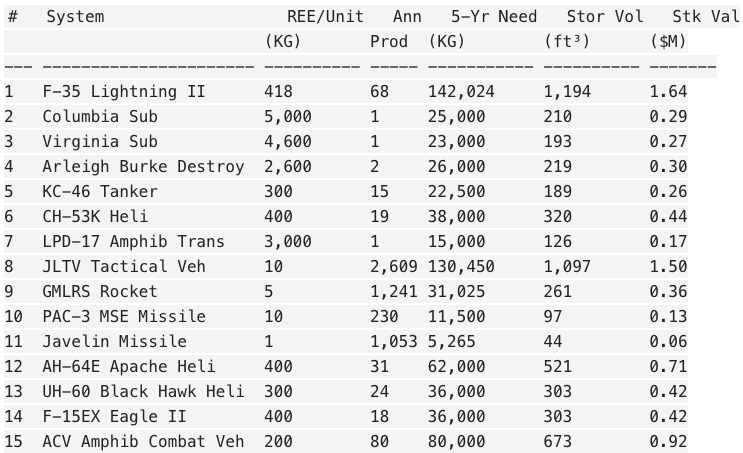
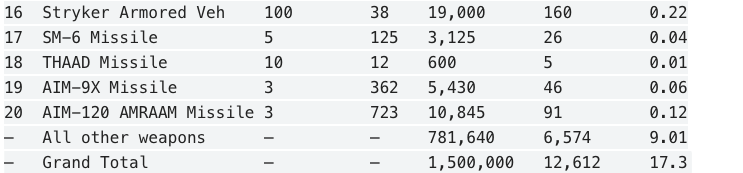
For want of doubt, consider the requirements for the first listed item and largest REE using weapons system in the DOD’s procurement roster. We are referring to the F-35 Lightening II, where five years worth of storage would amount to 142,024 kgs or about 1,194 cubic feet of storage space.
Needless to say, that’s not a big number. It would fit into just a single one of the 10X10X10 ft. cubicles now occupied by Secretary Pete Hegseth’s 7 office secretaries.
Then, of course, there should actually be zero REE requirements for the F-35 because it is the most useless and costly boondoggle in Pentagon history. The later has already committed upwards of $300 billion for nearly 1,000 of these aircraft, yet what is the actual role and function of the F-35 in America’s Homeland defense?
Does it have a role in our invincible triad nuclear deterrent? Nope!
Would it have a role in a Fortress America defense of the homeland from a conventional military invasion?
Nope, again. That’s because any bombers launched from enemy aircraft carriers would be sent into Davy Jone’s locker by US cruise missiles long before they got near the Atlantic or Pacific coasts.
As for air-to-air defense against long-range bombers launched from Russia or China—that role would go to the F-22 Raptor, not the F-35. As it happens, the whole mission of the F-35 is not continental defense of America’s airspace, but to patrol the far frontiers of the Empire and to conduct wars of invasion and occupation around the planet—neither of which are relevant to a true America First military defense.
 How To Cut $2 Trillion...
Best Price: $7.55
Buy New $11.00
(as of 05:01 UTC - Details)
How To Cut $2 Trillion...
Best Price: $7.55
Buy New $11.00
(as of 05:01 UTC - Details)
In fact, the F-22 is DOD’s go-to aircraft for intercepting long-range bombers due to its stealth design, super-cruise speed (Mach 1.5+ without afterburners), advanced radar (AN/APG-77), and beyond-visual-range missiles like the AIM-120D AMRAAM. And F-22s are stationed at forward bases like Elmendorf (Alaska) for Russian threats or Andersen (Guam) for Chinese ones, and can engage bombers from 100+ miles away.
However, the Pentagon wouldn’t need even a waste basket full of REE storage for the F-22. That’s because DOD completed the acquisition of its fleet of 180 operational aircraft in 2012 and is no longer buying additional units!
By contrast, the 25,000 kgs of REEs needed to support five year’s of the Columbia class strategic nuclear sub procurement (one per year) would fit into a 6X6X6 storage cabinet in Secy Hegseth’s 4,000 square foot office in Room 3E880 on the third floor of E Ring at the Pentagon. And, for good measure a second filing cabinet of similar size would handle five years of REE oxide needs for the Virginia class attack subs.
Both of these systems are essential for an invincible homeland military defense against nuclear threats and conventional invasion, respectively, but for crying out loud: We are talking about five year REE supplies for these two weapons systems combined that would total less than $560,000 to purchase and store.
And, no, we didn’t inadvertently drop any zeros. Just eyeball the final column of the table above, which shows the dollar cost of 5-year’s worth of storage for the top twenty REE-using weapons system, and let the absurdity of the matter do the talking. At Grok 4’s estimate of $17.4 million of cost for a 5-year stockpile to support the whole shebang, we talking about nine minutes worth of annual defense spending!
In short, Project Vault is a crony capitalist crock. Any actual need for safety stocks to support military procurement can be handled via rounding errors of the regular Pentagon budget.
On the other hand, when it comes to civilian use—-especially the 60% of estimated annual supply that goes into wind turbines and EV production—the question recurs: Why in the hell do the companies that make REE-using products need to have their inventory carry costs subsidized by the hard-pressed taxpayers of Flyover America?
The truth is, this is just another case of the Donald being taken to the cleaners by the DC Swamp creatures he claims to be fighting. As it happens, planet earth is literally littered with geologic deposits. So the only real issue is the relatively high cost of extraction and refining, including the extensive environmental protection costs involved in handling massive amounts of mined ores in order to extract relatively tiny volumes of usable oxides for the 17 REEs (see below).
The crucial point is two-fold:
- In the scheme of the global economy the $4.5 billion REE market is a complete, total and unequivocal nothingburger, which could be handled without a hiccup even if costs from non-China sources were double or triple that figure; and
- China’s current dominant position is just a function of temporary economics—red capitalism pays workers comparatively little and more often than not uses the ambient air, water and land as a free dump for industrial sewage.
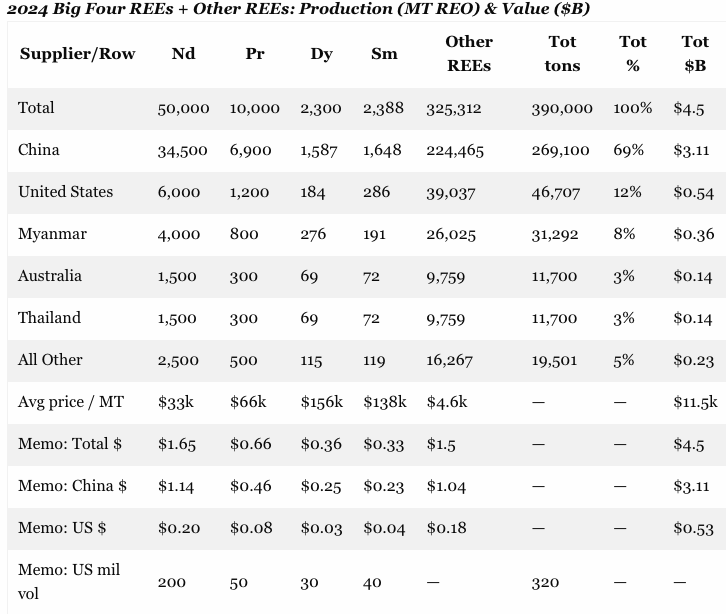
As we show below, however, at relatively small additional dollars costs, civilian users in the USA and elsewhere could obtain all the supply they need from non-China sources. For instance, if the largest REE shown as neodymium (Nd) in the first column were to cost $75,000 per metric ton to produce and be priced at say $90,000 per ton rather than $33,000—so what?
As also shown in the table, several of the REEs are already priced at well more than $100,000 per ton. Markets would adjust, product specifications would change and end demand might shift—such as to fewer modern day relics known as wind turbines.
For want of doubt, it is essential to start with the reality that so-called “rare earth elements” are not geologically rare at all, as the crony capitalist agitators for Project Vault would have you believe. In fact, the underlying ores are distributed widely across the Earth’s crust in concentrations comparable to more common metals like zinc or copper.
The primary geologic deposits containing REEs include carbonatites, alkaline igneous rocks, ion-adsorption clays, monazite-bearing placer sands and bastnasite-rich ores. Carbonatites, for instance, are volcanic rocks that often host high-grade REE minerals and are found in locations like the Mountain Pass mine in California (USA) or the Bayan Obo deposit in Inner Mongolia (China), the world’s largest known reserve.
Alkaline igneous complexes, such as those in Greenland’s Kvanefjeld or Australia’s Mount Weld, also concentrate REEs through magmatic processes. Ion-adsorption clays, which are particularly rich in heavy REEs, are prevalent in southern China but also exist in Madagascar, Brazil, and Myanmar. Likewise, placer deposits, formed by erosion and sedimentation, yield monazite sands along coastlines in India, Australia, and South Africa.
Globally, identified REE resources exceed 120 million metric tons of rare earth oxide (REO) equivalents, with reserves (economically viable portions) around 90–110 million tons.
That’s about 300 years at current production rates!
Moreover, these extensive reserves are spread across over 30 countries including the United States (e.g., Round Top in Texas with 1.4 billion tons of low-grade ore), Brazil (21 million tons of reserves), and Vietnam.
The core challenge with REEs is not scarcity, therefore, but the high cost and complexity of extracting trace levels of oxides from these ores. REEs typically occur in low concentrations—often 0.1–5% of the ore mass—requiring massive volumes of rock to be mined, crushed, and processed.
 The Triumph of Politic...
Best Price: $2.56
Buy New $15.99
(as of 05:55 UTC - Details)
The Triumph of Politic...
Best Price: $2.56
Buy New $15.99
(as of 05:55 UTC - Details)
For example, bastnasite ores might yield only 1–2% rare earth oxide after initial concentration, necessitating energy-intensive steps like acid leaching, solvent extraction, and precipitation to separate individual oxides. This process is environmentally demanding, producing toxic wastewater and radioactive byproducts (from thorium/uranium often co-occurring with REEs), which adds regulatory and cleanup costs.
In non-Chinese operations, stricter environmental standards (e.g., in the US or Australia) can double or triple expenses compared to China’s historically laxer regulations. As a result, while global resources could sustain centuries of production at current rates (390,000 tons annually), economic viability hinges on market prices covering these extraction hurdles.
At typical market values for key REEs like neodymium (Nd) or praseodymium (Pr)—around $33,000–$66,000 per metric ton based on recent estimates—there is substantial margin to support production outside China if geopolitical pressures intensify. For Nd, with costs of extraction and processing ranging from $20,000–$40,000 per ton in Western projects (e.g., MP Materials’ Mountain Pass at about $30,000/ton all-in), margins of 50–100% are feasible at current prices, to say nothing of say $100,000 per ton.
The case is similar for Pr, where Australian or U.S. mines can achieve breakeven below $50,000/ton. This has already spurred investments, like Australia’s Lynas Rare Earths expanding output to 12,000 tons/year or USA Rare Earth’s Texas project aiming for 2028 startup.
Thus, if “push came to shove” (e.g., a full China export ban), elevated prices would further widen margins, enabling rapid scaling in the USA, or even in Brazil, Greenland, or Canada, where untapped reserves exceed 30 million tons combined. Ultimately, market forces, not geological limits, dictate supply—proving that REE “scarcity” is essentially a crony capitalist marketing ploy, not an economic reality.
At the end of the day, the entire Project Vault undertaking by the Trump White House is just another corrupt scheme percolating in the Washington Swamp to solve a non-existent problem. Even then, it would further line the already ample profit margins of REE-users, who should absorb their own stock-piling and inventory management costs—just like the millions of small US business who can’t afford the going price for lobbyist and PACs on K-Street.
But here’s the real irony: Project Vault is living proof that the Donald and his MAGA Hats can’t even recognize SOCIALISM when it is staring them in the face.
Reprinted with permission from David Stockman’s Contra Corner.
Copyright © David Stockman
 Ron Paul’s Warnings Have Come True: Rising Debt, Endless War & Economic Collapse