


Puncturing the Propaganda-Bubble of the USSA and Its EUSSR Vassals
January 6, 2026
One of the most flawlessly executed special forces operations of the last half-century took place in 1979 when Soviet commandos stormed Afghanistan’s heavily defended presidential palace, killing Hafizullah Amin and several of his top aides. This allowed Moscow to install a replacement government much more congenial to its interests, though the result was the long Afghanistan war against Muslim guerillas.
Soviet leader Leonid Brezhnev, elderly and decrepit and not long for this world, must have felt tremendous pride at that successful action, as did his equally superannuated Politburo colleagues. I’m sure they all believed it demonstrated that the Soviet Union and its powerful military were still just as robust and vigorous as all their propagandistic Pravda editorials always proclaimed.
But despite that momentary military success, the Soviet economy and political system continued to decay. Just a dozen years later the USSR collapsed and disintegrated, with its Russian successor state soon entering one of the worst periods in its entire national history.
I think that lesson of the past should be kept in mind as the Trump Administration and its mindless sycophants currently crow over their successful seizure of Venezuelan President Nicolas Maduro and his wife. The latter are now rather bizarrely being brought to trial in Manhattan federal district court, with one of the charges against that foreign head of government apparently being that he had been in possession of illegal firearms.
No Monty Python skit would have ever dared include such outlandish elements.
Our dramatic kidnapping of the Venezuelan president followed the recent blockade we had imposed on his country and the resulting seizure of various large Venezuelan oil tankers on the high seas, doing so based upon our unilateral declaration that they had been “sanctioned.” In proudly taking credit for those blatant acts of international piracy, President Donald Trump had boasted at his press conference a couple of weeks ago that he planned to keep the oil or possibly sell it.
Then at yesterday’s press conference announcing his triumphant seizure of President Maduro, Trump declared that America will now control Venezuela and our country will “take back” the Venezuelan oil reserves, which he stated were rightfully ours.
While neither I nor anyone else can be entirely sure what the American president meant by those bold statements, they do seem to set a uniquely dangerous precedent for international relations between supposedly sovereign nations.
In recent weeks, Trump’s Venezuelan policies have led some of his critics to condemn him for returning to President Theodore Roosevelt’s notorious “Gunboat Diplomacy” of the early twentieth century. But such accusations are entirely false. Neither America nor any other civilized country had ever taken such bizarre and lawless actions at any time during the twentieth century nor for hundreds of previous years. Or at least nothing along such lines comes to mind.
Noted military expert Col. Douglas Macgregor expressed a great deal of concern over this outrageous behavior of the country he’d long served:
In an excellent interview with Norwegian academic Glenn Diesen not long after Trump’s public announcements, Prof. Jeffrey Sachs of Columbia University emphasized the totally lawless nature of current American policy. Trump simply takes whatever actions happen to come into his head, doing so while nothing is heard from Congress, the United Nations, or any other legal body that might normally weigh in on such matters.
Sachs was convinced that Trump’s sudden attack on Venezuela would probably soon be followed by his seizure and annexation of Denmark’s Greenland, a plan of American territorial expansion that he had heavily promoted during the early months of his presidency. Stephen Miller ranks as one of Trump’s most powerful advisors, and just yesterday his wife Katie Miller tweeted out an image of that large island covered in the American Stars-and-Stripes, headlined by the single word “SOON.” Her social media post attracted more than twenty millions views:
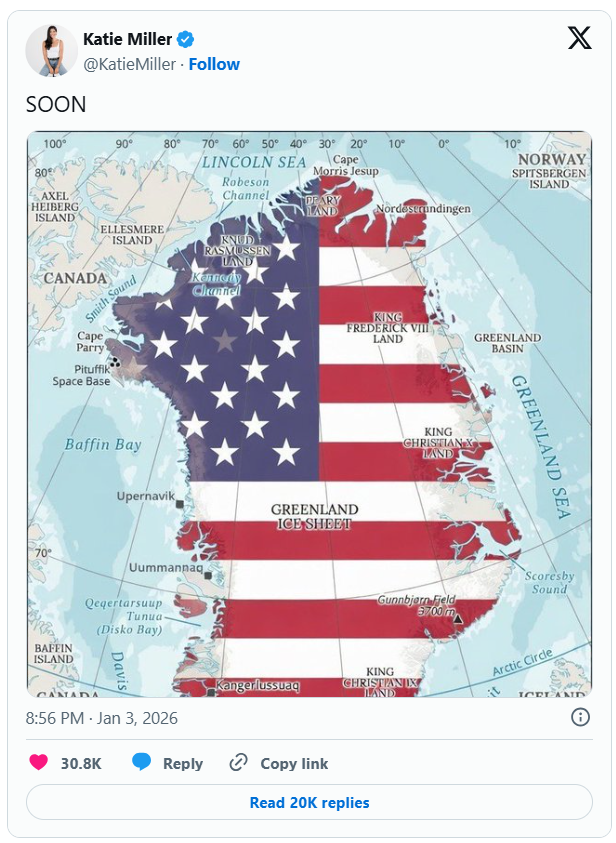
Sachs believed that even if America took that radical step, our supine European vassals would very likely fall into line and endorse what had happened, notwithstanding all the explicit mutual-defense provisions of the NATO military alliance, an alliance that Denmark had joined as a founding member more than 75 years ago. Perhaps Trump’s plans to annex Canada might eventually follow.
I was also interested that Sachs drew a strong analogy between America’s current situation and the transformation of the Roman Republic into the Roman Empire. He noted that although Augustus had originally maintained the fig-leaf of republican institutions when he founded the Principate, the true nature of the hereditary absolute monarchy he thus established became more and more obvious under Tiberius and his other successors. Last month I had published an article making some similar points:
- Donald Trump as Our President Caligula
Ron Unz • The Unz Review • December 15, 2025 • 8,300 Words
Legal precedents obviously count for little in an era of total international lawlessness, but if they did, Trump should have carefully considered the potential implications of some of his recent actions.
Over the last few weeks, he had steadily escalated his pressure on Venezuela by declaring a unilateral naval blockade and seizing some of its oil tankers in international waters, taking these actions with no legal justification other than the superior military force that he deployed.
Oil exports were the source of that country’s income and by cutting those off, he demonstrated the terrible economic damage he could inflict. This added to the leverage he apparently applied as he somehow managed to have the local military air defenses stand down when he launched his raid to capture Maduro. But two can play at that same blockade game.
China was a leading importer of Venezuelan oil and one of the tankers Trump seized was carrying crude that it had already purchased. Around that same time he announced that he would be selling an additional $11 billion of advanced weaponry to Taiwan, including missiles able to hit Chinese cities. Adding insult to injury, Trump’s abduction of President Maduro came just hours after the latter had held extensive meetings with a high-level visiting Chinese delegation, and this must have surely been a major embarrassment to the Chinese government.
I doubt that China will appreciate the prospect of having their cities placed within missile range of the new weapons systems that Trump will be delivering to Taiwan, so perhaps they might decide that now is the time to finally take decisive action.
An actual invasion of Taiwan would be out of the question, but if Trump can declare a blockade of the independent country of Venezuela with no justification, China can certainly claim it has an equal right to do the same towards an island that the U.S. government and almost the entire world has long recognized as an integrable part of a single, unified China. Indeed, at the end of December, China engaged in some extremely serious saber-rattling, threatening to impose a “chokehold” against what it has always considered a rebellious, breakaway province.
Not only would such a blockade put severe pressure on the Taiwanese government, but it would do the same to America and the rest of the West. Taiwanese foundries produce a majority of the world’s microchips, including up to 90% of the most advanced ones. Although Venezuela is an important oil producer, its exports accounted for merely a small slice of that fungible global commodity. Meanwhile, without Taiwanese microchips, much of Western industrial production would soon grind to a halt, and it’s not obvious to me what America or any of its allies could do in response.
Although for generations, we have boasted that our unequaled navy controls the waters of that region, dramatic changes in military technology over the last couple of decades have radically transformed that balance of power.
If our forces tried to break such a Chinese naval blockade and war erupted, the results seem likely to be extremely one-sided. China has amassed an enormous arsenal of both conventional and hypersonic missiles, while our own air-defense systems are rather ineffective. I’m no military expert, but I really don’t see anything that would prevent the Chinese from using waves of their missiles to immediately sink every American aircraft carrier and other warship in the region, as well as destroying all our airbases within a thousand miles or so, thereby winning the war within the first 24 hours.
Indeed, the notion that America would be decisively defeated after just a day or so of combat might even be an overly cautious conclusion. Last month, a leaked Pentagon report indicated that the Chinese could destroy our biggest aircraft carriers “within minutes.” So perhaps America would suffer a crushing military defeat within the first hour or two.
I think that the only plausible factor restraining Chinese’s cautious leaders from taking such actions would be their concern that faced with such a dismal and embarrassing outcome, our only possible military response would be to go nuclear, and they would fear that our totally irrational leaders might do exactly that.
Surprisingly enough, our sudden attack against Venezuela’s capital city and our abduction of its president may not have even been the most shocking and dangerous action our government had recently undertaken.
About a week ago, a huge wave of 90-odd explosive drones had attacked the personal Novgorod residence of Russian President Vladimir Putin in what seemed clearly to have been a major assassination attempt. All the drones were shot down by Russian air defenses and the CIA declared that the target of the drone strike had actually been a nearby military base, leading Trump to say that Putin was lying.
But analysts such as former CIA operative Larry Johnson noted that the CIA’s claims to have known the exact destination of the drones actually indicated that they had been directly involved in the attack. Meanwhile, the Russians announced that they had deciphered the intended coordinates from one of the recovered microchips, proving that Putin’s home had indeed been the target, and they turned over some of that hard evidence to American representatives. Whether or not the Ukrainians themselves launched the drones, such a long-range strike almost certainly required the direct use of American targeting intelligence, implying that our country was almost certainly involved.
Putin’s home was located more than 200 miles from any Russian border, so a drone strike of that type so deep within Russian territory was extraordinarily reckless and provocative. Trump’s own lavish Mar-a-Logo residence is right on the Florida coast, and I doubt he would take kindly to having it hit by explosive drones or a missile strike especially if he and his family happened to be there at the time. Moreover, the pitiful quality of American air-defense systems would greatly increase the likelihood that such a strike would be at least partially successful, with Trump’s home likely to be severely damaged or even destroyed.
Obviously, it would be very unwise for the Russians to consider any such extreme retaliatory measures, regardless of how legally justified they might be.
But I do think that Putin and his government have to finally respond in sufficiently strong fashion as to deter such continuing American provocations. In the past they have failed to do so, and as a result these Western actions have continually escalated, with Trump’s ignorant and bellicose national security team having apparently convinced themselves that the Russians were militarily so feeble that their leadership could be regularly attacked with total impunity.
In a further example of such Western provocations, just a few days ago yet another three-star Russian general was assassinated by a car-bomb in Moscow, the third such senior military officer to suffer that fate over the last year.
I wonder how America would react if the Russians began assassinating our own high-ranking generals with terrorist car-bombs on the streets of Washington, D.C.
Once again, although such tit-for-tat Russia retaliation might be fully warranted, it would be extraordinarily unwise for the Russians to consider taking that step.
Copyright © The Unz Review
 Regime Change and Nation-Building Are Back!