


How Good is YOUR Grammar?
Take our 15-question quiz to find out whether you belong at the back or the front of the class
November 3, 2015
In a world where LOL and BRB are as commonplace as full stops, it can be easy to let standards slip when it comes to spelling and grammar.
However, despite the majority of the population being up to speed with language short cuts, it appears that we value grammar more than ever.
Earlier this year it was revealed that millennials are most annoyed by bad grammar and spelling slips, according to a survey by Dictionary.com.
And now those offended by such faux pas can put their knowledge to the test.
John Sutherland, one of Britain’s most celebrated professors of English literature, is here to test, stretch, amuse and instruct you with his definitive quiz on all things grammatical.
Answer the 15 questions below to sort the grammatical wizards from those who need a little punctuation.
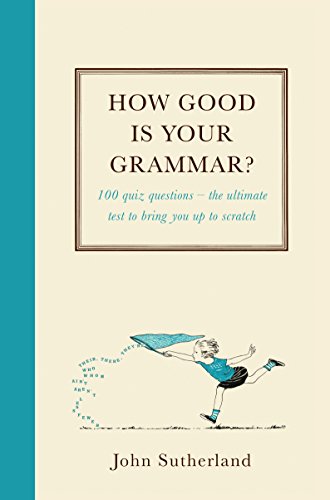 How Good is Your Gramm...
Buy New $7.49
(as of 11:45 UTC - Details)
How Good is Your Gramm...
Buy New $7.49
(as of 11:45 UTC - Details)

1. ‘Different to’; ‘different from’; ‘different than’. Which is correct?
ANSWER:
The iron schoolroom rule used to be always ‘from’, because of the Latin parentage of the prefix ‘de/di’. Catherine Soanes, in the Oxford Words blog, commonsensically decrees ‘different to’ and ‘different from’ don’t have any difference from each other, or to each other, and notes that ‘than’ (which grates on British ears) is more common in America.
But Anglophile F. Scott Fitzgerald would never have said to Hemingway that the rich ‘are different than you and me’. Other grammarians point out that ‘than’ is comparative (e.g. ‘Hemingway was taller than Fitzgerald’) and ‘different’ implies something contrastive – hence ‘to’ or ‘from’ are the best choices.
2. One can say ‘a book well worth the read’, and ‘a path well worth the walk’. Why can’t one say ‘a meal well worth the eat’?
ANSWER:
The infinitive, in English, can sometimes become a noun (with ‘to’ changed to ‘the’), but there’s no rule controlling it that I know of. In German, the practice is universal: e.g. ‘auch das Essen wert’ (well worth the eat) is quite respectable. Well worth the consider (and yes, that’s OK in German as well – ‘das Betrachten wert’).
3. On 16 March 2015, the Guardian printed in its ‘Corrections and Clarifications’ column: ‘Grammar Corner: We used ‘dependent’, the adjective, where we should have used ‘dependant’, the noun, in two articles in Monday’s paper.’ Is this a distinction worth making?
ANSWER:
 Eats, Shoots & Leave...
Best Price: $1.21
Buy New $6.28
(as of 10:10 UTC - Details)
Eats, Shoots & Leave...
Best Price: $1.21
Buy New $6.28
(as of 10:10 UTC - Details)
No – unless you want to stress the fact that you’re a stickler for grammatical correctness, however pifflingissimo.
There’s no risk to meaning whichever spelling is used. I personally don’t see any point in preserving the distinction, nor does the IRS, the American tax authority (who wants to tangle with them?), which asks those filing their returns if they have any ‘dependents’. Britain’s HMRC still goes, crustily, for ‘dependants’. Harumph.
4. Despite his publisher’s use of them on his cover, Marsh has little time for the exclamation mark (!): they are, he says, ‘seldom, if ever, obligatory’. The biopic film of Keats’s life is called Bright Star. The Keats poem from which the title is taken opens ‘Bright Star!’. Was Keats wasting ink?
ANSWER:
Poets love the exclamation mark; Keats frequently used it in his opening lines to give the impression of ‘breaking’ into verse, as one breaks into song. Journalists on ‘quality’ papers – like Marsh, style guru of the Guardian – despise them because of the association with the ‘Gotcha!’ school of tabloid headlines.
5. What’s an Oxford comma?
ANSWER: A ‘serial comma’ – the comma that comes after the penultimate item in a list, where there are three or more listed items; e.g. ‘a, b, c, and d’.
It’s widely ignored, which can lead to occasional ambiguity as in: ‘I hate my school teachers, Tom Cruise and Arnold Schwarzenegger’ (there are lots of variations on this example).
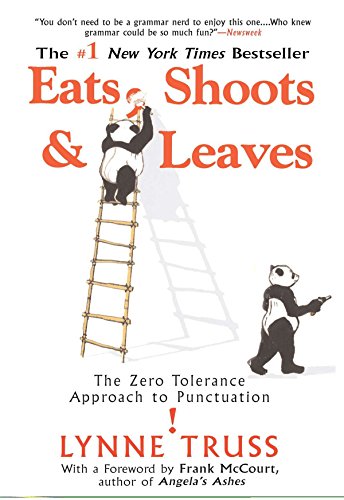
The most thoughtful meditation on the serial comma’s rightness or wrongness is in Lynne Truss’s Eats, Shoots & Leaves. The objection is that the terminal ‘and’ is a conjunction and cluttering it up with a conjoining comma ‘smacks of smug pedantry’, as Harry Mount (BA, Oxon) complains. It was first imposed (via what later became Hart’s Rules – the compositors’ commandments) by Oxford University Press typesetters and editors.
Copyright © 2015 Daily Mail
 Look Good, Live Long