If theres
one asset thats heated up over the last several months amid
tensions in the middle east and a second round of the Federal Reserves
quantitative easing, its silver. The price has risen so dramatically,
some 20% since January 1, 2011 through today, that investors may
be wondering what actions they should take. For those who have not
acquired the precious metal, the obvious question is, should I buy
now or is silver in bubble territory? Those fortunate enough to
have seen the crisis writing on the wall in 2008 and before, and
have seen a 200% or more increase in the value on their holdings
to date, may be considering selling and locking in profits.
No one can
predict what happens next. The fact that silver has gone to
the moon as metals bugs like to say, should raise awareness
and caution in any diligent investor. After all, the last time we
saw such meteoric price rises in the summer of 2008, when stocks,
commodities and home prices were reaching all-time highs, and precious
metals were pushing higher than they had in twenty years, it ended
very badly for anyone invested in just about any asset other than
the US dollar.
Is there cause
for alarm today? Are silver and gold, along with equities and commodities,
destined to see yet another massive correction or collapse, as they
did when the markets bottomed out in late 2008 and early 2009? The
trigger for the last asset crash was blamed, in part, on rising
oil prices and food costs, and we are very clearly approaching similar
territory today. If gas prices reach that $4.50 mark like they did
before many experts, both mainstream and contrarian, have voiced
their opinions that the economy will revert back to no-growth or
negative growth, completely disintegrating any semblance of recovery
that has been perpetrated on the American people and global populace.
The end result,
as in 2008, will likely be a collapse in asset prices.
But will precious
metals once again collapse along with equities and commodities,
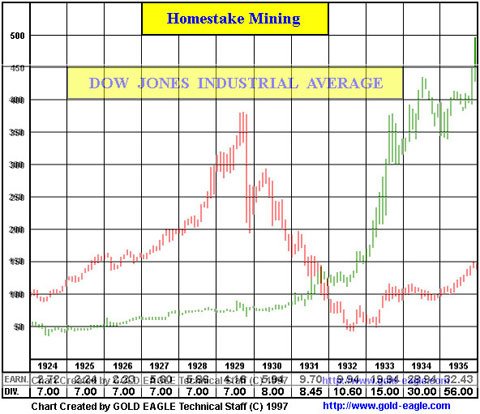
or have we reached the long awaited decoupling phase,
where tangible assets and historical monetary instruments diverge
from traditional paper investments like stocks, or debt based assets
like real estate? A
similar decoupling occurred in the 1930s, when the Dow Jones
and gold assets went their own way:
According to
the chart below, silver versus the Dow Jones has outperformed significantly,
with the Dow experiencing a collapse versus silver of 86% over the
last ten years:
The above chart
indicates that we are already seeing a decoupling in terms of value.
Whether you
are a new investor deciding whether or not you are going to buy
silver at todays prices, or are currently holding silver related
assets and considering whether or not to sell or buy more, we suggest
watching the following interview with trusted analyst and financial
manager Eric Sprott, whose Sprott
Physical Silver Trust is one of the very few paper
investments that is physically backed with vault-stored (never to
be leased) precious metals.
In his latest
interview with Canadas Business News Network, Sprott provides
some key reasons for why silver, although priced much higher today
than ten years ago, will continue to rise and likely become one
of the top performing investments of this decade. According to Sprott,
there are various data points that scream at you that the
price of silver has to go higher.
Before you
sell, consider the following reasons for why silver may be the best
investment of the decade:
1. Demand
is not only up, but still rising. The US Mint in the months
of January and February sold as many dollars of silver as they sold
dollars of gold. The Chinese used to export 100 million ounces of
silver they now import 112 million ounces and thats
in a market thats a total of 800 million ounces, or a 20%
shift in just Chinese demand.
2. Supply
and Delivery Challenges for Physical Bullion. In a market that
trades roughly 400 million (paper) ounces a day, when Sprott Asset
Management was preparing to open their physical silver trust they
had difficulty acquiring just 15 million ounces. Other evidence
direct from the US Mint further solidifies this point. The Mint
recently advised potential investors that it can no longer coin
the popular Silver American Eagle saying, The United States
Mint will resume production of American Eagle Silver Uncirculated
Coins once sufficient inventories of silver bullion blanks can be
acquired to meet market demand for all three American Eagle Silver
Coin products.
3. Technological
demand for silver is increasing. In 2010 industrial production
of silver was up 18% due to rising demand from the technology sector.
Among other things, silver is increasingly being used in computers,
cell phones, and solar panels. Health care, alternative and traditional,
is another market segment that will see silver demand increase because
of silvers antibiotic properties. Its already
being used in bandages, clothing, and medical devices.
4. Silver
is closing the margin on the gold-to-silver ratio. Historically,
though not in recent decades, silver has traded at an average ratio
of about 16-to-1. It is currently trading at about 40-to-1, and
just recently was trading at nearly 70-to-1. If the historical ratio
of gold to silver holds up, then if gold is priced at $1600 an ounce,
silver would need to be trading at about $100. If gold were to trade
at $3000 an ounce, a prediction made by several contrarian precious
metals analysts, silver would trade at $300 if the gold-to-silver
ratio returned to historical norms.
5. There
is a silver shortage. Weve already discussed the supply
issues that many investors taking large deliveries may be experiencing.
But, there is also a pricing disconnect occurring, that indicates
supply problems, at least in the short-term, are prevalent. According
to Sprott and other analysts, forward-looking silver prices indicate
that a silver shortage exists. The phenomenon of price backwardation
is one way of being able to identify this. Though there are millions
of ounces in the ground, backwardation can mean there is simply
not enough of an asset available right now. Sprott, for example,
says that when they purchased the aforementioned 15 million ounces
of silver, some of it wasnt even minted until two weeks after
they made the purchase, suggesting that existing inventory is simply
not available.
6. More
(Paper) Money. As the US Federal Reserve and central banks around
the world continue to deal with fiscal issues through monetary means,
more and more paper currency hits the global marketplace. As a result,
more money is chasing fewer goods, with silver being one of those
goods. For the reasons above, as well as the fact that there is
more money available, the price of silver will continue to inflate,
just like other hard assets. Over the last 100 years, since the
Federal Reserve was established, the US dollar has lost some 95%
of its value. This is a long-term 100-year trend, and given the
current policies of the Fed, which are no different than the policies
of the last century, the US dollar will continue to depreciate.
7. Gold
for Main Street. While an ounce of gold may cost $1500, silver
is significantly cheaper, giving working individuals and families
the ability to invest without having to spend this months
mortgage on a coin. Silver is available in various weights and mintages,
from one-ounce government issue coins like silver eagles to one-hundred
ounce poured bars from Johnson Matthey. In addition, for newer investors,
though fake
silver exists, the risk to the investor is much lower because
of the price, and investors can choose US junk silver
coins like pre-1965 half dollars, quarters and dimes for easily
identifiable and tradeable instruments. With silver, anyone who
has a desire to do so can become their own central bank.
8. Crisis.
Inflation is often identified as the single biggest reason for
why precious metals like gold and silver rise. However, this is
not always the case. During the 1990s, a period
where inflation was anywhere from 1% to 6% annually, the price of
gold and silver barely moved. There was simply no investor demand.
One of the reasons for this may have been because during the 90s,
the US was experiencing a period of boom. It was the advent of the
internet and the general mood was positive. Stocks were rising and
were the primary investment vehicle of choice during the technology
boom. Gold and silver took a back seat. After the technology crash
and September 11th, however, sentiment changed. As boom times gave
way to recession, precious metals rose. They continued to rise as
governments, namely in the US, passed more restrictive laws on everything
from personal liberty to capital investment. When countries start
restricting freedoms, people tend to shift capital. Throughout the
first decade of the 21st century, this may have been the primary
reason for gold and silvers powerful rise. After the collapse
of 2008, more and more investors began to realize that crisis is
upon us. The government, failing to mitigate the problem, and likely
making it even worse, forced those in traditional investments into
the safe haven historical assets of choice gold and silver.
Thus, while inflation may play a part in the rise of precious metals,
it is the perception that government is unable to deal with crisis
that has been the real driving force. As the economic crisis continues
to deepen, civil unrest breaks out around the world, and citizens
lose faith in their governments ability to manage crisis,
the prices of precious metals, the last vestige of monetary security,
will continue to rise.