


Dismantling the Empire
July 31, 2009
The Obama administration’s plan to end production of the F-22 Raptor has received plenty of press coverage, but the Pentagon budget itself, even though it’s again on the rise, hardly rates a bit of notice. In fact, amid the plethora of issues large and small — from health care reform to Gates-gate, from energy policy to the culpability of Michael Jackson’s doctor — that make up the American debate in the media, in Washington, and possibly even in the country, what Chalmers Johnson has called “our empire of bases” goes essentially unmentioned. Not that we don’t build them profligately. At one point, we had 106 of them — mega to micro — in Iraq alone; right now, we have at least 50 forward operating bases and command outposts in Afghanistan to go with a few giant bases (and the Pentagon is evidently now considering the possibility of creating a single, privatized, mercenary force to defend them, according to the Washington Post).
This is all staggering expensive. In an era when the need for funds at home is self-evident, on purely practical grounds — and there are obviously others — the maintenance of our global imperial stance, not to speak of the wars, conflicts, and dangers that go with it, should be at the forefront of national discussion. Instead, it has largely been left to oppositional websites to keep this crucial issue alive.
Our military empire, and the vast national security state and bureaucracy that go with it, have been perhaps the central focus of TomDispatch since it launched in late 2002. This site has concentrated on our military bases, the Pentagon’s blue-sky thinking about future weaponry, air war as the American way of war, the defense budget, and the out-of-control nature of the Pentagon, among many other related issues. Nick Turse, associate editor at this site and an expert on the Pentagon, has even put its properties on “the auction block.”
Since Chalmers Johnson first wrote of that empire of bases at this site back in 2004, no one has more cogently analyzed the dangers of militarism, military Keynesianism, and a Pentagon budget spun out of control. His trilogy of books on the subject, Blowback, The Sorrows of Empire, and Nemesis are already classics, and assumedly on the shelves of all TomDispatch readers.
Today, he turns to the issue which should be, but isn’t, central to our moment: dismantling the empire. Think of this as the American health care reform program that no one is discussing. ~ Tom
Three Good Reasons To Liquidate Our Empire: And Ten Steps to Take to Do So
By Chalmers Johnson
 The Sorrows of Empire:...
Best Price: $0.93
Buy New $9.25
(as of 11:20 UTC - Details)
The Sorrows of Empire:...
Best Price: $0.93
Buy New $9.25
(as of 11:20 UTC - Details)

However ambitious President Barack Obama’s domestic plans, one unacknowledged issue has the potential to destroy any reform efforts he might launch. Think of it as the 800-pound gorilla in the American living room: our longstanding reliance on imperialism and militarism in our relations with other countries and the vast, potentially ruinous global empire of bases that goes with it. The failure to begin to deal with our bloated military establishment and the profligate use of it in missions for which it is hopelessly inappropriate will, sooner rather than later, condemn the United States to a devastating trio of consequences: imperial overstretch, perpetual war, and insolvency, leading to a likely collapse similar to that of the former Soviet Union.
According to the 2008 official Pentagon inventory of our military bases around the world, our empire consists of 865 facilities in more than 40 countries and overseas U.S. territories. We deploy over 190,000 troops in 46 countries and territories. In just one such country, Japan, at the end of March 2008, we still had 99,295 people connected to U.S. military forces living and working there — 49,364 members of our armed services, 45,753 dependent family members, and 4,178 civilian employees. Some 13,975 of these were crowded into the small island of Okinawa, the largest concentration of foreign troops anywhere in Japan.
These massive concentrations of American military power outside the United States are not needed for our defense. They are, if anything, a prime contributor to our numerous conflicts with other countries. They are also unimaginably expensive. According to Anita Dancs, an analyst for the website Foreign Policy in Focus, the United States spends approximately $250 billion each year maintaining its global military presence. The sole purpose of this is to give us hegemony — that is, control or dominance — over as many nations on the planet as possible.
 Nemesis: The Last Days...
Buy New $7.99
(as of 11:38 UTC - Details)
Nemesis: The Last Days...
Buy New $7.99
(as of 11:38 UTC - Details)
We are like the British at the end of World War II: desperately trying to shore up an empire that we never needed and can no longer afford, using methods that often resemble those of failed empires of the past — including the Axis powers of World War II and the former Soviet Union. There is an important lesson for us in the British decision, starting in 1945, to liquidate their empire relatively voluntarily, rather than being forced to do so by defeat in war, as were Japan and Germany, or by debilitating colonial conflicts, as were the French and Dutch. We should follow the British example. (Alas, they are currently backsliding and following our example by assisting us in the war in Afghanistan.)
Here are three basic reasons why we must liquidate our empire or else watch it liquidate us.
1. We Can No Longer Afford Our Postwar Expansionism
Shortly after his election as president, Barack Obama, in a speech announcing several members of his new cabinet, stated as fact that “[w]e have to maintain the strongest military on the planet.” A few weeks later, on March 12, 2009, in a speech at the National Defense University in Washington DC, the president again insisted, “Now make no mistake, this nation will maintain our military dominance. We will have the strongest armed forces in the history of the world.” And in a commencement address to the cadets of the U.S. Naval Academy on May 22nd, Obama stressed that “[w]e will maintain America’s military dominance and keep you the finest fighting force the world has ever seen.”
What he failed to note is that the United States no longer has the capability to remain a global hegemon, and to pretend otherwise is to invite disaster.
 Dying to Win: The Stra...
Best Price: $1.96
Buy New $11.57
(as of 11:00 UTC - Details)
Dying to Win: The Stra...
Best Price: $1.96
Buy New $11.57
(as of 11:00 UTC - Details)
According to a growing consensus of economists and political scientists around the world, it is impossible for the United States to continue in that role while emerging into full view as a crippled economic power. No such configuration has ever persisted in the history of imperialism. The University of Chicago’s Robert Pape, author of the important study Dying to Win: The Strategic Logic of Suicide Terrorism (Random House, 2005), typically writes:
“America is in unprecedented decline. The self-inflicted wounds of the Iraq war, growing government debt, increasingly negative current-account balances and other internal economic weaknesses have cost the United States real power in today’s world of rapidly spreading knowledge and technology. If present trends continue, we will look back on the Bush years as the death knell of American hegemony.”
There is something absurd, even Kafkaesque, about our military empire. Jay Barr, a bankruptcy attorney, makes this point using an insightful analogy:
“Whether liquidating or reorganizing, a debtor who desires bankruptcy protection must provide a list of expenses, which, if considered reasonable, are offset against income to show that only limited funds are available to repay the bankrupted creditors. Now imagine a person filing for bankruptcy claiming that he could not repay his debts because he had the astronomical expense of maintaining at least 737 facilities overseas that provide exactly zero return on the significant investment required to sustain them… He could not qualify for liquidation without turning over many of his assets for the benefit of creditors, including the valuable foreign real estate on which he placed his bases.”
In other words, the United States is not seriously contemplating its own bankruptcy. It is instead ignoring the meaning of its precipitate economic decline and flirting with insolvency.
 The Complex (American ...
Best Price: $2.02
Buy New $16.69
(as of 11:00 UTC - Details)
The Complex (American ...
Best Price: $2.02
Buy New $16.69
(as of 11:00 UTC - Details)
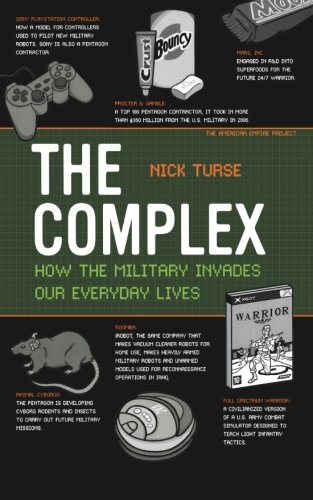
Nick Turse, author of The Complex: How the Military Invades our Everyday Lives (Metropolitan Books, 2008), calculates that we could clear $2.6 billion if we would sell our base assets at Diego Garcia in the Indian Ocean and earn another $2.2 billion if we did the same with Guantnamo Bay in Cuba. These are only two of our over 800 overblown military enclaves.
Our unwillingness to retrench, no less liquidate, represents a striking historical failure of the imagination. In his first official visit to China since becoming Treasury Secretary, Timothy Geithner assured an audience of students at Beijing University, “Chinese assets [invested in the United States] are very safe.” According to press reports, the students responded with loud laughter. Well they might.
In May 2009, the Office of Management and Budget predicted that in 2010 the United States will be burdened with a budget deficit of at least $1.75 trillion. This includes neither a projected $640 billion budget for the Pentagon, nor the costs of waging two remarkably expensive wars. The sum is so immense that it will take several generations for American citizens to repay the costs of George W. Bush’s imperial adventures — if they ever can or will. It represents about 13% of our current gross domestic product (that is, the value of everything we produce). It is worth noting that the target demanded of European nations wanting to join the Euro Zone is a deficit no greater than 3% of GDP.
Thus far, President Obama has announced measly cuts of only $8.8 billion in wasteful and worthless weapons spending, including his cancellation of the F-22 fighter aircraft. The actual Pentagon budget for next year will, in fact, be larger, not smaller, than the bloated final budget of the Bush era. Far bolder cuts in our military expenditures will obviously be required in the very near future if we intend to maintain any semblance of fiscal integrity.
2. We Are Going to Lose the War in Afghanistan and It Will Help Bankrupt Us
 Afghanistan
Best Price: $44.62
Buy New $65.00
(as of 10:10 UTC - Details)
Afghanistan
Best Price: $44.62
Buy New $65.00
(as of 10:10 UTC - Details)
One of our major strategic blunders in Afghanistan was not to have recognized that both Great Britain and the Soviet Union attempted to pacify Afghanistan using the same military methods as ours and failed disastrously. We seem to have learned nothing from Afghanistan’s modern history — to the extent that we even know what it is. Between 1849 and 1947, Britain sent almost annual expeditions against the Pashtun tribes and sub-tribes living in what was then called the North-West Frontier Territories — the area along either side of the artificial border between Afghanistan and Pakistan called the Durand Line. This frontier was created in 1893 by Britain’s foreign secretary for India, Sir Mortimer Durand.
Neither Britain nor Pakistan has ever managed to establish effective control over the area. As the eminent historian Louis Dupree put it in his book Afghanistan (Oxford University Press, 2002, p. 425): “Pashtun tribes, almost genetically expert at guerrilla warfare after resisting centuries of all comers and fighting among themselves when no comers were available, plagued attempts to extend the Pax Britannica into their mountain homeland.” An estimated 41 million Pashtuns live in an undemarcated area along the Durand Line and profess no loyalties to the central governments of either Pakistan or Afghanistan.
The region known today as the Federally Administered Tribal Areas (FATA) of Pakistan is administered directly by Islamabad, which — just as British imperial officials did — has divided the territory into seven agencies, each with its own “political agent” who wields much the same powers as his colonial-era predecessor. Then as now, the part of FATA known as Waziristan and the home of Pashtun tribesmen offered the fiercest resistance.
 Invisible History: Afg...
Best Price: $2.54
Buy New $6.29
(as of 11:14 UTC - Details)
Invisible History: Afg...
Best Price: $2.54
Buy New $6.29
(as of 11:14 UTC - Details)
According to Paul Fitzgerald and Elizabeth Gould, experienced Afghan hands and coauthors of Invisible History: Afghanistan’s Untold Story (City Lights, 2009, p. 317):
“If Washington’s bureaucrats don’t remember the history of the region, the Afghans do. The British used air power to bomb these same Pashtun villages after World War I and were condemned for it. When the Soviets used MiGs and the dreaded Mi-24 Hind helicopter gunships to do it during the 1980s, they were called criminals. For America to use its overwhelming firepower in the same reckless and indiscriminate manner defies the world’s sense of justice and morality while turning the Afghan people and the Islamic world even further against the United States.”
In 1932, in a series of Guernica-like atrocities, the British used poison gas in Waziristan. The disarmament convention of the same year sought a ban against the aerial bombardment of civilians, but Lloyd George, who had been British prime minister during World War I, gloated: “We insisted on reserving the right to bomb niggers” (Fitzgerald and Gould, p. 65). His view prevailed.
The U.S. continues to act similarly, but with the new excuse that our killing of noncombatants is a result of “collateral damage,” or human error. Using pilotless drones guided with only minimal accuracy from computers at military bases in the Arizona and Nevada deserts among other places, we have killed hundreds, perhaps thousands, of unarmed bystanders in Pakistan and Afghanistan. The Pakistani and Afghan governments have repeatedly warned that we are alienating precisely the people we claim to be saving for democracy.
When in May 2009, General Stanley McChrystal was appointed as the commander in Afghanistan, he ordered new limits on air attacks, including those carried out by the CIA, except when needed to protect allied troops. Unfortunately, as if to illustrate the incompetence of our chain of command, only two days after this order, on June 23, 2009, the United States carried out a drone attack against a funeral procession that killed at least 80 people, the single deadliest U.S. attack on Pakistani soil so far. There was virtually no reporting of these developments by the mainstream American press or on the network television news. (At the time, the media were almost totally preoccupied by the sexual adventures of the governor of South Carolina and the death of pop star Michael Jackson.)
Our military operations in both Pakistan and Afghanistan have long been plagued by inadequate and inaccurate intelligence about both countries, ideological preconceptions about which parties we should support and which ones we should oppose, and myopic understandings of what we could possibly hope to achieve. Fitzgerald and Gould, for example, charge that, contrary to our own intelligence service’s focus on Afghanistan, “Pakistan has always been the problem.” They add:
“Pakistan’s army and its Inter-Services Intelligence branch… from 1973 on, has played the key role in funding and directing first the mujahideen [anti-Soviet fighters during the 1980s]… and then the Taliban. It is Pakistan’s army that controls its nuclear weapons, constrains the development of democratic institutions, trains Taliban fighters in suicide attacks and orders them to fight American and NATO soldiers protecting the Afghan government.” (p. 322—324)
 Beyond the Green Zone:...
Best Price: $3.12
Buy New $10.00
(as of 09:50 UTC - Details)
Beyond the Green Zone:...
Best Price: $3.12
Buy New $10.00
(as of 09:50 UTC - Details)
The Pakistani army and its intelligence arm are staffed, in part, by devout Muslims who fostered the Taliban in Afghanistan to meet the needs of their own agenda, though not necessarily to advance an Islamic jihad. Their purposes have always included: keeping Afghanistan free of Russian or Indian influence, providing a training and recruiting ground for mujahideen guerrillas to be used in places like Kashmir (fought over by both Pakistan and India), containing Islamic radicalism in Afghanistan (and so keeping it out of Pakistan), and extorting huge amounts of money from Saudi Arabia, the Persian Gulf emirates, and the United States to pay and train “freedom fighters” throughout the Islamic world. Pakistan’s consistent policy has been to support the clandestine policies of the Inter-Services Intelligence and thwart the influence of its major enemy and competitor, India.
Colonel Douglas MacGregor, U.S. Army (retired), an adviser to the Center for Defense Information in Washington, summarizes our hopeless project in South Asia this way: “Nothing we do will compel 125 million Muslims in Pakistan to make common cause with a United States in league with the two states that are unambiguously anti-Muslim: Israel and India.”
Obama’s mid-2009 “surge” of troops into southern Afghanistan and particularly into Helmand Province, a Taliban stronghold, is fast becoming darkly reminiscent of General William Westmoreland’s continuous requests in Vietnam for more troops and his promises that if we would ratchet up the violence just a little more and tolerate a few more casualties, we would certainly break the will of the Vietnamese insurgents. This was a total misreading of the nature of the conflict in Vietnam, just as it is in Afghanistan today.
Twenty years after the forces of the Red Army withdrew from Afghanistan in disgrace, the last Russian general to command them, Gen. Boris Gromov, issued his own prediction: Disaster, he insisted, will come to the thousands of new forces Obama is sending there, just as it did to the Soviet Union’s, which lost some 15,000 soldiers in its own Afghan war. We should recognize that we are wasting time, lives, and resources in an area where we have never understood the political dynamics and continue to make the wrong choices.
 The Lonely Soldier: Th...
Best Price: $3.00
Buy New $12.50
(as of 10:54 UTC - Details)
The Lonely Soldier: Th...
Best Price: $3.00
Buy New $12.50
(as of 10:54 UTC - Details)
3. We Need to End the Secret Shame of Our Empire of Bases
In March, New York Times op-ed columnist Bob Herbert noted, “Rape and other forms of sexual assault against women is the great shame of the U.S. armed forces, and there is no evidence that this ghastly problem, kept out of sight as much as possible, is diminishing.” He continued:
“New data released by the Pentagon showed an almost 9 percent increase in the number of sexual assaults — 2,923 — and a 25 percent increase in such assaults reported by women serving in Iraq and Afghanistan [over the past year]. Try to imagine how bizarre it is that women in American uniforms who are enduring all the stresses related to serving in a combat zone have to also worry about defending themselves against rapists wearing the same uniform and lining up in formation right beside them.”
The problem is exacerbated by having our troops garrisoned in overseas bases located cheek-by-jowl next to civilian populations and often preying on them like foreign conquerors. For example, sexual violence against women and girls by American GIs has been out of control in Okinawa, Japan’s poorest prefecture, ever since it was permanently occupied by our soldiers, Marines, and airmen some 64 years ago.
That island was the scene of the largest anti-American demonstrations since the end of World War II after the 1995 kidnapping, rape, and attempted murder of a 12-year-old schoolgirl by two Marines and a sailor. The problem of rape has been ubiquitous around all of our bases on every continent and has probably contributed as much to our being loathed abroad as the policies of the Bush administration or our economic exploitation of poverty-stricken countries whose raw materials we covet.
 Blackwater: The Rise o...
Best Price: $1.10
Buy New $8.55
(as of 03:15 UTC - Details)
Blackwater: The Rise o...
Best Price: $1.10
Buy New $8.55
(as of 03:15 UTC - Details)
The military itself has done next to nothing to protect its own female soldiers or to defend the rights of innocent bystanders forced to live next to our often racially biased and predatory troops. “The military’s record of prosecuting rapists is not just lousy, it’s atrocious,” writes Herbert. In territories occupied by American military forces, the high command and the State Department make strenuous efforts to enact so-called “Status of Forces Agreements” (SOFAs) that will prevent host governments from gaining jurisdiction over our troops who commit crimes overseas. The SOFAs also make it easier for our military to spirit culprits out of a country before they can be apprehended by local authorities.
This issue was well illustrated by the case of an Australian teacher, a long-time resident of Japan, who in April 2002 was raped by a sailor from the aircraft carrier USS Kitty Hawk, then based at the big naval base at Yokosuka. She identified her assailant and reported him to both Japanese and U.S. authorities. Instead of his being arrested and effectively prosecuted, the victim herself was harassed and humiliated by the local Japanese police. Meanwhile, the U.S. discharged the suspect from the Navy but allowed him to escape Japanese law by returning him to the U.S., where he lives today.
In the course of trying to obtain justice, the Australian teacher discovered that almost fifty years earlier, in October 1953, the Japanese and American governments signed a secret “understanding” as part of their SOFA in which Japan agreed to waive its jurisdiction if the crime was not of “national importance to Japan.” The U.S. argued strenuously for this codicil because it feared that otherwise it would face the likelihood of some 350 servicemen per year being sent to Japanese jails for sex crimes.
Since that time the U.S. has negotiated similar wording in SOFAs with Canada, Ireland, Italy, and Denmark. According to the Handbook of the Law of Visiting Forces (2001), the Japanese practice has become the norm for SOFAs throughout the world, with predictable results. In Japan, of 3,184 U.S. military personnel who committed crimes between 2001 and 2008, 83% were not prosecuted. In Iraq, we have just signed a SOFA that bears a strong resemblance to the first postwar one we had with Japan: namely, military personnel and military contractors accused of off-duty crimes will remain in U.S. custody while Iraqis investigate. This is, of course, a perfect opportunity to spirit the culprits out of the country before they can be charged.
Within the military itself, the journalist Dahr Jamail, author of Beyond the Green Zone: Dispatches from an Unembedded Journalist in Occupied Iraq (Haymarket Books, 2007), speaks of the “culture of unpunished sexual assaults” and the “shockingly low numbers of courts martial” for rapes and other forms of sexual attacks. Helen Benedict, author of The Lonely Soldier: The Private War of Women Serving in Iraq (Beacon Press, 2009), quotes this figure in a 2009 Pentagon report on military sexual assaults: 90% of the rapes in the military are never reported at all and, when they are, the consequences for the perpetrator are negligible.
It is fair to say that the U.S. military has created a worldwide sexual playground for its personnel and protected them to a large extent from the consequences of their behavior. As a result a group of female veterans in 2006 created the Service Women’s Action Network (SWAN). Its agenda is to spread the word that “no woman should join the military.”
I believe a better solution would be to radically reduce the size of our standing army, and bring the troops home from countries where they do not understand their environments and have been taught to think of the inhabitants as inferior to themselves.
 The End of Victory Cul...
Best Price: $5.06
Buy New $15.79
(as of 03:00 UTC - Details)
The End of Victory Cul...
Best Price: $5.06
Buy New $15.79
(as of 03:00 UTC - Details)
10 Steps Toward Liquidating the Empire
Dismantling the American empire would, of course, involve many steps. Here are ten key places to begin:
1. We need to put a halt to the serious environmental damage done by our bases planet-wide. We also need to stop writing SOFAs that exempt us from any responsibility for cleaning up after ourselves.
2. Liquidating the empire will end the burden of carrying our empire of bases and so of the “opportunity costs” that go with them — the things we might otherwise do with our talents and resources but can’t or won’t.
3. As we already know (but often forget), imperialism breeds the use of torture. In the 1960s and 1970s we helped overthrow the elected governments in Brazil and Chile and underwrote regimes of torture that prefigured our own treatment of prisoners in Iraq and Afghanistan. (See, for instance, A.J. Langguth, Hidden Terrors [Pantheon, 1979], on how the U.S. spread torture methods to Brazil and Uruguay.) Dismantling the empire would potentially mean a real end to the modern American record of using torture abroad.
4. We need to cut the ever-lengthening train of camp followers, dependents, civilian employees of the Department of Defense, and hucksters — along with their expensive medical facilities, housing requirements, swimming pools, clubs, golf courses, and so forth — that follow our military enclaves around the world.
 The World According to...
Best Price: $1.49
Buy New $14.57
(as of 05:40 UTC - Details)
The World According to...
Best Price: $1.49
Buy New $14.57
(as of 05:40 UTC - Details)
5. We need to discredit the myth promoted by the military-industrial complex that our military establishment is valuable to us in terms of jobs, scientific research, and defense. These alleged advantages have long been discredited by serious economic research. Ending empire would make this happen.
6. As a self-respecting democratic nation, we need to stop being the world’s largest exporter of arms and munitions and quit educating Third World militaries in the techniques of torture, military coups, and service as proxies for our imperialism. A prime candidate for immediate closure is the so-called School of the Americas, the U.S. Army’s infamous military academy at Fort Benning, Georgia, for Latin American military officers. (See Chalmers Johnson, The Sorrows of Empire [Metropolitan Books, 2004], pp. 136—40.)
7. Given the growing constraints on the federal budget, we should abolish the Reserve Officers’ Training Corps and other long-standing programs that promote militarism in our schools.
8. We need to restore discipline and accountability in our armed forces by radically scaling back our reliance on civilian contractors, private military companies, and agents working for the military outside the chain of command and the Uniform Code of Military Justice. (See Jeremy Scahill, Blackwater: The Rise of the World’s Most Powerful Mercenary Army [Nation Books, 2007]). Ending empire would make this possible.
9. We need to reduce, not increase, the size of our standing army and deal much more effectively with the wounds our soldiers receive and combat stress they undergo.
 10. To repeat the main message of this essay, we must give up our inappropriate reliance on military force as the chief means of attempting to achieve foreign policy objectives.
Unfortunately, few empires of the past voluntarily gave up their dominions in order to remain independent, self-governing polities. The two most important recent examples are the British and Soviet empires. If we do not learn from their examples, our decline and fall is foreordained.
 Hate Crimes and Free Speech