

The presidential oath of office contains a pledge to defend and protect the Constitution of the United States, and by implication the liberties of the American people that the document is intended to preserve. In light of this, can you name which of the delegated powers in the U.S. Constitution allow the president to invade his own country, mass murder his own American citizens, and bomb, burn and plunder their cities? Can you explain how such acts would be consistent with protecting the constitutional liberties of those unfortunate citizens? If you think you can, then congratulations, you are a u201CLincoln Scholar.u201D If not, do not despair. You are in decent company, including the five living past presidents as of 1861, namely, Martin Van Buren, John Tyler, Millard Fillmore, Franklin Pierce, and James Buchanan. Lincoln’s predecessor, President James Buchanan of Pennsylvania, stated the truth when he said the following:
Has the Constitution delegated to Congress the power to coerce a State into submission which is attempting to withdraw . . . from the Confederacy [of states]? If answered in the affirmative, it must be on the principle that the power has been conferred upon Congress to declare and to make war against a State. After much serious reflection, I have arrived at the conclusion that no such power has been delegated to Congress or to any other department of the federal government (Senate Journal, 36th Congress, 2nd Session, 4 December 1860, 15—16).
Unlike Lincoln, James Buchanan was a constitutionalist. His opinion that a president has no constitutional right to invade his own country and murder his fellow citizens has relegated him to the bottom of every ranking of American presidents by the American history profession for generations. This doesn’t mean he was wrong, only that a large segment of the history profession is hopelessly corrupt. Buchanan understood, as did nearly everyone prior to Lincoln, that the states did not give up any of their sovereignty when they ratified the Constitution; they merely delegated several distinct powers to the central government that was designed to act for their mutual benefit.
Buchanan’s position on secession is described in some detail by John Avery Emison in his new book, Lincoln ber Alles: Dictatorship Comes to America. It’s high time that Americans grow up, says Emison, and confront the reality of their own history, as opposed to the childish fairy tales concocted by the court historians of the Church of Lincoln.
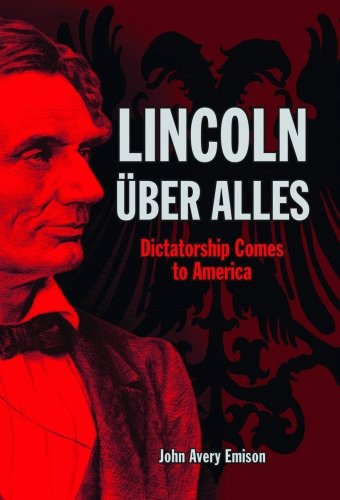 Lincoln u00dcber Alles...
Best Price: $12.47
Buy New $24.95
(as of 03:50 UTC - Details)
Lincoln u00dcber Alles...
Best Price: $12.47
Buy New $24.95
(as of 03:50 UTC - Details)

As for the other living presidents mentioned above, the New Yorker Millard Fillmore, a former Whig, opposed the war for its duration and never joined the new Republican Party after the Whig Party imploded, as did most Northern Whigs. Franklin Pierce of New Hampshire was a fierce critic of the war and especially of Lincoln’s Stalinist, police-state tactics in suppressing political opposition in the North. New Yorker Martin Van Buren died in 1862 but opposed the war, and John Tyler of Virginia, who also died in 1862, actually served in the Confederate Congress.
These men were all patriotic Americans who understood that waging war against the citizens of any state was an act of treason. They understood this because, unlike Lincoln, they had read, understood, and believed in the Constitution. As Emison points out, Article III, Section 3 of the U.S. Constitution defines treason as follows: u201CTreason against the United States, shall consist only in levying War against them, or in adhering to their Enemies, giving them Aid and Comfortu201D (emphasis added). As with all the founding documents, u201CUnited Statesu201D is in the plural, signifying that the free and independent states are united for some specific purpose, in this case in delegating certain powers to the central government, mostly for foreign policy reasons. Treason meant waging war against the citizens of the states, not the government in Washington, D.C. Lincoln’s war was nothing if it was not a war prosecuted by the Republican Party against the Southern states. It was therefore the very definition of treason under the U.S. Constitution.
The Lincoln Cult sometimes claims that the so-called u201Cinsurrection clauseu201D of the Constitution (Article 4, Section 4) gives the government the ability to wage war on its own citizens, but this is a gross misreading of the document. Article 4 states: u201CThe United States shall guarantee to every State in this Union a Republican Form of Government, and shall protect each of them against Invasion; and on Application of the Legislature, or of the Executive (when the Legislature cannot be convened) against domestic violence.u201D
 Lincoln Unmasked: What...
Best Price: $5.95
Buy New $9.85
(as of 07:10 UTC - Details)
Lincoln Unmasked: What...
Best Price: $5.95
Buy New $9.85
(as of 07:10 UTC - Details)
Lincoln violated the first part of Article 4 by imprisoning members of the Maryland legislature in 1861 and by occupying various southern states, ruling over them with military dictatorships during the war. The war was not a domestic insurrection within the Southern states. But even if one assumes that it was, as Lincoln falsely did, it is important that the second part of Article 4 denotes that the central government cannot interfere in an insurrection within any state unless first invited to do so by the legislature or governor of that state. The governors of the Southern states never invited Lincoln to invade them, bomb their cities, and murder their citizens by the thousands. But then again, Lincoln believed that he was more important than the Constitution.
In his chapter entitled u201CSecession, the Constitution, and the Law,u201D Emison devastatingly critiques Lincoln Cultist James McPherson’s one-sentence quip in his (McPherson’s) book, Battle Cry of Freedom, that the states that entered the union after the original thirteen were creatures of the central government and therefore were not sovereign over it and had no right to secede. This quip has been endlessly repeated by Lincoln cultists in their defense of Lincoln’s war despite the fact that it is historically and constitutionally baseless. It is baseless because of what the Supreme Court has called the u201CEqual Footing Doctrine.u201D When Tennessee became the third new state in 1796, for example, it was admitted u201Con an equal footing with the original states in all respects whatsoever,u201D phraseology that has been used ever since, Emison reminds us. This means that, just as the original thirteen states were sovereign over the central government, so are all the others. All states are equal under the Constitution.
 The Real Lincoln: A Ne...
Best Price: $4.25
Buy New $7.48
(as of 07:05 UTC - Details)
The Real Lincoln: A Ne...
Best Price: $4.25
Buy New $7.48
(as of 07:05 UTC - Details)
This fact motivates Emison to ask the obvious question: u201CIf all the states are equal, do any states or combination of states have the legal or moral authority to destroy another state and replace its lawfully elected government with one imposed by military occupation? If so, which states have such authority? How did they get it? Lincoln’s answer to these questions was, essentially, u201Cthe side with the most bayonets makes the rules.u201D
In his chapter entitled u201CWar Crimesu201D Emison details just how Lincoln u201Cprovedu201D his new theories about the absolute and omnipotent powers of the federal government to be u201Ccorrect.u201D He explains how the Lincoln regime reignited the horrors of total war in the world, including the waging of total war on one’s own citizens. Among the language used to describe the waging of total war on Southern civilians is u201Crampage,u201D u201Ctheft and indiscriminate destruction of property,u201D u201Crob, tyrannize, threaten,u201D u201Cnumerous reports of rape,u201D and u201Cwoe betide the region’s unprotected black women, against whom acts of the most beastly an infamous characteru201D were perpetrated by Union Army soldiers.
Much of this barbarism was the work of the u201Cheroicu201D General Sherman. Emison scoured numerous biographies of Sherman and found him to be described in the following ways by those who knew him best: u201CA near emotional crippleu201D; a dangerous manu201D; u201Ctraumatized, marginalized, and self-loathingu201D; u201Ca caged lion . . . angryu201D; suffering from u201Cdelusional misjudgmentu201D; u201Csuicidal impulsesu201D; u201Cconfessed to his wife a death-wish for himself . . .u201D; u201Ca man of primal rage.u201D
u201CSherman’s gone in the head, he’s luny [sic],u201D said Assistant Secretary of War Thomas Scott, as quoted by Emison. u201CIt would be dangerous to give [Sherman] command,u201D said General Henry Halleck. Of course, Lincoln not only gave Sherman command, but made him one of the top commanders, and the Republican Party turned him into a national icon after the war. (Sherman spent the next 25 years after the war orchestrating the campaign of genocide against the Plains Indians.)
Emison documents with Sherman’s own words how the man seemed to hate just about everyone especially blacks, Mexicans, Jews, and Indians. He was not an enlightened egalitarian devoted to black equality, as the buffoonish Lincoln cultist Victor Davis Hanson has contended. This mentally-deranged maniac u201Cjustifiedu201D his mass killing of civilians by inventing the u201Cdoctrine of military necessity,u201D which essentially said that anything goes in war, even the murder of innocent women and children. Sherman’s armies would later perfect this barbaric ideology during the Indian Wars, as Emison recounts.
When backed into a corner the Lincoln Cult usually resorts to the preposterous claim that everything the Lincoln regime did (or did not do, such as peacefully ending slavery, as the rest of the world did in the 19th century) was justified because Northerners were enlightened about race and Southerners were not. Evil Southerners had to be civilized, the story goes, even if that meant killing them by the hundreds of thousands. But as Emison writes, u201CThe idea that . . . white Northerners . . . fought the Civil War to end slavery, or were on the right side of the racial justice issue, is preposterous.u201D It is u201Cnothing short of gullible self-deception, bordering on simple-mindedness.u201D
Your author is not as generous as Emison in this regard. James McPherson, Doris Kearns-Goodwin, Arthur Schlesinger, Jr., and other Lincoln cultists are not simple minded. They know what they are doing, and they know that it pays very well careerwise and moneywise to be a court historian.
In another attempt to allow Americans to wean themselves from childish self-deceptions about their own history, Emison devotes a chapter to race in American history. He discusses how slavery existed for hundreds of years in the North, especially in New York, Boston, and Newport, Rhode Island, the hubs of the transatlantic slave trade. The transatlantic slave trade u201Cwas one of the foundations of New England’s economic structureu201D for generations. The slave trade was also u201Cone of the cornerstones of New York’s commercial prosperity in the eighteenth century.u201D
 How Capitalism Saved A...
Best Price: $2.18
Buy New $7.37
(as of 12:45 UTC - Details)
How Capitalism Saved A...
Best Price: $2.18
Buy New $7.37
(as of 12:45 UTC - Details)
Emison documents the truth behind Tocqueville’s statement in Democracy in America that u201Cthe problem of raceu201D was even worse in the North than it was in the South in the early nineteenth century. He presents a table of seventy-six Northern Jim Crow Laws that were enacted beginning with Vermont in 1777 and ending with New York in 1868. Jim Crow laws were a Northern invention. In the decade preceding the War to Prevent Southern Independence alone, California, Utah Territory, Indiana, Ohio, Kansas Territory, Nebraska Territory, Wisconsin, Minnesota, Iowa, and Oregon disenfranchised all free blacks.
In 1839 Ohio’s legislature passed u201Ca resolution that Negroes have no right to petition the legislature for any purpose whatever.u201D Massachusetts banned interracial marriage in 1836, after Rhode Island did so in 1822; during the same year (1836), state legislator Abraham Lincoln voted for an Illinois resolution that u201Cthe elective franchise should be kept pure from contamination by the admission of colored votesu201D; In 1833 Connecticut criminalized u201Cthe establishment of any school for persons of the African raceu201D; Ohio, Indiana and Illinois required u201Cgood behavior bondsu201D from free blacks; many Northern states enacted u201CNegro Exclusion Lawsu201D; the Connecticut Supreme Court ruled that blacks were not citizens twenty years before the famous Dred Scott decision; and Illinois amended its Constitution in 1862 to add a Negro exclusion provision.
One very interesting aspect of Lincoln ber Alles is Emison’s discussion of the preponderance of u201CGerman Forty-Eightersu201D in the Lincoln administration and at the upper levels of his army. These men were German immigrants who participated in an 1848 European political revolt that advocated highly centralized government, despised state’s rights, and believed that citizens needed to subordinate their personal interests to the state. u201CMany Forty-Eighters were Marxists; some considered themselves communists. One of the Forty-Eighters was Marx’s own brother-in-law . . . the Forty-Eighters saw themselves as international agents of change.u201D
 Hamiltonu2019s Curse: ...
Best Price: $1.35
(as of 11:00 UTC - Details)
Hamiltonu2019s Curse: ...
Best Price: $1.35
(as of 11:00 UTC - Details)
One of the more prominent German immigrants in the Lincoln administration was Francis Lieber, who Lincoln employed to write the military code for the U.S. Army, which was known as the u201CLieber Code.u201D Another was General Franz Sigel, and officer in the Prussian army who fled Europe and became a Union army general who gained notoriety for his defeat in the Battle of New Market at the hands of VMI cadets. Sigel apparently believed he would teach the sons of Virginia, including a descendant of Thomas Jefferson’s who was killed in the battle, what it meant to be an American. Emison describes numerous other German u201Crevolutionariesu201D who were given important commands in Lincoln’s army.
A great many German immigrants settled in the Midwest and were instrumental in Lincoln’s nomination and election. Abe recognized this, and purchased several German-language newspapers in order to bolster his German immigrant support. Emison makes a very persuasive case that it was German immigrants who u201Cput him over the topu201D in six key states (Indiana, Iowa, Michigan, Minnesota, Ohio, Wisconsin) in the 1860 election. This perhaps explains why so many prominent Germans, some of whom barely spoke English, were commissioned as colonels, majors, or generals in Lincoln’s army.
 Emison views Lincoln’s relevance to modern America very differently than Mario Cuomo and Harold Holzer, authors of Why Lincoln Matters: Today More Than Ever. Cuomo and Holzer celebrate the fact that Lincoln has long been the image/poster boy of America. In a textbook example of the kind of childish simplemindedness that Emison refers to, Holzer has even said that u201Ceverything goodu201D in all of American history since 1865 is due to Abraham Lincoln.
Emison agrees that Lincoln’s influence is tremendous, but writes that u201CAmerica is haunted by Lincoln’s blood lust for a coercive, dominant, unitary, unaccountable, debt-laden central governmentu201D whose principle function is u201Cthe plunder of society and the redistribution of wealth to the politically privileged elite [like the Cuomo family] and their collection of political sycophants [like Lincoln cultists] who help keep them in power.u201D In this regard, u201Cthe two major parties have become the party of Lincoln, each a metastatic twin of the other.u201D Abraham Lincoln u201Copened the door to the Leviathan central state that mandates, manipulates, and regulates virtually every aspect of life in America and seeks unilateral hegemony around the globe.u201D


