


A Trip to Cemetery Beach
September 21, 2005
Grand Cayman — My usual routine is to stop by a place known as Cemetery Beach before collecting my ten-year-old son from school. The beach has a decent snorkeling reef far enough out to offer a bracing swim. As well, it is very close to my son’s school. And, as the name suggests, the beach is right next to a cemetery, West Bay Cemetery by name.
A narrow sandy path leads to Cemetery Beach. A row of modest, mixed style bungalows, some brightly colored, some plain, is on the right. On the left is one of numerous cemeteries scattered about Grand Cayman Island.
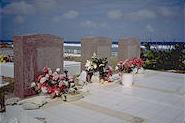 Caymanian cemeteries are not fashioned after the sanitized American model. Neither Forest Lawn style grass nor Arlington marble memorial parks, the burial places of the Cayman Islands are plain but picturesque affairs. And, they are always placed on the beach.
Caymanian graves are cement boxes known as vaults, which are two-thirds, buried in the sand. Each vault is sealed with a cement lid. Four wire hooks serve as handles. Funds permitting, Caymanians will cap the vaults of their loved ones with marble ledgers, slant stones and upright headstones. There are unadorned vaults of those who cannot afford such expense.
However, most of the graves are adorned with floral bouquets. A Caymanian cemetery is lush with flowers. It says something about Caymanian culture. According to Roger McKinny, Funeral Director at Bodden Memorial Funeral Home, religion on the Cayman Islands is much like it was in the southern United States half a century ago. On the Cayman Islands the dearly departed are held in reverence. On a regular basis, the living will visit the vaults of their loved ones of whom it is believed that they have passed on to Heaven.
Quaint and charming to the tourists, Cayman Islands cemeteries are an important part of the community. Their proximity to the beaches seems puzzling at first and as a result the cemeteries have sometimes been misconstrued as a tourist attraction.
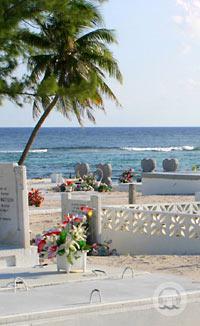 Nothing could be farther from the truth. A talk with Margi Ebanks, local Caymanian historian and Principle of Triple C School, revealed the practicality of placing the cemeteries on the beach. Ebanks says that heat, time constraints and the lack of refrigeration made it necessary to bury the deceased as quickly as possible for many years. Lacking the proper tools to dig quickly in the hard limestone and iron shore rock of which much the islands are comprised, there was little choice but to bury the dead in the sand. It wasn’t until as recently as 1970 that cement vaults replaced the less permanent sand graves.
Each Caymanian district has its own public cemetery while many private family cemeteries dot the islands. Originally cemeteries were placed at the very outskirts of the districts. To avoid "duppies," or ghosts, superstitious locals wanted to keep the living as far way from the dead as possible. Of course duppies were always malignant forces. No matter how kind and loving one’s grandmother might have been in her life, her duppy was feared as a dark force. Today, few believe these superstitions and the cemeteries are integral parts of the communities.
The gate of West Bay Cemetery boasts a neatly painted sign that reads: "Please respect our loved ones, keep out". The sign is for the tourists. Sadly, not all bother to take notice. I have seen a tourist standing on the ledger of a vault to clean the sand off her feet.
There’s one West Bay grave that speaks to me.
Located in a row of half-sized vaults for children, the grave is distinguished by its lack of classic ornamentation. There is no marble ledger, slant or headstone. There is no engraving to tell the child’s name or the dates of birth and death. What does mark the grave is a small plastic pot with faded artificial flowers, a stuffed white bear with angel wings and a toy car. The bear is wired to one of the handles of the vault while the others items simply rest there. No one has taken them. Clearly someone visits.
My own son plays with toy cars and stuffed animals. As a child, I played with toy cars and had stuffed animals. Maybe it is the lack of any marker that moves me so. Maybe it is the shameful admission that on occasion I have lost my patience and yelled at my own son. Although we try to be, no parent is perfect.
When standing by the child’s vault I have wondered: Who was the living child who now inhabits the achingly chill grave? Was the child a boy close in age to my son? How did he die? Could his passing have been prevented? Hurricanes hit the island and there can be scant time and resources for refuge. Could he have been a victim? How has his death affected his family? I know so little but I know enough.
What kind of adult would this child have grown into? What kind of children would he have had?
The dead child must have come from a family without the means to afford more than this, the most modest of headstones. Yet the stuffed animal and car create an intimate and profound memorial.
I always pause for a moment while passing the unknown boy’s grave. I do this out of respect for him and his family. I do this out of appreciation for what I have.
Yesterday, when I went to fetch my son from school, I walked that path by the grave. I noticed a new stuffed animal, a cat, had been added.
 It would be a good day. When I picked up my son at school, he was happy to see me and had drawn a picture for me.
Not all parents are so lucky.
Edited by Elizabeth Gyllensvard
 The Voluntary Community