

The New York Times reported last week that the Bush administration considered sending in the U.S. military to arrest the so-called Lackawanna Six in 2002. Ironically, one of the worst prosecutorial overreaches by the Justice Department in the war on terror almost resulted in a temporary period of martial law.
The Lackawanna Six was a group of half-a-dozen Yemeni-Americans from a Buffalo suburb who traveled to Pakistan and Afghanistan in the spring and summer of 2001 and attended an al-Qaeda training camp. Some members of the group asserted that they fled the camp after they heard appeals for violence against America.
After the six were arrested by the FBI and local police in September 2002, the Justice Department announced that it had "identified, investigated and disrupted an al-Qaeda-trained, terrorist cell on American soil." President Bush hyped the arrests of an “al-Qaeda cell” in Buffalo in his State of the Union address a few months later. While the president, the Justice Department, and legions of federal officials speaking anonymously to the media touted the Lackawanna Six as terrorists, the feds never dared make such a suggestion in court. Salon noted that “prosecutors never offered evidence that the Lackawanna defendants intended to commit an act of terrorism.” A secret FBI report in early 2005 admitted: "To date, we have not identified any true ‘sleeper’ agents in the U.S." nor any “evidence of concealed cells or networks acting in the homeland as sleepers."
But the feds did “persuade” the defendants to plead guilty to “material support of terrorism” — an amorphous charge that could mean something as simple as paying for their food at the camp. The feds coerced the plea bargain by threatening to label the men “enemy combatants” and send them to Guantanamo — and to charge them with treason, for which they could be executed. Neal Sonnett, chairman of the American Bar Association’s Task Force on Treatment of Enemy Combatants, observed: "The [Lackawanna] defendants believed that if they didn’t plead guilty, they’d end up in a black hole forever. There’s little difference between beating someone over the head and making a threat like that."
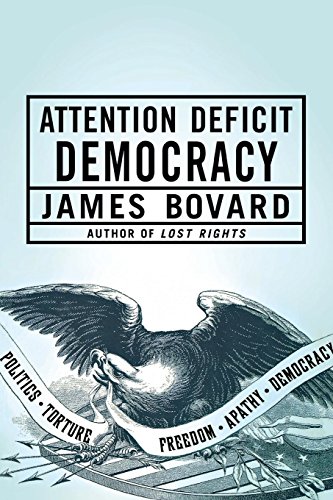 Attention Deficit Demo...
Best Price: $1.38
Buy New $12.39
(as of 03:50 UTC - Details)
Attention Deficit Demo...
Best Price: $1.38
Buy New $12.39
(as of 03:50 UTC - Details)

Georgetown University law professor David Cole commented: "It’s the first time in American history where people are going to prison for going to a training camp.” Virginia lawyer and human rights activist Elaine Cassel commented: “The idea is, ‘Let’s go out and arrest people before they actually commit a crime, or even think of a crime.’" The Bush team considered sending in the military in part because of the lack of evidence. The New York Times noted that the Justice department was concerned “that there might not be enough evidence to arrest and successfully prosecute the suspects in Lackawanna.” Vice President Cheney reportedly “argued that the administration would need a lower threshold of evidence to declare them enemy combatants and keep them in military custody.”
In other words, the idea was that it would require less evidence to totally nullify all of a person’s rights (including the “right” not to be tortured) then to arrest him on a felony charge. This judicial philosophy keeps getting stranger and stranger.
Some Pentagon officials supported Cheney’s proposal to send in the troops to grab the Lackawanna Six. Other administration officials objected, and Bush eventually decided to avoid the overt appearance of martial law for this roundup.
 Cheney was invoking a secret memo from Justice Department Office of Legal Counsel’s John Yoo, who had written: “The president has ample constitutional and statutory authority to deploy the military against international or foreign terrorists operating within the United States.”
Since some of Yoo’s memos leaked out in recent years, we have heard that they are irrelevant because they were only academic-type posturing. But the New York Times article makes it clear that Cheney and others wanted to seize new powers and fundamentally change the nature of the United States.
This case illustrates how there are no idle pro-Leviathan legal errors. Instead, any such error is like a ticking time bomb — waiting to be exploded under the people’s rights and liberties.
But apologists for Bush would insist that it would not have been a dictatorship because one lawyer in the Justice Department assured the vice president that the White House was entitled to such power. Supposedly, it only takes one weasel lawyer to nullify all the constitutional checks-and-balances accumulated over centuries. Some Bush administration officials viewed using the military for the Lackawanna arrests as “testing the Constitution.” In reality, it would have tested how much dictatorial power Americans would permit the Bush team to seize. And the mainstream media might have raised scant protest. As one wag quipped online: “If the tanks rolled down the streets on the same day the American Idol winner was named, you’d never even hear about the tanks.”

