


Iran Weathering the Storm, But Saudi Arabia Is Sinking
Middle East upheaval is already underway: “You will not recognize it in two years time”
November 5, 2026
While the disastrous US-Israeli attempt to impose regime change on Iran has commanded the world’s attention, most people are oblivious to the rising probability that regime change is instead coming to a major US and Israeli partner: the Kingdom of Saudi Arabia.
Owing to financial strains, demographics, military failures, and simmering domestic discontent, it may only be a question of magnitude. That is, will Crown Prince Mohammad bin Salman (MBS) be removed by fellow members of the House of Saud, or will the 94-year-old kingdom collapse altogether? Most likely, we’ll see both things happen in fairly rapid succession.
 Word Workout: Building...
Buy New $3.99
(as of 08:42 UTC - Details)

- Power-sharing across the branches of the Saudi royal family. Traditionally, authorities were shared among many senior princes, with their ministries providing each with a base of power and a well of patronage to tap. Major decisions were made by consensus, consistent with the Islamic principle of shura, which is expressly encouraged by the Quran.
- The integration of the Wahhabi religious establishment into Saudi government. Wahhabism is an austere and puritanical variant of Sunni Islam that arose in central Arabia in the 18th century and came to dominate it. In exchange for the Wahhabists’ bestowing of religious legitimacy on the monarchy, the Wahhabi religious authorities — or ulema — were given authority to guide schools, run charitable entities and enforce social norms.
- Tribal loyalty given in exchange for patronage and influence. The Arabian peninsula is home to dozens of tribes, with histories stretching back several hundred years or more. Their acquiescence to rule by the House of Saud has been secured via ongoing consultations and by government jobs, subsidies and contracts. Tribes have helped maintain internal peace by recognizing the monarchy’s authority, and by acting as mediators of disputes, and negotiators of access to tribal land and resources.
Everything changed when MBS became crown prince in 2017, as he radically concentrated power and decision-making in his own hands and those of a tight circle of trusted allies, to the detriment of the tribes and other members of the royal family. More than just a political maneuver, this was a bona fide revolution against the arrangement that had hitherto ensured the House of Saud’s survival.
In one of his first moves, MBS rounded up hundreds of Saudi royals and top business leaders and imprisoned them in the Riyadh Ritz-Carlton hotel. Most of them were reportedly abused, both psychologically and physically. Seventeen were hospitalized, and a major general died in custody. Faced with corruption accusations, detainees secured their freedom by forking over $107 billion, according to the claims of Saudi officials.
MBS also provoked the Wahhabi ulema, as he undertook an agenda of liberalization and Westernization aimed at improving Saudi Arabia’s image and keeping the country’s youth content. These moves included allowing women to drive cars, ending the requirement for traveling women to have male guardians, relaxing women’s dress codes, re-opening cinemas after a decades-long ban, and allowing rock concerts and art festivals. He also stripped the Saudi religious police of their investigation and arrest powers, shifting the overseers to an advisory role.
 Mises: The Last Knight...
Best Price: $14.80
Buy New $48.96
(as of 07:55 UTC - Details)
“He has offended virtually every constituency of the royal family,” Chas Freeman, former US ambassador to Saudi Arabia, said on Judging Freedom. “He’s also offended the reactionary religious establishment, so he’s made a hell of a lot of enemies.”
Like many other states in the region, Saudi Arabia is an example of a rentier state — a state that derives the great majority of its revenue from sale of resources to other countries, rather than from the taxation of domestic economic and entrepreneurial activity.
In rentier states, the relationship of the people and the government is far different from the norm. Instead of relying on the citizenry as a source of funding, rentier states use their resources to distribute money to the citizenry. “The state doesn’t need its citizens to work hard and pay taxes. It needs them to stay content,” explained The Marrow in a video report on Saudi Arabia’s challenges.
Rentier states are put in danger when revenue becomes insufficient to sustain the flow of money to the people. For Saudi Arabia, two variables have been moving in dangerous directions: the population has grown by leaps and bounds since the 1970s, and oil revenues haven’t kept up.
Saudi Arabia now has an extraordinarily young population: Nearly two-thirds of Saudi citizens are under age 30. In a typical state fueled by economic activity, a large, youthful population can be a great asset. In a rentier state, it’s a liability — one that strains the government’s ability to keep them financially secure, with the failure to do so carrying the risk of dangerous discontent.
 Human Action: The Scho...
Best Price: $6.75
Buy New $15.36
(as of 05:45 UTC - Details)
A primary means by which the Saudi government has distributed wealth — and prevented idleness that facilitates mischief — is government employment. As of 2016, an extraordinary two-thirds of employed Saudis held government jobs, and their salaries consumed 40% of the kingdom’s budget.
Government jobs’ domination of a market becomes a self-sustaining phenomenon. Private industry struggles to hire workers who’d prefer the lower demands, higher pay and greater job security of a government job. That, in turn, inhibits the growth of a private sector that could reduce the need for a large and costly public sector.
Recognizing the need to completely re-engineer the Saudi economy and relieve its reliance on oil money, MBS in 2016 unveiled “Vision 2030,” with a goal of spurring private-sector investment and employment, and improving the quality of life for Saudi citizens.
Many of MBS’s visions were the stuff of science fiction. A huge ski resort in the desert. A gigantic cube-shaped skyscraper in Riyadh as voluminous as 20 Empire State Buildings. A city for nine million people called “The Line,” comprising two parallel buildings 1,640 feet tall, 660 feet wide and stretching a staggering 110 miles.
One by one, Vision 2030 projects meant to dazzle the world have gone dim as the 2030 due date grows closer. The ski resort, which was supposed to host the 2028 Asian Winter games, has been put on ice. The Line has been suspended, leaving only a few kilometers of construction and a 70-mile-long trench. The colossal cubic skyscraper has been halted after initial excavation and installation of foundation pilings.
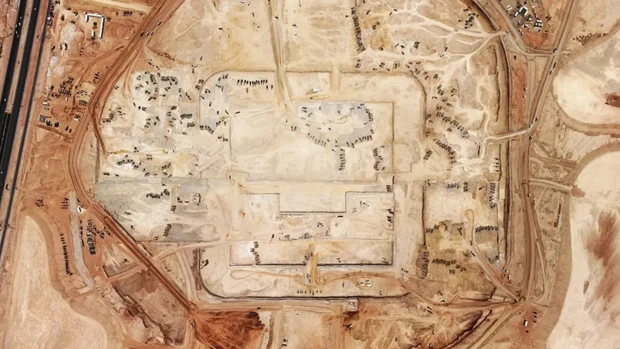
Construction of the Mukaab — a massive cubic skyscraper that would have been the largest building on Earth— was halted after oil revenues proved too weak (Architectural Digest)
The curtailing of those ambitions reflects an irony embedded in the kingdom’s predicament: Its quest to end its dependence on oil revenue itself depends on oil revenue. Since the announcement of Vision 2030, oil prices haven’t cooperated.
As MBS’s grand visions evaporate, they’re increasingly regarded as wasteful vanity projects that have only worsened Saudi Arabia’s situation. Questions about his judgment aren’t confined to economic matters — his military decisions have been even worse.
After his appointment as Saudi defense minister in 2015, MBS immediately sought to establish his military credentials by intervening in Yemen’s civil war, which had seen that country’s Saudi-allied government ousted from the capital by Ansar Allah, a Zaidi Shia group widely referred to as “the Houthis.”
It was an enormous failure. Even with refueling, arms and other assistance provided by the United States, the Saudi intervention failed to defeat Ansar Allah. It also inflicted enormous damage on Saudi Arabia’s reputation, as bombings routinely caused mass casualties among Yemeni civilians, and a Saudi blockade created one of the world’s worst humanitarian disasters.
 The Road to Serfdom: T...
Best Price: $3.06
Buy New $1.99
(as of 03:40 UTC - Details)
Saudi Arabia finally joined a truce in 2022. Despite his earlier humiliation, MBS stirred things back up again in July of this year, violating the truce by bombing an airport in Yemen’s capital to prevent a Yemeni delegation from landing in an Iranian jet, after attending the funeral of Iran’s Ayatollah Khamenei.
What followed has been devastating to Saudi Arabia. Ansar Allah retaliated, declaring the imposition of a blockade on Saudi Arabia to counter the Saudi blockade on Yemen. Furthering their ability to make good on that promise, Ansar Allah unleashed an offensive in which they rapidly seized the remainder of Yemen’s west coast, positioning their forces to easily threaten Saudi shipping entering the Red Sea via the Bab al-Mandab Strait.
Worse, Ansar Allah has taken the battle into Saudi territory, repeatedly inflicting damage on oil and gas facilities. Iraqi Shia militias joined them in that endeavor, shutting down the east-west pipeline that Saudi Arabia had been using as an alternative to the Iranian-blockaded Strait of Hormuz. Ansar Allah has also struck Saudi airports. In the worst such attack, a Yemeni cruise missile hit a passenger terminal at Riyadh’s King Khalid International Airport, killing 13 people, wounding more than 300, and causing a weeks-long closure. President Trump has compounded MBS’s ongoing military humiliation by refusing his repeated pleas for US forces to rejoin the war on Ansar Allah.
The destruction resulting from MBS’s renewal of the war in Yemen comes on top of damage caused by Iran, which has deemed any country that hosts US forces as fair targets for retaliation. Some analysts predict it will take seven to 10 years to replace all the specialized oil and gas equipment and fully restore production.
The physical damage from missiles and drones will be hard enough to repair, but the most enduring damage may have been inflicted on Saudi Arabia’s reputation as a safe place to visit and to open businesses — directly undercutting the kingdom’s quest to attract foreign investment and remake its economy.
 Natureu2019s Bounty Zi...
Buy New $7.42
(as of 05:21 UTC - Details)
 Magnesium Glycinate 40...
Buy New $15.29
(as of 06:57 UTC - Details)
 Men’s Daily Mult...
Buy New $19.97
(as of 05:34 UTC - Details)
 Nature Made Vitamin D3...
Buy New $11.95
(as of 07:21 UTC - Details)
Copyright © Brian McGlinchey
 Time for a Reset on Iran, Cuba, and Venezuela
