


The Hidden Harms of Modern Lighting and the Fight to Bring Back Incandescent Bulbs
Decades of forgotten research show natural light is an essential nutrient our bodies are being starved of
September 19, 2026
Over the years, I have become convinced sunlight is one of the most essential nutrients for the body. For example, as human beings moved further and further north from Africa and had increasingly lower sun exposure, their skin became progressively lighter, something which argues the human body needs light and that the whitening of human skin in the higher latitudes was a protecting mechanism designed to ensure enough of the remaining sunlight could get inside the body.
Note: an explanation of how the darker parts of the skin prevent UV from entering the body can be found here.
 Warm Incandescent Ligh...
Buy New $39.99
(as of 10:36 UTC - Details)
Warm Incandescent Ligh...
Buy New $39.99
(as of 10:36 UTC - Details)
 Unfortunately (outside of very specific patentable applications), since no one has a financial interest in promoting sunlight it hence has no lobbyists, almost everything we hear about instead focuses on why it’s terrible for us (as sunlight prevents many diseases other industries profit from). For example:
• As discussed in a previous article, dermatology was one of the least desirable professions in medicine. They then transformed themselves into one of the most sought after ones by rebranding themselves as cancer fighters and convincing everyone to get regular skin cancer exams where any potential cancer could be quickly removed, often for thousands of dollars apiece, quickly making dermatology into one of the highest paying specialties. A centerpiece of this rebranding was making benign cancers be labeled as deadly ones and claiming sunlight caused skin cancer (which while true, omitted to mention that that a lack of sunlight is what causes fatal skin cancers). Because of this, a lot of dermatology morphed into scaring people senseless about the sun, and despite billions being spent each year on skin cancer, the total death rate from skin cancer remains almost entirely unchanged (instead we simply diagnose and “treat” far more of it).
Note: in this article, I will attempt to explain why unnatural light causes skin cancer.
• While many factors contribute to cancer, the focus is often on sunlight and smoking as the primary culprits. I believe this emphasis explains why cancer rates continue to rise, as the true causes of cancer remain underexplored. Industries with vested interests lobby to keep these causes off-limits, diverting attention from potentially significant contributors to cancer.
In this article, I will present some of the forgotten knowledge on the incredible importance of light.
The Importance of Sunlight
Prior to dermatology’s disastrous war on the sun, the value of sunlight was widely recognized in medicine. For example, in the early 1900s, heliotherapy (sunbathing) was used with great success for treating many (otherwise incurable) conditions, such as the 1918 influenza, tuberculosis, and many other diseases.
The existing data, in turn, shows that sunlight provides an immense degree of benefit. For example:
• Sunlight is critical for mental health. This is most well appreciated with depression (e.g., seasonal affective disorder). Sadly, many workers (especially night shift workers such as those in hospitals) do not get that essential light exposure and suffer immensely. For example, consider this study of Chinese operating room nurses which found their mental health was significantly worse than the general population and that this decline was correlated to their lack of sunlight exposure (which I would argue does not benefit the patients they care for).
Note: I really got this point once, where after a long period of hospital night shifts under fluorescent lights, noticed I was becoming clinically depressed (which has never otherwise happened to me and led to another physician I was close to offering to prescribe antidepressants). I decided to do an experiment and stuck with it for a few more days, then went home and bathed under an Ott full spectrum bulb I’d been able to obtain, at which point I almost instantly felt better.
• Many different studies have found sunlight exposure dramatically reduces one’s risk of cancer (e.g., this large study found high solar UVB exposure halved one’s risk of breast and prostate cancer).
 dalattin 12 Pack A19 V...
Buy New $20.69
(as of 10:36 UTC - Details)
dalattin 12 Pack A19 V...
Buy New $20.69
(as of 10:36 UTC - Details)
• An excellent 20-year study of 29,518 women found that avoiding the sun made one 60% more likely to die (a 130% difference compared to those who had the most significant amount of sun exposure), and the most considerable benefit from regular sunlight exposure was reducing one’s risk of dying from heart disease.
Note: that study also found a variety of other common diseases were much less likely to affect those with adequate sun exposure.
• In a 2024 analysis of the UK Biobank, both measures of UV exposure that were examined (sunbed use and how much solar radiation reached the participant’s home) were associated with a lower risk of dying from any cause, from cardiovascular disease and from cancer. Likewise, when 88,905 Biobank participants wore light sensors for a week, those with brighter days and those with darker nights were each less likely to die over the following 8 years.
• Normal sunlight is critical for facilitating the circadian rhythm our body’s depend upon to rest and repair themselves. In turn, a major cause of the modern insomnia epidemic (and the profound health consequences it entails—which are discussed further here) are artificial light exposures, while one of the most useful treatments for it is to simply start your day with a full sunlight exposure.
Typically, sunlight’s benefits are thought to be due to producing vitamin D (a critical nutrient) within the body. However, I have long suspected that many of the benefits of vitamin D are not due to the vitamin itself but rather that its elevation serves as an indicator that the body is having regular sunlight exposure and hence is experiencing the myriad of benefits sunlight provides. For example, when 24 healthy volunteers were exposed to UVA (which does not produce vitamin D) at a dose equivalent to about 30 minutes of summer sun, their arteries dilated and their blood pressure dropped, as nitric oxide stored in the skin was released into the circulation. The dermatologist behind that work, has since argued (e.g., in this review) his specialty’s position on sunlight needs to be rethought. Similarly, a meta-analysis found that spending an hour or more a day in the summer sun was associated with a 16% lower risk of breast cancer, whereas simply living somewhere with more ambient UV was not.
Note: that being said, vitamin D supplementation can often be very beneficial. However, in almost all cases, elevating your vitamin D levels through appropriate sunlight exposure provides significantly greater benefits than supplementation.
What is Light?
Waves, by definition have a few fundamental properties:
• They require a medium to travel through. For example, the medium for waves at the beach is the ocean, whereas the medium for sound is the air.
• They travel at specific speeds.
 Wesome Lighting Vintag...
Buy New $22.99
(as of 10:36 UTC - Details)
Wesome Lighting Vintag...
Buy New $22.99
(as of 10:36 UTC - Details)
• They have a specific wavelength and frequency (which are inversely related to each other).
• Their strength is determined by how many waves elapse in a second (a higher frequency correlates to a higher total energy) and how greatly each individual wave disrupts its medium (e.g., a small wave at the beach has much less energy than a tsunami as does a loud sound compared to a quiet one).
By far, the most common wave in our lives is electromagnetic radiation, which is defined as a wave that travels at the speed of light and, unlike all other waves, does not have a medium it travels through (which is why EMR can travel through space and many objects). “Light,” for instance, is one type of EMR.
Since there is an inverse relationship between a wave’s wavelength and frequency, a variety of different types of EMR exist depending upon their wavelength. For example, visible light comprises the EMR with a wavelength between 380nm-700nm, as this is the EMR the eye can “see.” At the same time, depending on the wavelength of the EMR, its properties (e.g., color) vary immensely.
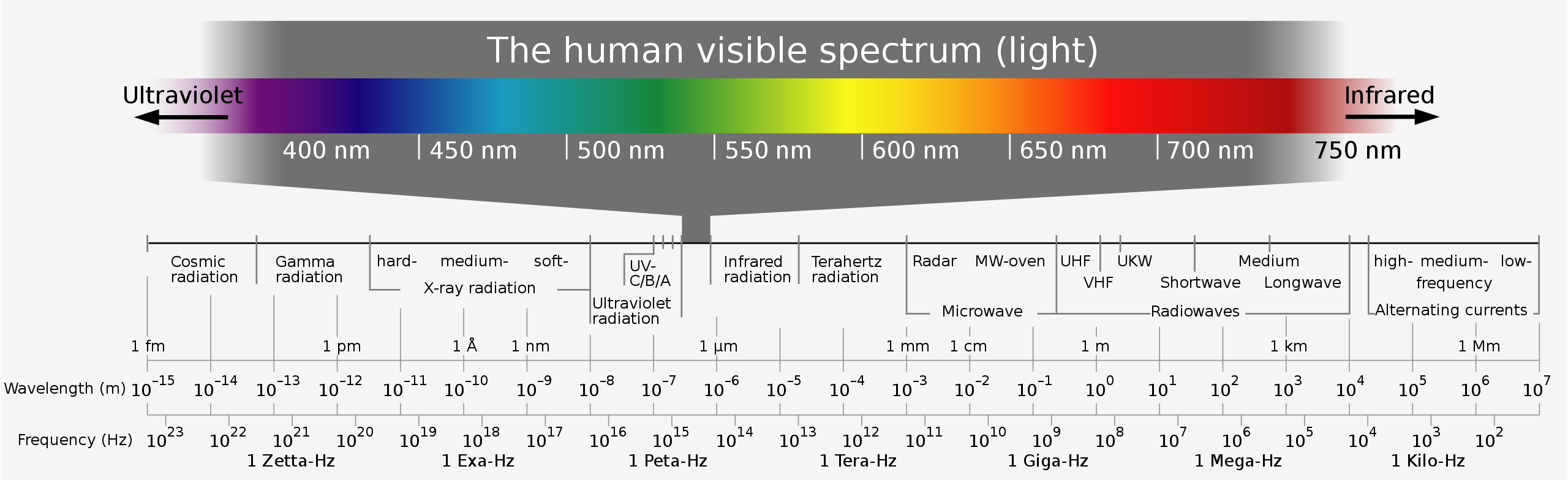
Likewise, many other types of EMR also exist (e.g., Gamma rays, x-rays, ultraviolet, visible light, infrared, microwaves, and radiowaves) which each have different properties. However, despite EMR being one of the fundamental constructs of our reality, much of its biological significance is still not recognized. For example, I feel some of the biggest misunderstandings about EMR are as follows:
• Natural light tends to have a fairly wide range of frequencies present within it (e.g., this is why sunlight splits into a rainbow once it passes through a prism). In contrast, artificial light tends to have a much narrower range of frequencies present within it which differs greatly from what biology evolved to handle.
 4 PCS ST58 Dimmable Sp...
Buy New $9.99
(as of 10:36 UTC - Details)
4 PCS ST58 Dimmable Sp...
Buy New $9.99
(as of 10:36 UTC - Details)
• This is easiest to see by comparing bulbs. A standard white LED emits a sharp spike of blue at around 450nm, a broader hump of yellow, and almost nothing past 700nm. An incandescent bulb, like the sun, emits a smooth curve that keeps rising through the red and continues past 2000nm, so most of what it produces is infrared we cannot see.1
Note: since the government grades bulbs on visible light per watt, that infrared was scored as “waste,” which is how the incandescent bulb came to be banned.
• The label “ultraviolet” is given to the EMR that lies between visible light and x-rays. This implies all UV is the same, when in reality, each type of UV (UV-A, UV-B, and UV-C behave very differently) and are present in very different amounts (e.g., the atmosphere blocks most UV-C from reaching the surface of the Earth).
• Infrared penetrates much deeper into the body than UV (5–40mm vs. 0.02-0.15mm) and in 2025, researchers at University College London were able to measure the infrared in sunlight after it had passed through the human body and found that it created systemic effects. Additionally, standard glass (for the most part) blocks UV from traveling through it.
• Conventional science typically describes the adverse effects of EMR as being a property of how much energy the EMR has and if that energy is sufficient to break molecular bonds (termed ionizing energy). For example, gamma rays (which are released by nuclear weapons) are so dangerous because their ionization energy is so powerful they shred the molecular structures of the body (e.g., DNA) apart. Conversely, microwaves (which are instead on the low energy end of the electromagnetic spectrum) are deemed to not be dangerous because they contain too little energy to ionize molecular bonds.
 TJOY 6 Pack A19 LED Li...
Buy New $9.99
(as of 10:36 UTC - Details)
TJOY 6 Pack A19 LED Li...
Buy New $9.99
(as of 10:36 UTC - Details)
• The previous point is not entirely correct because while EMR typically passes through whatever it contacts, if it instead “matches” that medium, it will store inside it and have a dramatically greater effect on it (e.g., this describes the concept of a resonance frequency). This is important because a wide number of critical living structures (e.g., mitochondria) evolved to have a resonance for a specific type of EMR and then respond to them while everything around them is largely unaffected by that specific type of EMR. Unfortunately, this aspect of science has been largely glossed over by our scientific apparatus, something I believe is due to the fact biophysics opens the doors to creating a variety of un-patentable medical therapies, and because it implicates a lot of the EMR we are now saturated in (e.g., the microwaves cell phones bluetooth and Wifi use) as a cause of poor health.
For example, radar works by sending out a large pulse of microwave energy in each direction (through the unit spinning around), and then using the reflections it receives from any radar pulse into the atmosphere to indicate the presence of an object being there. I personally think radar is far from benign as I’ve read numerous stories of soldiers stationed next to radar units (where the microwaves are exponentially stronger) becoming severely ill, I know many EMF sensitive people can tell if far away radar units are firing, and I personally can feel something when I am at an airport each time a radar sweeps by. While that seems abstract, I recently saw a brief video by John Ott that perfectly demonstrates the reality of this phenomenon.
 Physician’s CHOI...
Buy New $9.99
(as of 03:16 UTC - Details)
Physician’s CHOI...
Buy New $9.99
(as of 03:16 UTC - Details)
 Micro Ingredients Oil ...
Buy New $23.70
(as of 04:51 UTC - Details)
Micro Ingredients Oil ...
Buy New $23.70
(as of 04:51 UTC - Details)
 Emergen-C Vitamin C 10...
Buy New $12.33
(as of 12:51 UTC - Details)
Emergen-C Vitamin C 10...
Buy New $12.33
(as of 12:51 UTC - Details)
 Create Creatine Monohy...
Buy New $44.98
(as of 12:57 UTC - Details)
Create Creatine Monohy...
Buy New $44.98
(as of 12:57 UTC - Details)
Copyright © A Midwestern Doctor
 No Benefits: Why Most Americans Hate The Idea of AI Data Centers