


The 48-Hour Doctrine: How Public Assassination Became America’s New Political Language
From Eshkol’s headline to JFK’s rupture to Charlie Kirk’s final message, the same architecture appears: financial pressure, narrative warfare, and intelligence tools now normalized in America.
January 1, 2026
This is Charlie Kirk’s TPUSA examination of the JFK assassination, where he briefly delves into Israel’s interests, Lyndon B. Johnson’s pivot, and the concealed government dynamics of 1963.
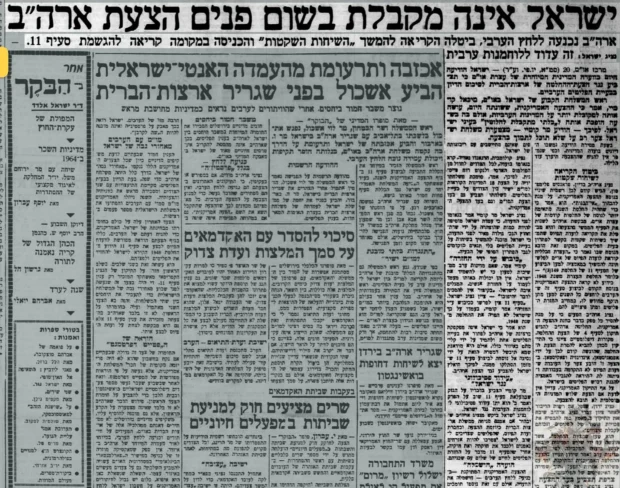
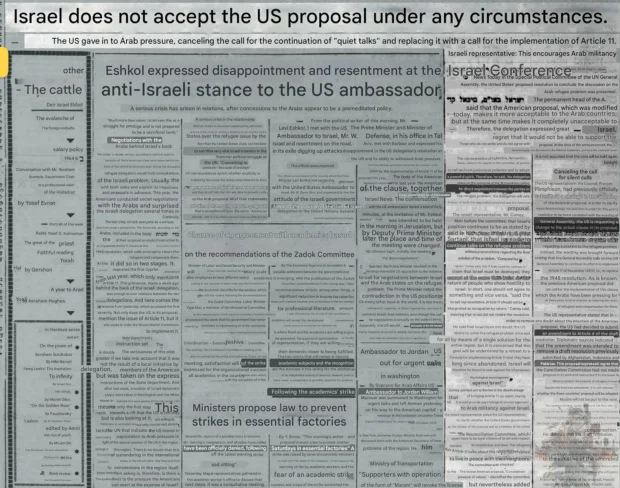
Front page of Davar — the Histadrut’s flagship Hebrew daily — November 20, 1963.
There, in black ink and absolute clarity, Israel Prime Minister Levi Eshkol laid out the doctrine that would define every confrontation with Washington for the next six decades: a fortress mentality, and a categorical rejection of President John F. Kennedy’s demand for the right of return (זכות השיבה) for Palestinian refugees, the very principle enshrined in UN Resolution 194 (1948).
The 48-Hour Pattern
I first noticed the symmetry when I read the leaked group message Charlie Kirk sent to close allies just forty-eight hours before his death:
“I cannot and will not be bullied like this. Leaving me no choice but to leave the pro-Israel cause.”
That line pulled me backward to the summer of 1963 when President John F. Kennedy’s administration moved to implement the right of return for displaced Palestinians. At that time, Israel’s prime minister Levi Eshkol publicly criticized Kennedy for taking the demand to the press rather than keeping it within “quiet talks.”
The front page of Davar (the Histadrut’s flagship Hebrew daily) on November 20, 1963 captured Eshkol’s defiance in blunt Hebrew:
“Israel does not accept the U.S. proposal under any circumstances.”
Forty-eight hours later, Kennedy was assassinated in Dallas.
In both stories—a president and a political media figure decades apart—we see men who challenged the same powerhouse of influence. Both had endured months of tension, leaks, and smear campaigns. Both went public at the critical moment. And in both cases, forty-eight hours separated defiance from death.
Declassified telegrams and memoranda from the National Security Archive confirm the depth of U.S.–Israeli friction at the time: Washington demanded inspection of the Dimona reactor and accountability on refugee policy; Jerusalem refused. Eshkol’s “fortress mentality” was clear, especially regarding Kennedy’s insistence on the right of return (זכות השיבה) guaranteed under U.N. Resolution 194 (1948).
Meanwhile, in 2025, investigators and media reports confirm that Kirk was shot during a public campus event on September 10, in a venue curiously lacking the usual surveillance and security presence.
This was not another random act of violence.
It was a pattern—where influence, ideology, and technology converge, and where the stakes have migrated from the global to the domestic.
The experiment abroad has come home.
JFK’s Missing 48 Hours
In the late spring and early summer of 1963, President Kennedy took a public stand against Israel on three escalating fronts, each one more existential than the last.
The first, already well documented, was his insistence that the Israeli lobby register under the Foreign Agents Registration Act (FARA) as a foreign lobby. It was the first serious effort by an American president to define the boundary between foreign influence and domestic sovereignty.
But it was the second and third fronts (nuclear oversight and the Palestinian right of return) that transformed policy into peril.
“Our best work,” said former Mossad Chief Yossi Cohen, “is done when the world looks super quiet.”
The following video, though recorded decades later and released after the Charlie Kirk assassination, captures Israel’s enduring creed: existential threats are neutralized in silence, not in war. The same logic defined the atmosphere surrounding both Kennedy and Kirk: calm on the surface, fatal beneath.
Copyright © Phantom Pain
 The Partnership From Hell