


The Remarkable Secrets of Olive Oil
October 20, 2026
One of the greatest problems in medicine today is that everything has become so rushed there is rarely time for a doctor to truly get to know their patients, and as a result, much of what matters most gets lost. Because of this, when I started this newsletter, I hoped to correspond with everyone who reached out to me, but as this publication has grown, that has no longer been possible.
The best solution I’ve found is these monthly open threads, where anyone can ask whatever is on their mind (e.g., questions that have accumulated over the last month). That lets me make a point of replying, and lets others with the same question see the answer. Each month, I also pair the thread with a topic I’ve long wanted to cover but that doesn’t quite warrant its own article.
 Extra Virgin Olive Oil...
Buy New $2.99
(as of 10:51 UTC - Details)

This month’s topic is olive oil, a food most of us already have in our kitchens, yet few appreciate.
Olive oil is little more than the juice of a fruit, yet few foods have been prized, traded, or counterfeited for as long. For most of human history, “oil” meant olive oil (our word petroleum comes from the Latin for “olive oil from a stone”), and the ancient world ran on it much the way ours runs on crude: as food, fuel, medicine, soap, perfume, and at times, currency.
A Medicine for Millennia
Across the ancient Mediterranean, olive oil was valued as much for healing as for eating, and that reputation persisted for thousands of years.
• Hippocrates called it “the great healer” and described over 60 medical uses for it, from healing wounds and burns to treating ear infections and settling the stomach.
• Pliny the Elder advised that medicinal oil be pressed from olives that had not yet begun to ripen. Modern chemistry confirms early-harvest oil has the highest polyphenol content.
• Into the 20th century, pharmacies in the US and Europe sold olive oil to be taken by the spoonful for digestive problems and high blood pressure.
• In Puglia, many people still drink a small cup of warmed oil each day as a ritual of health.
After World War II, the American physiologist Ancel Keys (who had developed the Army’s K ration) noticed that Greeks and Italians were comparatively free of heart disease despite eating a moderate to high amount of fat, and suspected the difference lay in the type of fat they ate. This led him to launch the Seven Countries Study, which found heart disease was lowest where fat came primarily from olive oil, and to promote what he termed a “Mediterranean-style regime” with olive oil at its core.
 Olive Oil: The Secret ...
Best Price: $6.49
Buy New $50.77
(as of 11:01 UTC - Details)
Decades later, this was put to a direct test in a randomized Spanish trial of 7,447 people at high cardiovascular risk, where those assigned a Mediterranean diet supplemented with extra virgin olive oil had roughly 30% fewer heart attacks, strokes, and cardiovascular deaths than those advised to cut their fat intake.
Note: Keys’ broader warnings about fat backfired. They helped spark an American war on all dietary fat, olive oil included, and a wave of low-fat processed foods loaded with sugar and salt. The flawed science behind this, along with the dangers of the statins it ultimately gave rise to, is discussed further in The Great Cholesterol Scam and The Dangers of Statins (which can be read here).
Personally, olive oil has become one of the foundations of how I eat. It started as what I cooked and roasted with, but I gradually noticed that a tray of roasted vegetables tasted much better with it, and that I could eat a meal rich in olive oil and feel completely fine afterwards, whereas snacks made with seed oils (and fried food in particular) frequently left me feeling ill. When I read the ingredients of a packaged product, whether it was made with high quality oil or a cheap seed oil is one of the first things I check, as I’ve found it to be a reliable indicator of how much care went into the rest of it. The same holds for restaurants. The occasional one that cooks with olive oil rather than seed oils makes dishes that taste better and leave me feeling better than the same dishes elsewhere, and it tends to be better across the board (as quality ingredients are prioritized—not unlike how the forms of common micronutrients used often indicate a supplement’s overall quality).
Along the way, I also began tasting different olive oils side by side and was surprised by how much they differed. Some were grassy, some buttery, and others so peppery they made me cough, which made me appreciate that olive oil is far more complex than the generic bottles most of us grew up with would suggest. In time, I found that a great deal of research supports what I noticed, and in many cases explains why.
 The Secret of the Oliv...
Buy New $11.50
(as of 11:01 UTC - Details)
Most notably, the Mediterranean diet has become one of the most consistently supported diets in nutrition research. It is built around vegetables, fruit, legumes, whole grains, nuts, and fish, with olive oil as the primary fat, wine in moderation, and little red meat, sugar, or processed food. Across 12 studies following over 1.5 million people, those who adhered more closely to it had lower rates of death (9%), cardiovascular death (9%), cancer (6%), and Parkinson’s and Alzheimer’s (13%).
Unlike most dietary advice, it has also held up in randomized trials. For example, in the previously mentioned 7,447-person Spanish trial, those given extra virgin olive oil were not only less likely to suffer a heart attack or stroke, but also 40% less likely to develop diabetes and 38% less likely to develop atrial fibrillation, the most common irregular heart rhythm. Likewise, another Spanish trial, which followed 1,002 patients who already had heart disease for seven years, found the diet prevented more heart attacks, strokes, and other major cardiovascular events than the low-fat diet cardiologists have long recommended. Few other diets have been shown to do this.
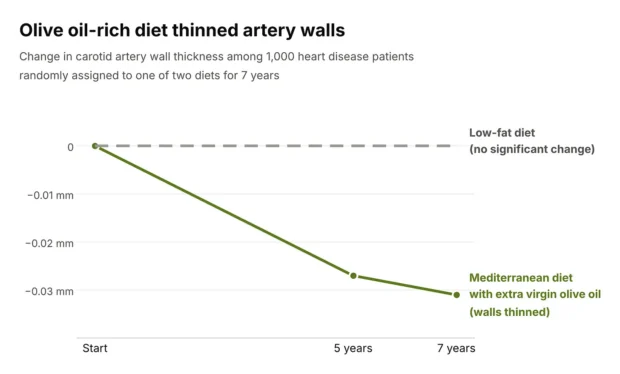
Note: I view the Mediterranean diet as one of the better diets (rather than the optimal one)—but unlike many of the other ones with merit, extensive research has been conducted that then showed it works, and in practice, we find certain subsets of patients greatly benefit from it.
However, the benefits from the Mediterranean diet were seen in people eating fresh, genuine olive oil (e.g., participants in the first of those trials were given a liter of extra virgin olive oil each week), whereas much of the olive oil sold in America is stale or not truly extra virgin. As such, I believe many Americans who adopt a Mediterranean diet never receive its full benefit, as the oil at its center is often missing the very compounds believed to be responsible for much of it.
Many of the chronic diseases that fill our offices today, such as cardiovascular disease and the degenerative diseases of aging, are driven in part by oxidative stress and inflammation, and extra virgin olive oil supplies compounds that counter both (one of which works much like ibuprofen), within a fat far more stable than the seed oils most people now cook with. Additionally, it requires no pill, prescription, or laboratory to produce, only fresh olives and a mill. Unfortunately, much of what is sold as extra virgin olive oil today has been cut with cheaper oils, made from inferior olives, or degraded by heat and age, and hence contains little of those compounds. Fortunately, genuine oil is still being made, frequently by small producers who grow and mill their own olives and make their oil commercially available.
 The Olive Oil Enthusia...
Best Price: $5.24
Buy New $13.48
(as of 11:01 UTC - Details)
What’s in Olive Oil
Unlike seed oils (e.g., soybean, canola, and sunflower), which are typically extracted with an industrial solvent and then refined, olive oil is made by crushing the olives and pressing or spinning the oil from the paste, without solvents, chemicals, or refining. Roughly 70% of the fat in olive oil is oleic acid, a monounsaturated fat that is much more stable than the polyunsaturated fats that dominate seed oils, which oxidize substantially faster. Oxidation turns oils rancid, and within the body, oxidative damage helps LDL cholesterol build up in the walls of the arteries.
More importantly, the fats circulating in your bloodstream largely reflect the fats you eat, so a diet rich in olive oil shifts them toward this more stable fat, and oleic acid is generally regarded as one of the healthiest fats we can consume. The heart in particular appears to benefit, as given a choice, it burns fat over any other fuel, and in animal and cell studies, injured hearts treated with oleic acid recovered faster and more completely.
Bottles labeled “olive oil,” “pure,” or “light” are mostly refined oil, yet still contain about as much oleic acid as the best extra virgin oil. What they lack is the remaining 2% of the oil, a mix of over a hundred compounds that refining destroys, and which research credits for most of olive oil’s benefits. The most significant of these are the polyphenols, a large family of plant compounds, many of which act as antioxidants.
In extra virgin olive oil, they are the most abundant natural antioxidants, and have been linked to slowing the progression of diseases driven by oxidative stress, such as cardiovascular disease, cancer, and the degenerative diseases of aging.
Olive oil contains several types: simple phenols, lignans, flavonoids, and secoiridoids. The secoiridoids are found only in the olive’s plant family. Their effects are well enough established that in 2012, European regulators actually approved a health claim stating that olive oil polyphenols protect blood fats from oxidative damage. However, the claim can only be made for oils containing at least 5 mg of hydroxytyrosol and its related compounds per 20 grams (roughly 1.5 tablespoons), the amount it specifies be consumed daily. Relatively few oils on the shelf state whether they meet it, but as I will discuss further below, they can be found.
The most notable of these compounds are:
Hydroxytyrosol: one of the oil’s most potent antioxidants, and the compound the European health claim is built on.
Oleocanthal: the source of the sting at the back of the throat, which inhibits the same enzymes as ibuprofen (discussed further below).
 Liquid Gold: The Story...
Buy New $12.99
(as of 11:01 UTC - Details)
Oleacein: oleocanthal’s chemical sibling, which has shown anticancer and metabolic activity in early laboratory and animal studies.
Squalene and vitamin E: antioxidants that protect the oil itself from oxidation, along with the tissues of those who eat it. The oil’s vitamin E comes primarily as α-tocopherol, its most biologically active form, which the cosmetics industry has long used to shield the skin from sun damage, while squalene is a compound the body uses to build sterols and vitamin D. Olive oil itself has been used as a skin and hair treatment for thousands of years.
Note: in a 2022 analysis of four randomized trials involving over 1,600 patients, olive oil applied to the skin reduced the incidence of pressure ulcers (bedsores) by roughly 44% compared to standard treatments.
One of the least appreciated aspects of olive oil is that many of its most valuable compounds do not exist in the olive. The fruit instead contains oleuropein (along with a close relative called ligstroside), a compound so bitter that a fresh olive is inedible until cured, and since it dissolves in water, most of it would be discarded with the water when the oil is separated. However, once the olives are crushed, an enzyme in the fruit’s flesh strips a sugar off of each, converting them into oil-soluble secoiridoids (e.g., oleacein and oleocanthal), some of which only form during milling. In essence, the same bitterness that makes a raw olive inedible is what becomes the oil’s medicine, and much of that medicine is made in the mill.
Even then, less than 1% of the olive’s phenolics end up in the bottle. Because of this, polyphenol content varies enormously, from roughly 50 to 800 mg per kilogram depending on the olive variety, where it was grown, how ripe it was at harvest, and how it was milled, whereas the European health claim requires about 250 mg per kilogram. Afterwards, both filtering and storage gradually reduce these compounds further. The most medicinally potent are typically your early harvest extra virgin olive oils with a strong and pungent taste, indicative of high polyphenol content, but not always the most palatable in the culinary sense.
Note: this means two bottles legally labeled extra virgin can differ more than tenfold in the very compounds the research credits for olive oil’s benefits.
Oleuropein, however, is not limited to the fruit, as the leaves of the olive tree are far richer in it, and they have a long medical history of their own. By the early 1900s, the British Pharmaceutical Codex listed olive leaves as a remedy for fevers, noting that a decoction of them had been used as a substitute for quinine in obstinate cases. Modern research has since found they have far more to offer. In a randomized trial of patients with high blood pressure, 500 mg of olive leaf extract twice a day lowered blood pressure as effectively as captopril (a commonly prescribed blood pressure drug), while also lowering triglycerides, which the drug did not. Likewise, in overweight middle-aged men, 12 weeks of olive leaf polyphenols improved insulin sensitivity by 15% and the responsiveness of the cells that produce insulin by 28% compared to placebo. So while I generally prefer whole foods to isolated extracts (discussed further below), olive leaf extract is one of the few I consider well worth knowing about.
Note: Olive leaf extract has a surprisingly broad preclinical antimicrobial profile (antibacterial, antiviral, antifungal, and some antiparasitic activity in vitro), while human data and clinical experience are strongest for viral infections—particularly topical use in herpes labialis and supportive symptom/inflammatory modulation in viral respiratory illness. Our own experiences (and many reports online) corroborate its value in treating viral infections.
 Amazon Basics Melatoni...
Buy New $7.73
(as of 08:56 UTC - Details)
 Micro Ingredients Oil ...
Buy New $29.71
(as of 09:31 UTC - Details)
 Seed DS-01 Daily Synbi...
Buy New $53.99
(as of 01:31 UTC - Details)
 Nature’s Bounty ...
Buy New $12.24
(as of 11:12 UTC - Details)
Copyright © A Midwestern Doctor
 RFK Jr. Blames Measles Outbreak on Missed Vaccinations After Years of Warning About MMR Risks
