


9 Terrifying Truths About Long-Term Economic Crises
September 17, 2026
Why preparation matters less than adaptation, and why the next crisis will not resemble the last
My father kept his layoff notice from 1982 taped inside his toolbox until he died. The letterhead—blue, corporate, indifferent—arrived on a Tuesday in March, six months after his machine shop started losing contracts. By August, we were living in my aunt’s basement. By Christmas, he was driving a delivery truck for half his previous wage.
 Borax 20 Mule Team Det...
Buy New $6.98
(as of 05:06 UTC - Details)
Borax 20 Mule Team Det...
Buy New $6.98
(as of 05:06 UTC - Details)

He kept that letter as a reminder about velocity. How fast the ground moves when it finally shifts.
Most Americans have never experienced that kind of speed. They’ve known recessions, certainly—the technical kind, the temporary kind, the kind that ends with rebounding markets and analysts declaring victory. They’ve never known a genuine crisis, the sort that grinds forward for years, rewriting the social contract so gradually that each degradation feels like common sense by the time it arrives. The sort that leaves permanent scars.
We may be closer than we think. Not because of prophecy, but because of arithmetic. Debt structures, demographic shifts, and institutional fragilities have accumulated to levels that historical precedent suggests are difficult to sustain. The question is not whether stress will come, but whether those experiencing it will recognize the tremors before they’re already falling.
The Numbers Behind the Warning
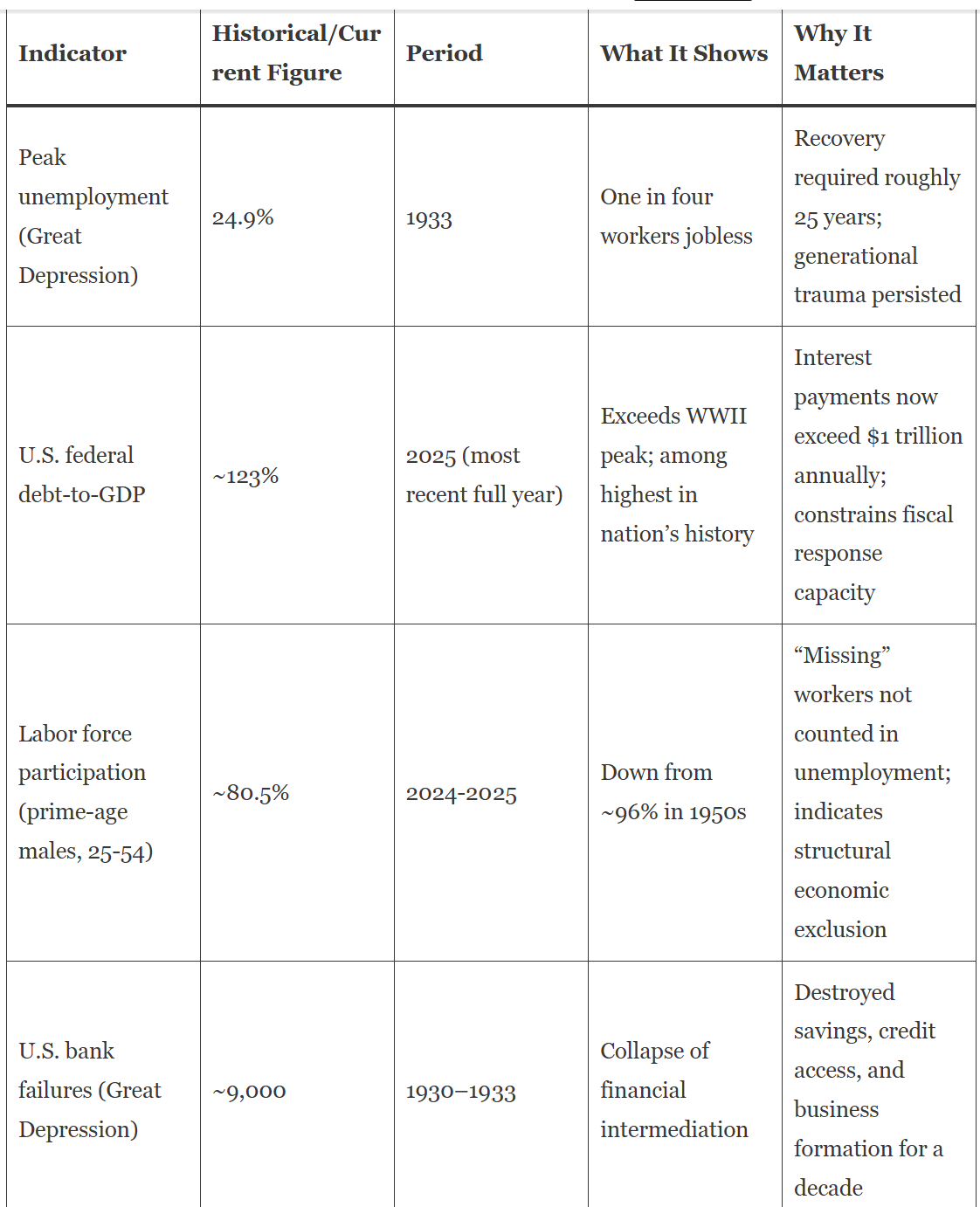
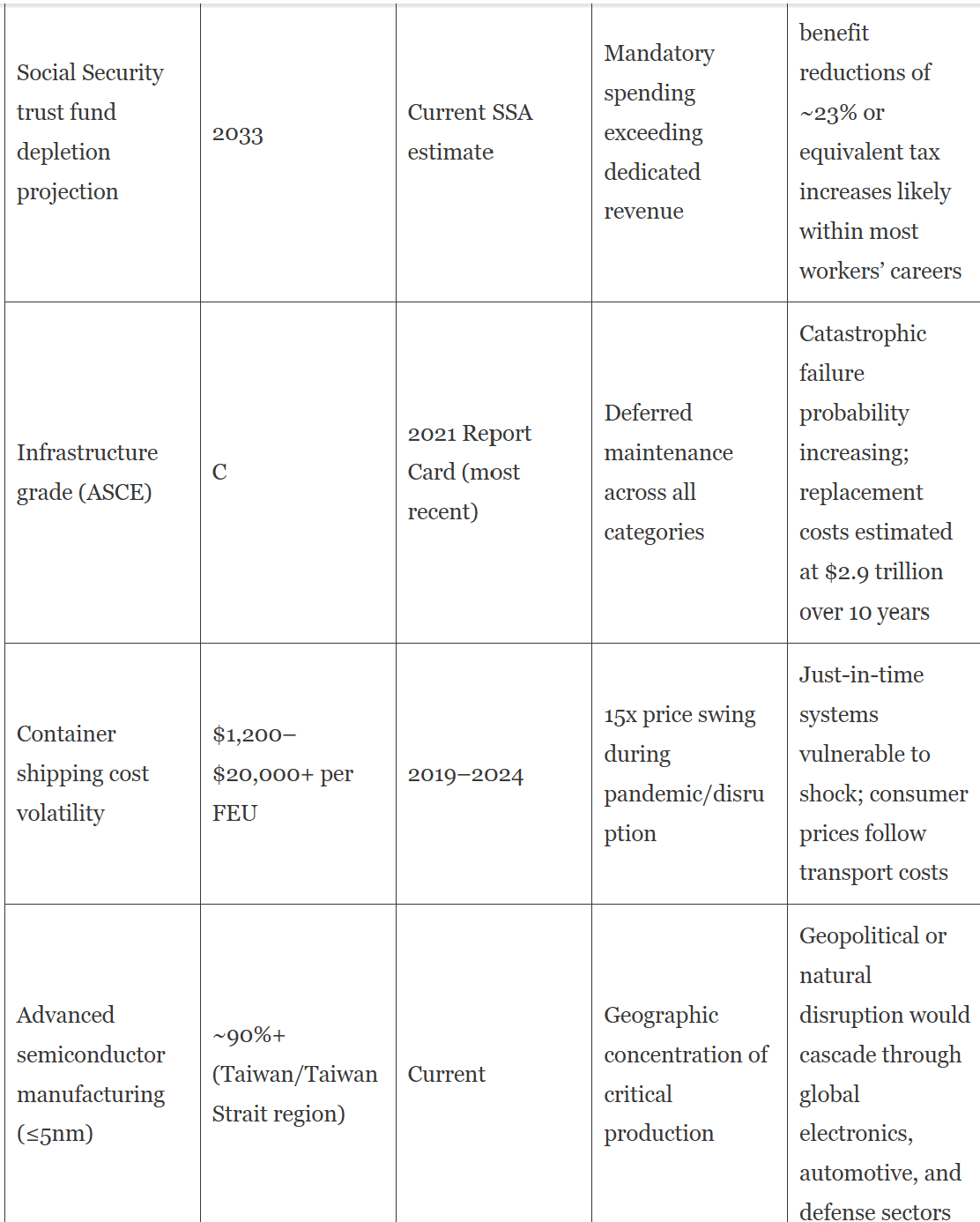
Sources: Congressional Budget Office, Social Security Administration, Bureau of Labor Statistics, American Society of Civil Engineers, Federal Reserve Economic Data, industry trade publications
These figures describe conditions, not predictions. Debt at 123% of GDP does not automatically trigger collapse—Japan has sustained higher ratios for decades, albeit with trade-offs. But high debt constrains options. When stress arrives, heavily indebted governments have less capacity to respond through stimulus. When unemployment spikes, extended benefits exhaust faster. When infrastructure ages, maintenance competes with emergency spending. The numbers suggest a system with reduced resilience—less able to absorb shocks, slower to recover, more vulnerable to cascading failures. What they cannot show is timing, specific triggers, or whether institutional adaptations will prove sufficient. History offers examples of both successful navigation and catastrophic failure from similar starting positions.
 Krispy Kreme Doughnuts...
Buy New $20.40
(as of 05:06 UTC - Details)
Krispy Kreme Doughnuts...
Buy New $20.40
(as of 05:06 UTC - Details)
First Reality: The Joblessness That Doesn’t End
Temporary unemployment is an inconvenience. Chronic unemployment is a transformation. During the Great Depression, joblessness persisted not for months but for years—peaking at nearly twenty-five percent in 1933, still above fifteen percent in 1940. A quarter of the workforce didn’t just lose income. They lost identity, social connection, and the psychological structure that employment provides.
The modern equivalent may already be developing. Labor force participation among prime-age males has declined steadily since the mid-20th century—not because jobs don’t exist, but because available jobs don’t match skills, locations, or expectations in ways that draw workers in. This “missing” workforce doesn’t appear in unemployment statistics, creating potential blind spots in labor market assessments. When crisis hits, these margins can expand rapidly. Businesses fail. Positions vanish permanently, not temporarily. Skills atrophy. Networks dissolve. What begins as cyclical can become structural.
The housing market follows employment with a lag. Mortgage defaults accumulate for months before foreclosure waves crest. Neighborhoods hollow as owner-occupants become renters, then face displacement. Property values in some affected areas—parts of Detroit post-2008, certain Rust Belt manufacturing centers—have struggled to recover pre-crisis levels even decades later. The damage isn’t always cyclical. Sometimes it’s geological.
Personal savings recommendations—typically three to six months of expenses—assume temporary interruption. They don’t account for multi-year income loss during which benefits exhaust, assets liquidate, and credit access disappears. Real preparation requires acknowledging that employment may not return on previous terms, that careers may end, that adaptation matters as much as preservation.
Second Reality: When Ordinary People Become Desperate
Economic compression doesn’t just increase crime—it can change its nature. Professional criminals adapt to conditions. Amateurs, driven by genuine desperation, may behave unpredictably. They panic. They escalate. They make mistakes that turn property crimes into violent confrontations.
 Bounty Paper Towels Qu...
Buy New $41.32
(as of 02:36 UTC - Details)
Bounty Paper Towels Qu...
Buy New $41.32
(as of 02:36 UTC - Details)
Historical patterns are documented. Argentina’s 2001 collapse generated organized looting within weeks. Venezuela’s deterioration produced criminal enterprises controlling food distribution through force. During the 1930s, American rural areas saw agricultural theft increase, while cities developed protection rackets and smuggling networks.
Contemporary data shows strain. Retail shrinkage has increased in recent years, with organized retail crime contributing significantly in many jurisdictions. As economic conditions tighten, participation may broaden. Individuals with no criminal history—former professionals, displaced workers, struggling families—may begin calculating risk differently when legitimate options narrow. Hunger and eviction concentrate the mind. Legal consequences can feel abstract when immediate survival is threatened.
Home invasion patterns have historically followed unemployment with a lag. The mechanism is comprehensible: savings deplete, desperation mounts, targets shift. Concurrently, municipal budgets can contract. Police departments may face difficult choices between personnel costs and other services. Camden, New Jersey, dissolved its municipal police force in 2013 due to fiscal insolvency; replacement required roughly eighteen months, during which criminal activity accelerated.
Personal security under these conditions isn’t solely about defensive capability. It’s about reducing visibility—appearing less prosperous than you are, avoiding predictable patterns, hardening entry points without advertising wealth. The goal is to avoid confrontation, not to win it.
Third Reality: The Fires That Spread
Protracted economic distress creates conditions for civil disturbance that can ignite from seemingly minor sparks. The ingredients—unemployment, inflation, governmental incompetence, perceived unfairness—combine gradually until reaching threshold. Then ignition. The specific trigger is often arbitrary: a price increase, a police interaction, a service reduction. Once started, disturbance can spread through networked populations faster than suppression capacity can mobilize.
Historical cataloging is extensive. The 1873 railroad strikes involved federal troop deployment and dozens killed. The 1932 Bonus Army occupation of Washington ended with military dispersal. The urban insurrections of 1967–1968 required National Guard activation in multiple cities. More recently, coordinated civil unrest in 2020 produced property destruction exceeding $2 billion in some estimates, with police stations abandoned in some jurisdictions.
 Scott ComfortPlus Toil...
Buy New $5.40
(as of 01:42 UTC - Details)
Scott ComfortPlus Toil...
Buy New $5.40
(as of 01:42 UTC - Details)
The pattern often involves escalation that outpaces response. Initial protests may express legitimate grievance. Opportunistic elements may infiltrate. Property destruction can begin. Law enforcement may withdraw to protect personnel and facilities. Vacuums can fill with looting. Geographic expansion may follow contagion dynamics. By the time authorities respond effectively, commercial districts can be devastated. Insurance coverage may evaporate. Businesses may close permanently. Tax bases erode. Services contract. The cycle can reinforce itself.
Preparation requires hardening of fixed assets and community organization. Commercial properties need security barriers, reinforced entry points, fire suppression. Residential properties need defensible space, clear sight lines, structural reinforcement. Community coordination—mutual aid agreements, communication protocols, coordinated response—can multiply individual capability. Isolation is vulnerability. Connection can be strength.
Urban concentration can become liability during such periods. Population density facilitates rapid spread. Resource competition intensifies. Infrastructure dependency creates multiple potential failure points. Less dense positioning may reduce certain exposures. Self-sufficiency capacity—food production, water independence, energy generation—can become a survival determinant.
 Natureu2019s Bounty Hi...
Buy New $14.39
(as of 12:46 UTC - Details)
Natureu2019s Bounty Hi...
Buy New $14.39
(as of 12:46 UTC - Details)
 Live Conscious Collage...
Buy New $32.30
(as of 01:51 UTC - Details)
Live Conscious Collage...
Buy New $32.30
(as of 01:51 UTC - Details)
 Seed DS-01 Daily Synbi...
Buy New $53.99
(as of 03:01 UTC - Details)
Seed DS-01 Daily Synbi...
Buy New $53.99
(as of 03:01 UTC - Details)
 Physician’s CHOI...
Buy New $9.99
(as of 02:51 UTC - Details)
Physician’s CHOI...
Buy New $9.99
(as of 02:51 UTC - Details)
Copyright © Preppgroup
 It’s No Surprise that Young Americans Are Going for Socialism