


Why Medicine Won’t Cure You—and How That's Finally Changing
The predatory business model that requires lifelong patients faces its first federal challenge with Kennedy’s historic SSRI initiative
August 15, 2026
Nothing is so permanent as a temporary government program—Milton Friedman
Recently, a noteworthy exampls of this principle came to my attention after I learned all of the online dating apps had switched from formats that allowed people to find suitable long-term partners to ones that prevented people from matching, because if someone found a good match, they would stop paying for the service. Once one company figured this out, they bought out all competitors and shifted them to this predatory model as well (and all the profound consequences it entails).1,2,3,4,5,6
Note: because online dating has now become so bad, the companies that monopolized the market are starting to lose a lot of users and money, signaling there may be a chance for this cycle to reset itself.1
This article will focus on how that principle applies to medicine and why I believe beyond greed, complacency also plays a central role in the continual recurrence of this dynamic across societies.
Is Money The Root Of All Evil?
The love of money has long been recognized as one of the most powerful forces for twisting human hearts towards evil. However, I would argue the core issue is that for many people effectively, accumulating money becomes the foundational axiom used to navigate life, causing them to rationalize a variety of unethical positions because their internal algorithm will frequently default to the choice that acquires more money. Recognizing this provides an invaluable tool for understanding the world, as the motivations of others often become far clearer once you view things strictly through what and how they stand to profit from their actions.
Algorithms of Business
In the same way that a default behavior to seek the most profitable choice helps to explain individual actions, businesses also follow a relatively predictable set of behaviors aimed at optimizing profit. In general, most large businesses aim for the following, prioritizing whichever are most feasible:
- Continual growth
- High markups on their product
- The widest possible market
- Market exclusivity (to protect and maximize sales)
- Repeating sales far into the future
The pharmaceutical industry excels in all of these, which helps to explain why they have managed to sustain steady growth for decades, and why one-fifth of all money spent in the United States goes to healthcare despite our country receiving very poor returns on that investment.
Note: annual adult vaccines (which frequently do nothing, particularly because they are often for the wrong strain) are an excellent example of an unsafe, unproven and ineffective product that is pushed on everyone because it fulfills the need for perpetually recurring sales.
Lifelong Patients
A frequently shared meme highlights that members of the medical community frequently face the same dilemma dating companies do.
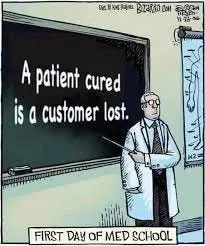
The more time I’ve spent in medicine, the more I’ve come to appreciate that many principles you see in business are not only replicated in medicine but inevitably will guide medical practice. The entire industry (and regulatory apparatus) is structured around this status quo, so anytime someone tries to deviate from it, countless stakeholders will emerge to oppose it.
This was best demonstrated by a 2018 report which provoked considerable public outrage when it was publicized by the mainstream media:
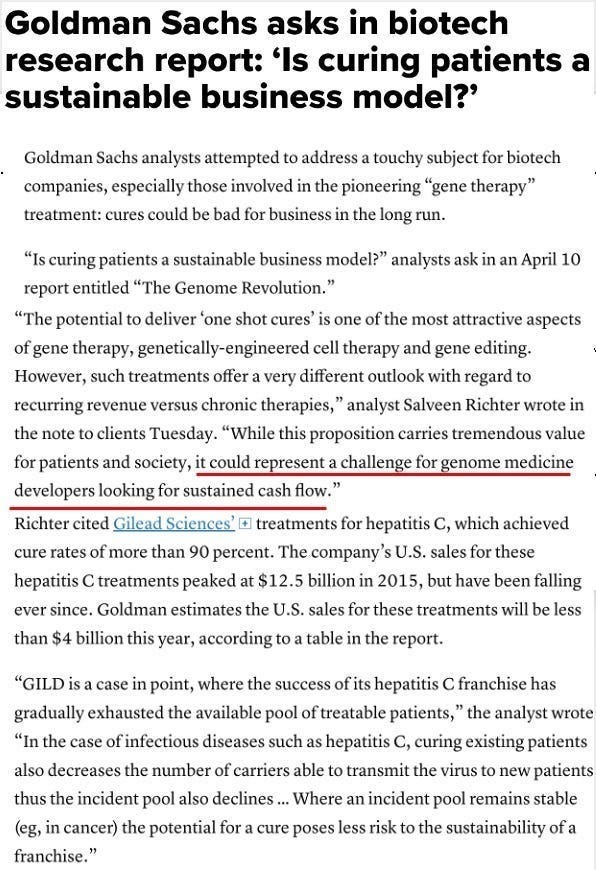
Note: while I can’t prove this, given how rarely the media will expose pharmaceutical misconduct, I believe the reason it did in this specific case was not to help the public but rather to send a message to the industry (and investors) to avoid curative genomic therapies.
All of this helps explain why the medical industry (and regulators) will only target competing therapies with the potential to meaningfully compete with their bottom line (e.g., we all saw what happened to the off-patent COVID-19 treatments like hydroxychloroquine and ivermectin).
Sadly, many even more consequential examples. For example:
• Ultraviolet blood irradiation cured a wide range of otherwise fatal bacterial and viral infections (and many autoimmune disorders), but as it was taking off across America’s hospitals, the American Medical Association tried to buy it, and once they couldn’t, successfully buried it (except in areas like Russia outside their monopoly).
• Sleeping medications have a wide range of issues which cause serious issues for their users, so once an effective (but un-patentable) one which restored people’s sleep and health (frequently to a profound degree) came into use, the FDA launched a relentless campaign that eventually outlawed it (detailed here).
• Oxidative therapies, like chlorine dioxide, when dosed appropriately, have shown remarkable efficacy against a variety of infectious diseases, along with certain ones (e.g., ozone) also showing significant efficacy against a variety of musculoskeletal issues, organ diseases and circulatory disorders. Yet, despite thousands of studies corroborating their use, the FDA treats them as toxic agents with no redeeming value, and any attempts to research these therapies (particularly chlorine dioxide) are obstructed.
• DMSO is safe and essentially free substance that rapidly heals injuries, cures a wide range of common debilitating problems (e.g., all types of pain, spine issues, most skin issues, most eye issues, gastrointestinal inflammation and many autoimmune disorders) along with addressing many otherwise incurable issues (e.g., stroke damage, paralysis, chronic lung disease, and many different neurodegenerative disorders). Yet, despite the life-changing properties of this substance, the FDA fought the public for decades (including at multiple Congressional hearings) to bury it, and as a result, few people know it is anything but an inert solvent widely used in research and to deliver pharmaceuticals (and an interstitial cystitis treatment).
While many other candidates exist too (e.g., many promising cancer therapies were blacklisted by the AMA and FDA), I believe DMSO’s story is likely the clearest case of the FDA suppressing something to maintain the status quo of profitable diseases being incurable (and requiring perpetual lucrative medical care). This is because roughly 15,000 studies (I am gradually compiling) show its efficacy across a wide range of illnesses and I have now received over 7000 thousand testimonials from readers who had a lifelong debilitating issue rapidly resolve with DMSO that are nearly identical to those the FDA received as the public begged them not to ban it.
Medical Sales Funnels
One of the most common critiques of the pharmaceutical industry is that the entire enterprise is a more sophisticated form of the addictive drug model: the drugs that are widely sold are designed to hook people for life and the immense lobbying the industry can afford effectively takes the place of cartel violence to maintain their market monopoly. Furthermore, unlike classic drug enterprises which have to market their products from the shadows, the state sanctioning of their business model makes it possible for them to publicly market the products to the entire society and buy out both the media and government so criticisms of their products are not allowed to be aired.
Note: other common criticisms include several of the largest pharmaceutical companies (e.g., Bayer via IG Farben) having been deeply entwined with Nazi Germany, and that many major pharma firms were once leading marketers and manufacturers of cocaine, methamphetamine, and heroin (Bayer famously marketed heroin as a “non-addictive” wonder drug1).
Fittingly, the medical profession has largely moved away from the language of “cure.” For centuries, major medical dictionaries either omitted a clear definition of “cure” or defined it only minimally.1,2 The word is also notably absent from the indexes of core references such as Merck’s Manual and Harrison’s Principles of Internal Medicine.1,2 In practice, physicians are strongly discouraged from promising or even declaring a “cure” in many contexts.1 You cannot be accused of failing to achieve something the profession rarely claims is possible.
Because of this, every successful pharmaceutical lies somewhere along a spectrum of being “addictive” to “ineffective.” Much of this results from the fact the body is designed to maintain homeostasis and resist unnatural alterations of physiology, so the human response to medications is frequently either: for the effect to be temporary, for progressively higher doses to be required, or for the body to shift to an unnatural baseline where it can no longer function without the artificial counterweight of the medication.
Note: sometimes additional steps are involved. For example, acid reflux frequently results from a lack of stomach acid (which prevents the top of the stomach from getting the signal to close) which argues for supplementing meals with stomach acid (that beyond frequently curing reflux, provides numerous other health benefits). However, rather than do this, the preferred approach is to completely suppress stomach acid production so nothing is there to reflux, making it very difficult to stop the medications because once small (insufficient) amounts of acid return, they will reflux and cause heartburn.
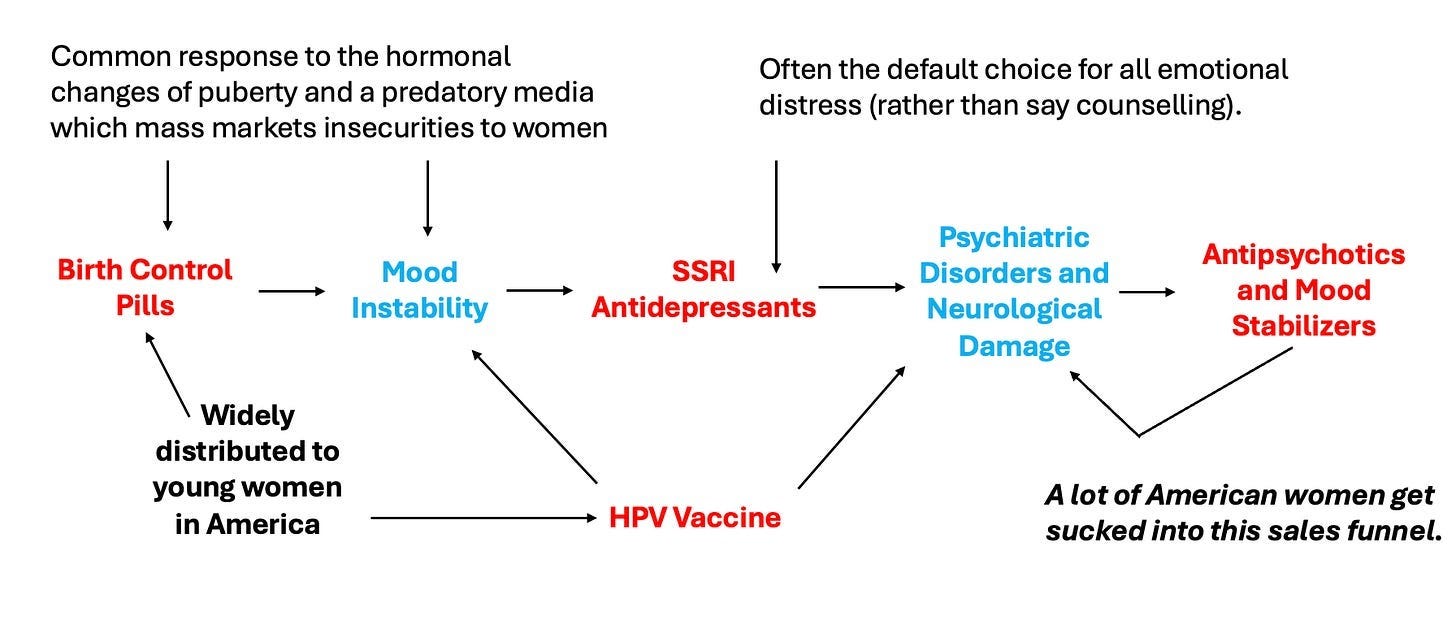
Beyond the design of pharmaceutical drugs inevitably producing side effects, those side effects are often actually an upside for the industry because they create additional problems that require other drugs to treat, hence creating a robust “sales funnel.” General practitioners not only provide a steady stream of patient referrals to more expensive medical services, but also give patients tests that convert a significant number into taking common lifelong drugs (which half of American adults are on at least one of1).
Copyright © A Midwestern Doctor
 The Delusional Premises of Woke Greens