


The Coming Precious Metals Shock Could Reshape the Global Economy
August 5, 2026
Three years ago, the prevailing assumption across Wall Street, the City of London, and most government institutions was remarkably simple: inflation would normalize, supply chains would heal, interest rates would eventually decline, and precious metals would once again retreat into the background as investors chased higher returns elsewhere. Gold, according to that narrative, had already enjoyed its moment. Silver, despite its indispensable role in modern industry, was expected to settle back into a familiar cycle of moderate demand and predictable pricing. Instead, 2026 has produced a far more unsettling reality. Gold has repeatedly demonstrated that even record-breaking prices have not been sufficient to discourage institutional accumulation, while silver continues to face a structural supply deficit for the sixth consecutive year—a situation that is becoming increasingly difficult for manufacturers, traders, and policymakers to dismiss as a temporary imbalance. These are no longer isolated developments confined to commodity exchanges; they are signals of a financial environment in which confidence itself is quietly becoming a contested asset.
 Bushcraft 101: A Field...
Best Price: $10.37
Buy New $7.73
(as of 01:25 UTC - Details)
Bushcraft 101: A Field...
Best Price: $10.37
Buy New $7.73
(as of 01:25 UTC - Details)
 What makes this moment particularly uncomfortable is not the spectacular rise in precious metals alone. Markets have always experienced dramatic rallies before eventually correcting. The more important question is why demand has remained remarkably resilient despite conditions that, historically, should have weakened it. Interest rates in many developed economies remain elevated compared with the previous decade. Economic growth forecasts have been revised lower across several major regions. Consumer spending is beginning to show signs of fatigue, while businesses continue navigating higher financing costs, geopolitical uncertainty, and increasingly fragmented trade relationships. Under such circumstances, conventional economic models would normally predict softer investment flows into defensive assets. Yet central banks continue adding gold to their reserves, institutional investors remain reluctant to reduce strategic allocations, and physical demand continues to absorb supply at levels that suggest something more profound than routine portfolio diversification.
Perhaps the most revealing aspect of this story is that it is unfolding almost entirely outside the headlines dominating mainstream financial news. Artificial intelligence, equity valuations, political campaigns, and quarterly earnings reports continue attracting the overwhelming share of public attention, while the foundations supporting the global monetary system are shifting with surprisingly little discussion. The world’s central banks have spent years gradually increasing their gold holdings, motivated not by nostalgia for the gold standard but by a growing desire to diversify away from geopolitical risk, currency uncertainty, and an increasingly fragmented international financial order. At the same time, industrial demand for silver has accelerated well beyond its traditional role as a precious metal. Every expansion of solar manufacturing, every investment in advanced electronics, data infrastructure, electric vehicles, power grids, and next-generation semiconductor technologies quietly increases dependence on a resource whose supply has struggled to keep pace with consumption.
The numbers alone paint a picture that deserves considerably more attention than it has received.
GLOBAL PRECIOUS METALS SNAPSHOT — 2026
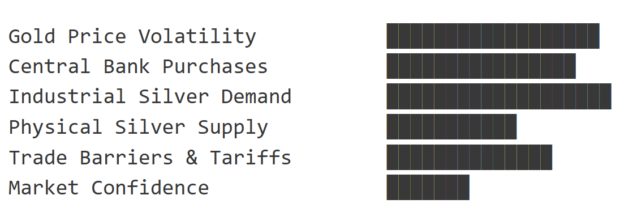
None of these indicators should be interpreted in isolation. Their significance emerges only when viewed together, because each reinforces the pressure created by the others. A stronger appetite for physical gold reduces available liquidity. Persistent deficits in the silver market force industrial consumers to compete more aggressively for finite supplies. Rising tariffs increase production costs throughout global manufacturing networks. Slowing economic growth leaves governments with fewer fiscal options just as public debt continues reaching unprecedented levels. Each development amplifies the next, creating a feedback loop that becomes progressively more difficult to reverse without imposing meaningful economic costs.
For decades, globalization functioned on a relatively straightforward assumption: efficiency would always outweigh politics. Manufacturers optimized production wherever labor was cheapest, shipping was fastest, and regulations were least restrictive. Precious metals flowed through international markets with comparatively limited friction, allowing refiners, technology companies, automotive manufacturers, and energy producers to plan years ahead with a reasonable degree of certainty. That assumption is now steadily eroding. Trade disputes between the United States and China have evolved far beyond tariffs on consumer goods. Strategic resources, advanced technologies, critical minerals, and industrial metals have increasingly become instruments of geopolitical leverage rather than ordinary commercial products. Every new restriction introduced by one government invites retaliation from another, gradually replacing decades of economic integration with an environment defined by strategic competition.
This transformation matters far more than most investors appreciate because neither gold nor silver exists in isolation from the broader economy. Gold reflects confidence in financial systems; silver reflects the operational health of industrial civilization itself. When both begin sending warning signals simultaneously, ignoring them becomes considerably more difficult. Gold continues attracting buyers seeking protection against uncertainty, while silver remains essential for industries that governments simultaneously describe as critical to future economic growth. That combination creates an unusual contradiction: economies desperately need affordable silver to support renewable energy, digital infrastructure, defense manufacturing, and advanced electronics, yet the market responsible for supplying that metal has spent years operating in structural deficit. The longer this imbalance persists, the greater the likelihood that price volatility becomes not an exception but a defining feature of the decade.
When the Vaults Start Speaking Louder Than Governments
There is another reason why experienced commodity traders have become increasingly reluctant to dismiss the current environment as just another cyclical rally. Gold and silver are behaving differently because the forces driving them are no longer confined to inflation alone. A decade ago, price movements could often be explained through monetary policy or fluctuations in the U.S. dollar. Today, that explanation feels incomplete. The market is reacting to an accumulation of pressures that extend well beyond interest rates, creating an environment in which every geopolitical shock, every tariff announcement, every disruption to industrial supply chains and every unexpected policy decision reinforces an already fragile equilibrium instead of restoring confidence.
Several developments have quietly converged over the past twelve months, each significant on its own, but considerably more alarming when viewed as part of the same economic landscape.
• Central banks continue treating gold as a strategic reserve rather than a speculative investment. While public attention remains focused on equity markets and artificial intelligence, monetary authorities have maintained historically elevated purchases, reinforcing the perception that sovereign institutions are preparing for a future in which reserve diversification becomes increasingly important.
• Silver remains trapped in a structural supply deficit. The global market has now spent years consuming more silver than mines and recycling operations are consistently able to replace. Unlike gold, much of the silver used in electronics, medical equipment, solar panels and advanced manufacturing disappears into industrial applications where recovery is neither immediate nor economically efficient.
 SAS Survival Handbook,...
Best Price: $12.99
Buy New $12.49
(as of 01:15 UTC - Details)
SAS Survival Handbook,...
Best Price: $12.99
Buy New $12.49
(as of 01:15 UTC - Details)
• Trade fragmentation continues raising production costs across multiple sectors. The gradual expansion of tariffs, export controls and strategic restrictions between major economies has transformed global manufacturing into a far less predictable system than it appeared only a few years ago. Companies are no longer optimizing solely for efficiency—they are increasingly optimizing for resilience, even if resilience comes with substantially higher costs.
• Public debt continues expanding while fiscal flexibility continues shrinking. Governments facing slower economic growth have fewer politically acceptable options available. Raising taxes risks slowing investment, cutting spending risks recession, and increasing borrowing only postpones the pressure into future fiscal cycles.
Individually, none of these developments guarantees financial instability. Collectively, however, they reveal something considerably more uncomfortable: the margin for policy mistakes has become remarkably thin. Every additional disruption now arrives in an environment where inventories are tighter, borrowing costs remain elevated, geopolitical cooperation has weakened and confidence can evaporate far faster than policymakers are able to restore it.
China represents perhaps the clearest illustration of this new reality. For decades, its extraordinary industrial expansion reshaped demand for virtually every strategic commodity on Earth. Steel, copper, rare earth elements, lithium, silver and gold all became intertwined with the country’s manufacturing engine. Yet today’s Chinese economy is navigating a far more complex landscape than the one that fueled its historic growth. Property-sector weakness, cautious consumer spending and slowing export momentum have forced policymakers into an increasingly delicate balancing act. At the same time, Chinese investors have continued demonstrating a remarkable preference for physical gold whenever uncertainty surrounding domestic financial markets intensifies. That behavior is not irrational. It reflects a familiar instinct repeated throughout modern financial history: when confidence in conventional assets weakens, tangible stores of value regain their appeal regardless of price.
The United States faces a different, though equally challenging, set of pressures. The American economy remains one of the most resilient in the world, supported by deep capital markets, technological leadership and the continued dominance of the U.S. dollar. Yet resilience should not be confused with immunity. Persistent federal deficits, rising interest expenses on government debt, political polarization and ongoing trade disputes have created an environment where fiscal decisions are becoming progressively more expensive. Every percentage point increase in borrowing costs reverberates across trillions of dollars in outstanding obligations. Meanwhile, manufacturers attempting to rebuild domestic supply chains often encounter higher labor costs, more expensive imported components and growing uncertainty surrounding access to strategic raw materials.
 The Off-Grid Family Su...
Check Amazon for Pricing.
This is where silver quietly re-enters the conversation in a way that many investors still underestimate. Unlike gold, whose value is largely financial, silver sits at the intersection of investment demand and industrial necessity. A solar manufacturer cannot simply replace it without affecting efficiency. Semiconductor producers, medical technology companies, defense contractors and advanced electronics manufacturers all depend upon properties that few alternative materials can fully replicate at scale. Every additional megawatt of renewable energy capacity, every expansion of artificial intelligence infrastructure requiring advanced electronic components, every modernization of electrical grids adds another layer of structural demand to a market that has struggled for years to achieve equilibrium.
The Off-Grid Family Su...
Check Amazon for Pricing.
This is where silver quietly re-enters the conversation in a way that many investors still underestimate. Unlike gold, whose value is largely financial, silver sits at the intersection of investment demand and industrial necessity. A solar manufacturer cannot simply replace it without affecting efficiency. Semiconductor producers, medical technology companies, defense contractors and advanced electronics manufacturers all depend upon properties that few alternative materials can fully replicate at scale. Every additional megawatt of renewable energy capacity, every expansion of artificial intelligence infrastructure requiring advanced electronic components, every modernization of electrical grids adds another layer of structural demand to a market that has struggled for years to achieve equilibrium.
The contradiction becomes impossible to ignore. Governments around the world continue announcing ambitious industrial strategies built around electrification, digital infrastructure, renewable energy and technological independence, while simultaneously operating within a commodity market where one of the most critical industrial metals remains persistently constrained. If demand continues expanding faster than supply, higher prices become less a temporary anomaly than an unavoidable economic adjustment—one that eventually filters into manufacturing costs, consumer prices and corporate investment decisions alike.
 OLLY Women’s Mul...
Check Amazon for Pricing.
OLLY Women’s Mul...
Check Amazon for Pricing.
 Natureu2019s Way Sambu...
Buy New $11.19
(as of 02:10 UTC - Details)
Natureu2019s Way Sambu...
Buy New $11.19
(as of 02:10 UTC - Details)
 Nature’s Bounty ...
Check Amazon for Pricing.
Nature’s Bounty ...
Check Amazon for Pricing.
 Metamucil Fiber Gummie...
Check Amazon for Pricing.
Metamucil Fiber Gummie...
Check Amazon for Pricing.
Copyright © Preppgroup
 Tensions Flicker Into Flame, Lapping Across the Middle East