


How To Determine the Risks and Benefits of Each Vaccine
Knowing how vaccines work is necessary for understanding which ones are likely to help, which ones are likely to harm, and the forgotten alternatives to immunization they medical industry buried.
August 4, 2026
I’ve held a longstanding belief that regardless of how strongly I feel about one side of a debate, effort should be made to understand both sides of an argument, as normally, valid points are raised by both parties and you can provide a much more effective and persuasive case for your position if you are able to clearly elucidate how the other has gone awry rather than simply dig into your pre-existing position.
So, despite my strong personal objections to vaccination and my belief their harms greatly outweigh their benefits, I have spent a lot of time trying to understand the case for vaccination, and more importantly how it varies for each vaccine (as some are much more egregious than others). Unfortunately, much in the same way medicine’s mantra is “all vaccines are safe and effective” (an extremely nebulous statement) the vaccine brand is treated as a homogenous entity where every single one is “good” simply by virtue of being a vaccine, and as such, surprisingly little information is available to objectively assess the merits of each individual vaccine—rather, all complications of vaccines are treated as being unrelated to the vaccine unless extraordinary efforts are gone to establish them, whereas extremely whimsical assumptions are made to establish their benefits and any complication of any infectious disease is nearly always attributed to the individual (or those around them) not vaccinating.
Because of this, one of the most common questions I receive is “which vaccines should I give my children” as parents who have become skeptical of vaccination essentially have nothing to go off besides a general distrust of vaccination and fearmongering from the medical community over the dangers of not vaccinating.
At the same time, this paradigm is somewhat understandable, as calculating the benefit and risks of a vaccine is quite challenging, as it requires you to know the following:
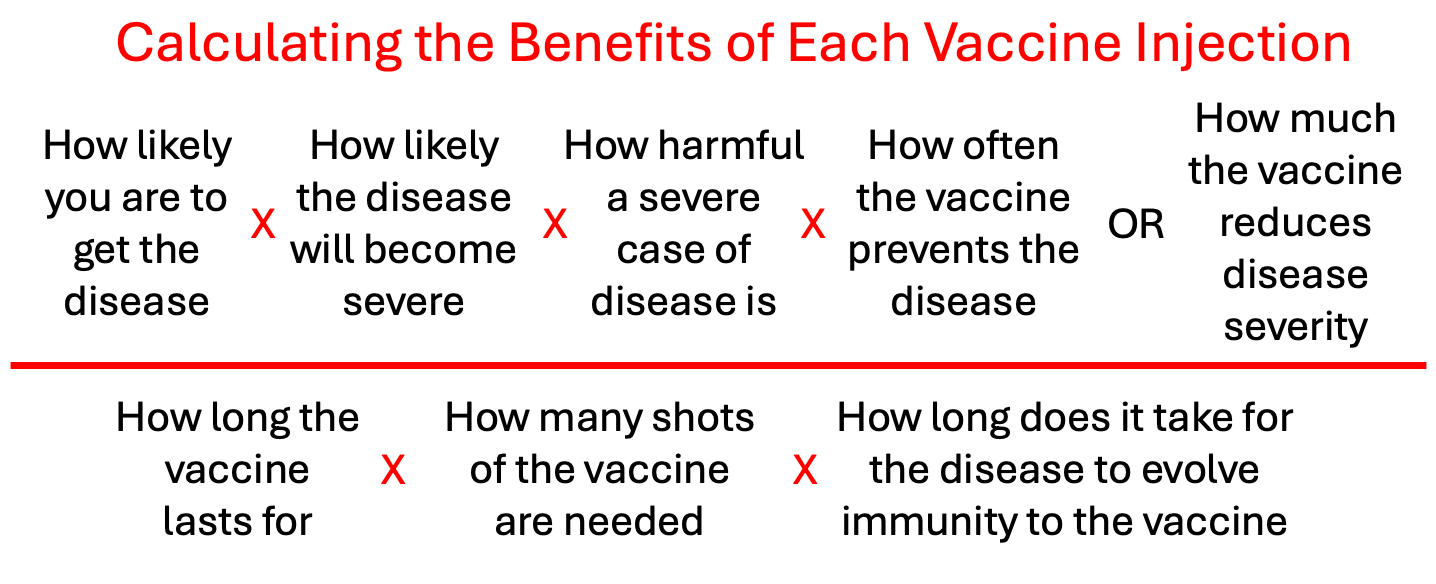
Note: in the above calculations, medicine typically assume the vaccine preventable disease is “incurable,” whereas in reality, non-standard (and sometimes conventional) therapies often exist which can treat the rare cases that turn into a problem (significantly decreasing the actual justification for any vaccine).
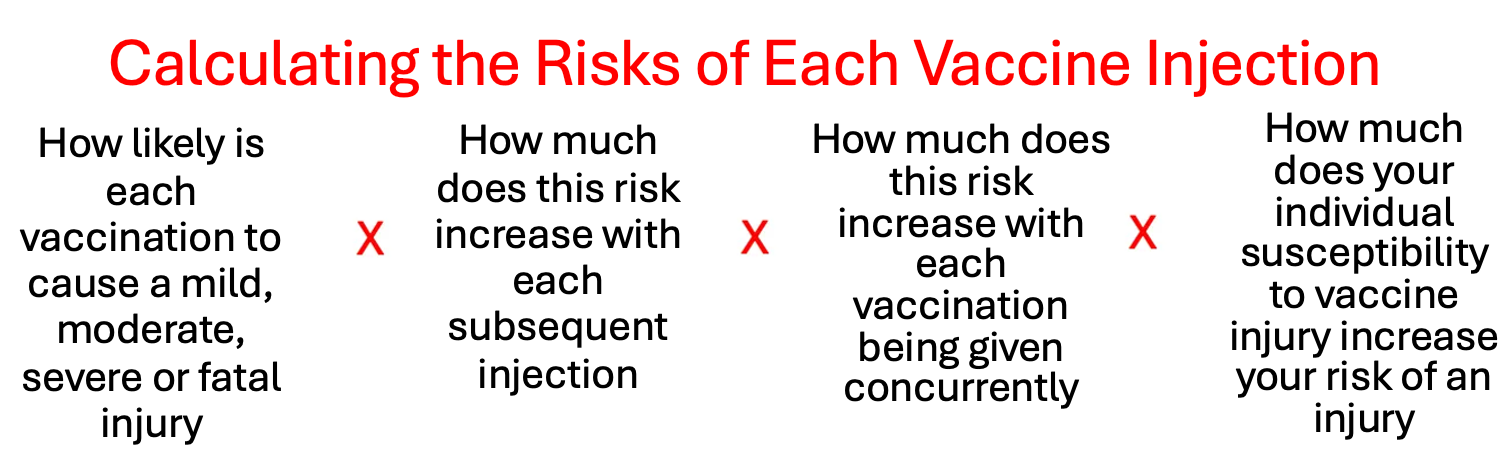
Note: one common vaccine injury is OAS immune suppression which reduces your resistance to other strains of the disease and hence subtracts from the net “benefit.” Likewise, research has repeated shown that if one is currently infected with a disease, vaccinating increases their risk of a severe infection (which was “solved” by not testing for infections beforehand to preserve vaccine sales).
One of the many aggravating things I’ve long noticed about the vaccine program is that the information needed to make this calculation is never made readily available. For example, a few years ago, someone shaping public policy asked me if COVID was more dangerous than the flu. Answering this required me to know how deadly each was, and as I showed here, I eventually discovered no one actually knows how deadly the flu is (the estimates vary widely, and fatalities are typically less than 0.1% of cases that progress enough to become symptomatic)—something I found quite surprising, given that the CDC dedicates a large portion of their resources each year to expounding the dangers of the flu so we will vaccinate.
In turn, rather than objectively showing the risks and benefits of a vaccine, the medical community focuses on a few components of the above equation to create the impression there is a massive danger from not vaccinating (e.g., Merck convinced women around the country to be terrified of cervical cancer despite it being fairly rare) and that there is minimal risk from vaccinating, or in lieu of that theoretical arguments lacking data which suggest vaccination has merit. For example, the HPV vaccine, by increasing the immune system’s attack on HPV, could potentially reduce cervical cancer, but trial data that directly showed this was never provided, and it is unclear from the existing data sets that have followed decades of Gardasil if the vaccine increased, decreased or had no effect on (the rare to begin with) cervical cancer rates.
As such, we have a reality where the case for many of the vaccines on the schedule is quite weak, and many are for more likely to injure you than the actual infection—but despite this being readily apparent to an outside observer (particularly one who has been injured), most medical professionals carry a diametrically opposed world view which firmly believes vaccines are safe, effective, and necessary and are almost never willing to research the actual risks and benefits of a vaccine.
Note: during medical training, students are expected to memorize a massive amount of information and repeat it verbatim to the doctors supervising them (without showing any doubt or skepticism in it). Because of this, extremely complex subjects with vast nuance are distilled into simple facts or “if A then B” statements they are effectively forced to commit to memory rather than taking far more time to explore and question, after which the social status attached to being a doctor and medical expert cements the validity of their approach (memorizing accepted medical facts without critically examining them), particularly since “cognitive dissonance” makes doctors reluctant to consider what they worked so hard to learn was wrong or that they had injured their patients. This dynamic understandably makes many people loathe physicians who are close minded to facts which fall outside their training, but I feel the system was designed so that nearly anyone who goes through that training would think in this manner, so rather than resent those doctors, I primarily extend gratitude for the physicians whose minds are evolved enough to have the flexibility to break through this conditioning.
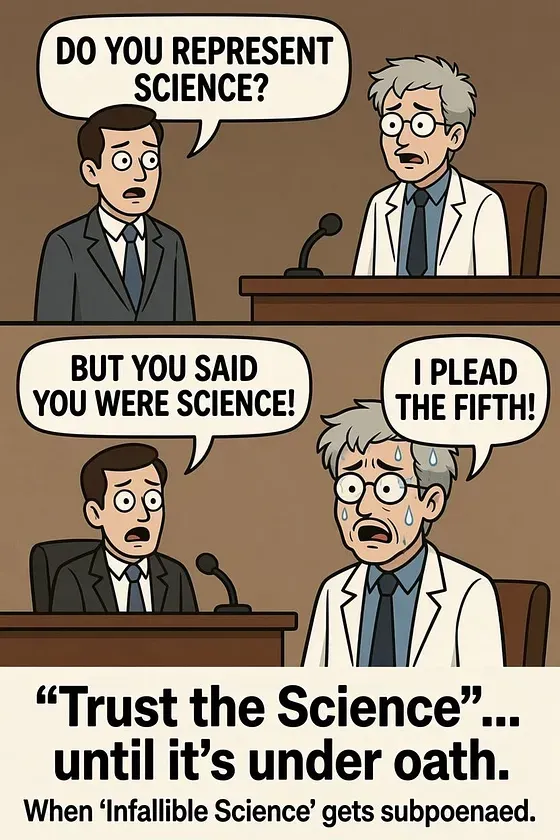
In short, we essentially have a system where we are expected to follow science (with legal penalties for not doing so) but rather than “science” being the result of an objective and critical examination of data, we instead are expected to trust the perspectives of experts who have evaluated that data but will not make it available to us (e.g., Steve Kirsch and ICAN spent years going to great lengths to get the government data on COVID vaccine injury and efficacy, often having to rely upon leakers, because governments simply would not provide any data which undermined the justification for the vaccination program).
Somewhat ironically, Fauci (who had proclaimed he “represented science” to frame any questions of his positions as “attacks on science”) recently provided an excellent metaphor of this dynamic, as in response to over a hundred questions, Fauci pled the fifth.
Additionally, after I sent out Thursday’s article on Fauci’s testimony, I was informed about something else I felt I had to share about it:
Twenty-two years ago, Dave Chapelle predicted Anthony Fauci’s Senate testimony. pic.twitter.com/IQdoN4oMlX
— A Midwestern Doctor (@MidwesternDoc) July 31, 2026
Hepatitis B
One of the more egregious vaccinations on the schedule is newborn hepatitis B, so when I learned Trump wanted it off the schedule, to help with that effort, I spent a lot of time, via official sources, trying to calculate the actual risks and benefits of the newborn hepatitis B vaccination (which I detailed here). To summarize that article:
Since hepatitis B is transmitted through blood to blood contact (e.g., sharing drug needles or unprotected sex), it’s difficult to justify giving it to newborns who will never do any of that. So, presently, the justifications are as follows:
1. It will prevent newborn infants from catching hepatitis B from their mothers during delivery when their immune system is too weak to resist the infection.
2. It will prevent young children from catching hepatitis B, either from family members or outside (e.g., touching an infected drug needle in a playground).
3. If an infant gets a hepatitis B infection, they run a real risk of it becoming a chronic hepatitis B infection (which causes a variety of problems including liver failure).
4. Hepatitis B vaccination has caused a massive drop in acute hepatitis B cases in adults, and hence creates a massive drop in chronic hepatitis B in infants.
The problems with the first (primary) argument are:
• Pregnant mothers are routinely screened for hepatitis B, so a benefit can only be found in the odd cases where the test is either not done or has a false negative.
• It is not guaranteed a child will catch hepatitis B from their mother, and giving the vaccine to a child at birth born to a hepatitis B positive mother only partially protects them from catching the disease (which is why it is typically is given alongside antibodies designed to increase the likelihood of preventing transmission).
• Hepatitis B is fairly rare outside of a few key demographics (e.g., Southeast Asian immigrants—which was a real issue following the influx of Vietnam War refugees).
• The form of hepatitis B which is more likely to transmit to infants is fairly rare, and something the vaccine is significantly less effective against.
In turn, when I looked through all the available official (e.g., CDC) data (which likely overestimates the need for vaccine), I discovered a significant number of data points which should have been worked out to assess the benefit of the vaccine never were, but if you took the mid-point of the ranges given for each of those coincidences lining up, you had to vaccinate roughly 1 million infants to prevent 1 case of mother to infant hepatitis B transmission, and 6.5 million infants to prevent one case of chronic hepatitis B—which means you cannot justify the program unless the vaccine has a less than 1 in 10 million chance of causing a severe injury.
However, while I watched the coverage of this discussion, the media simply amplified things like doctors stating there was no evidence the vaccine caused harm, a Vietnamese doctor who got hepatitis B from her parents testifying at the ACIP committee meeting she would have given anything to have been given the vaccine at birth and not have to live with hepatitis B, or Senator Cassidy discussing the horrors of chronic hepatitis B and citing wildly incorrect figures and the likelihood it would transmit to the infant.
Similarly, the other justifications for newborn vaccination are equally unfounded:
• In one study of 274 children who pricked themselves with drug needles in a playground (which is a rare occurrance), none developed hepatitis B (including cases from known carriers), in a review of studies spanning 1,565 instances, only one needlestick was potentially linked to catching hepatitis B, and throughout the literature, I could only find one case of this ever conclusively happening (making this significantly rarer than being hit by lightning).
• The decline in acute hepatitis B following adult vaccination was also seen with Hepatitis C (which is not vaccinated for but spreads in a similar manner as hepatitis B) suggesting other public health policies may account for the decline.
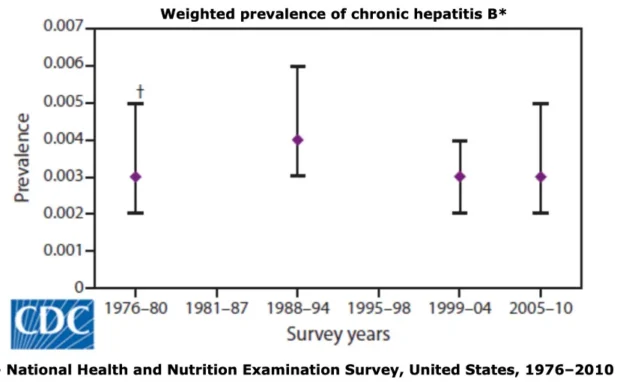
•Despite decades of the program, there has been no decrease in chronic hepatitis B (the ultimate justification for the program). This, I suspect, results from the fact a small portion of people do not respond to the vaccine, and those individuals who progress from acute to chronic hepatitis B share the same underlying immune dysfunction (effectively making it impossible for vaccination to achieve its ultimate goal as it cannot protect those who need protection)—a recurring issue with vaccination seen ever since the original smallpox vaccines.
Note: many suspect the newborn hepatitis B program was mass introduced to provide a larger market for Merck than homosexuals and IV drug addicts at risk for Hepatitis B or to prevent newborn hepatitis B transmission in Vietnamese refugees (both of which are plausible). However, an ACIP insider shared with me it was actually done to reduce Hepatitis B transmission in inner city youth engaged in risky behaviors (which was a public health issue) under the theory that they were unlikely to come in for vaccination appointments, so a blanket newborn hospital immunization policy was the only thing that could reach them, with newborn transmission then being concocted to justify that blanket policy.
Given this low benefit, extensive safety research should have been conducted to ascertain its safety and if it meets the “1 in 10 million threshold.” However, despite decades of pleas for this to happen (including from the IOM), other than studies tracking symptoms for 4-5 days after vaccination (where depending upon the symptom, 10-30% of recipients experience them, including some that can be quite serious in a neonatal context) nothing has been done.
At the same time, many datasets have shown there are more deaths each year immediately following the vaccine than (far less serious) cases of newborn hepatitis B transmission, and that many autoimmune diseases (particularly MS) have been repeatedly observed to follow the vaccine as its antigen matches human myelin (e.g., a buried 2005 study found that 60% of its recipients also developed immune reactivity to the myelin coating their nerves—which in the majority of cases persisted for over 6 months, while an unpublished 1999 study found newborn hepatitis B vaccination increased the risk of autism by 12.35X—with many other studies finding a comparable increase in developmental disability).
Corroborating this, a 1999 Congressional hearing featured many witnesses severely injured by the injection and a 1999 ABC investigation (aired prior to the pharmaceutical industry buying out the media in an era where segments on vaccine injury were routinely aired) highlighted many of the dangers of the hepatitis B vaccine.
Yet, despite all of this and the newborn hepatitis B vaccine long being one of the most unpopular vaccines, the medical community has continually circled wagons around it, has almost no knowledge of any of the previously mentioned data (rather they view hepatitis B vaccination as one of public health’s crowning achievements) and over the years, I’ve heard numerous reports from parents (and readers here) who gave birth at a hospital of their child either being vaccinated against their consent while separated from the mother (with developmental disability following in some cases) or being threatened with CPS involvement if they did not vaccinate.
In short, the hepatitis B example demonstrates that the medical community does not accurately provide the risks and benefits of vaccination, and were they to do so, parents would likely decline many vaccines.
Justifications for Vaccination
Our society has a very weird obsession with vaccination, many (myself) included have likened to a dogmatic religion. I believe this ultimately results from:
• After Christianity stopped being the shared foundation of our society, something had to fill the void, and “science” stepped in—shifting from a method for uncovering reality into a dogmatic pseudo-religion that claims exclusive ownership of truth (often for money and power). Medicine became a core pillar of that system as it offered the modern version of miracles (against death and disease), and vaccines took on the role of the ritual that marks you as one of the faithful by baptizing you into the faith.
• Much of the credibility and social status of Western medicine (and arguably the Western order itself) rests on the story that science and medicine conquered the dark ages of disease and lifted us out of the primitive conditions that kept everyone trapped in sickness and early death. Admitting that vaccines were actually counterproductive would therefore be existential suicide for the medical profession.
• In the early days of medicine (when infectious disease ran rampant due to poor sanitation and living conditions), there were very few options for treating them, and the main ones that existed—serums and vaccines—had major issues (e.g., partial efficacy and severe toxicity) that made them far from perfect From having read through all the historical documentation, I believe the physicians and public health officers of that time regretted the harm those early treatments caused, but gradually felt forced to adopt a callous attitude that viewed the harm as a necessary sacrifice for the benefit those therapies created, and once this mentality cemented, it persisted long after the need for those therapies had disappeared (e.g., diphtheria used to be a major killer—now it’s non-existent but we still vaccinate for it) and much better solutions had appeared.
Note: likewise, I believe the reason why allergies are the one accepted contraindication to vaccination is due to the fact allergic reactions (to the early unpurified vaccinations) was a major recurring issue (and at some point in the future I will publish all the examples and studies Sir Graham Wilson collected on this).
• Governments tend to excel at top down measures their force and power can be leveraged to administer rather than bottom up grass roots approaches (which are often necessary to fix the health of the society). Vaccines are the quintessential top-down approach as they provide the promise a tangible health benefit can be achieved through the tools at their disposal (and as mandates are needed, feed into the need for power and control that inevitably emerges in governance). Because of this, you see a surprising number of people in government and public health get sucked into the belief “all our health problems would go away if we just vaccinated more people” whose focus largely shifts towards whatever can be done to increase vaccination rates (even in instances where the vaccine fails to live up to its initial promises and the goalposts have to keep being moved).
Note: a recurring theme in government is that they will be tasked with solving a problem but only have an imperfect solution available. In these cases, rather than improve the solution, they will use the power of the state to force the solution to “work” in manner akin to using a hammer to pound a square peg through a round hole.
• While most infectious diseases we vaccinate for can be treated with conventional or natural methods, in many cases, parents do not know how to spot the early signs of the disease or have immediate access to effective therapies. As such, I always consider that while this point does not apply to me, for many others who lack the resources I am fortunate to have, vaccines do provide a critical safety net (although I could see AI greatly reducing the value of this as the early red flags are easy for it to detect if queried).
• In some cases, vaccine arguably provided a public health benefit (particularly if their harms are ignored), so per the inevitable human tendency to confirmation bias, these positive aspects of these examples are always focused on rather than the litany of forgotten failures and catastrophes1,2 seen throughout the history of immunization.
Note: a case can also be made the justification for vaccination is far more malignant (e.g., reducing fertility, causing chronic illness that creates lifelong medical customers, it being a religious sacrifice mirroring that seen in other societies like the Aztecs or blunting the consciousness of children so they are easier to control), but ultimately, I have no way to know why things are the way they are.
Copyright © A Midwestern Doctor
 Dr. Fauci Clams Up