The Three SHTF Scenarios That Could Change the World Faster Than Anyone Expects!

By Madge Waggy
MadgeWaggy.blogspot.com

July 4, 2026

For decades, the greatest threats to global stability were often imagined as distant possibilities—events reserved for history books, military simulations or the darkest years of the Cold War. Today, that assumption is becoming increasingly difficult to defend. International defense spending has reached levels not seen in decades, armed conflicts continue to reshape regional security architectures, and governments across Europe, North America and Asia are investing heavily in civil defense, cybersecurity and the protection of critical infrastructure. These are not preparations made in anticipation of ordinary times, but responses to a world that has become measurably more volatile than it was only a few years ago. The First-Time Gardene... Sowards, Jessica Check Amazon for Pricing.

History offers a sobering reminder that societies are rarely transformed by a single catastrophic event. More often, they are changed by a sequence of crises that appear unrelated until they begin reinforcing one another—geopolitical confrontation, economic instability, infrastructure failures and the gradual erosion of public confidence. Whether viewed through the lens of preparedness, national security or historical precedent, one conclusion remains remarkably consistent: the most consequential moments are often recognized only after they have already begun.

Top Three Unstoppable SHTF Scenarios

Three crises that could change everyday life faster than most people believe possible.
1. Nobody Notices the Beginning

One of the biggest misconceptions about large-scale disasters is that they begin with a single dramatic event. Movies have trained us to expect sirens, mushroom clouds and emergency broadcasts interrupting television programming. Reality has been far less theatrical. Most crises begin quietly, almost anonymously, disguised as temporary inconveniences that appear manageable until they suddenly aren’t.

Think back to the first weeks of 2020. News reports about an unfamiliar virus circulated for weeks before most people paid attention. Outside a handful of specialists, almost nobody seriously believed that international travel would stop, businesses would close overnight or supermarket shelves would be stripped bare by ordinary shoppers. Looking back now, it’s easy to say the warning signs were obvious. At the time, they blended into the constant flow of headlines competing for attention every single day. That pattern has repeated itself throughout history. Major disruptions rarely arrive without warning; they arrive surrounded by so much background noise that almost nobody recognizes them until hindsight turns scattered events into an obvious timeline. The All In One Amish S... Zook, Ephraim Check Amazon for Pricing.

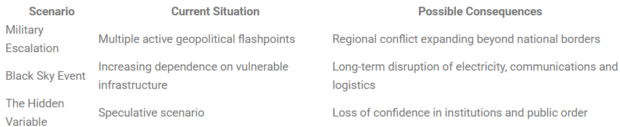
The reason this matters is that the international situation entering the second half of the decade feels unusually crowded with risks that, taken individually, don’t necessarily point toward catastrophe. The war in Ukraine continues to reshape European security policy. Military spending has increased across much of NATO, while countries that had spent decades reducing their armed forces are now expanding recruitment and rebuilding stockpiles of ammunition. In Asia, naval activity around Taiwan has become more frequent, North Korea continues to invest in its missile program, and governments throughout the Pacific are preparing contingency plans that would have sounded alarmist only a few years ago. None of those developments automatically lead to global conflict, but together they create an environment where a single mistake could carry consequences well beyond the region where it begins.

Military planners have long argued that modern wars are less likely to start with a formal declaration than with a sequence of rapidly escalating incidents. A cyberattack disables part of a communications network. Intelligence services detect unusual military movements that may—or may not—be routine exercises. Satellite images are interpreted differently by opposing governments, each convinced the other is preparing to move first. Political leaders are then forced to make decisions in real time while operating with incomplete information, knowing that waiting too long carries risks, but acting too quickly may trigger the very crisis they hope to avoid. History contains numerous examples of conflicts that expanded not because every participant wanted war, but because every participant believed the other side had already decided that war was unavoidable.

2. The Black Sky Event

Few people spend much time thinking about the electrical grid. It is one of those systems that exists almost entirely in the background, quietly supporting modern life without demanding much attention from the people who depend upon it every single day. Flip a switch, and the lights come on. Open a banking application, and a payment is processed within seconds. Order groceries online, and thousands of decisions involving warehouses, logistics companies, transportation hubs and inventory management systems unfold without ever becoming visible to the customer. The greatest achievement of modern infrastructure may not be its scale, but its ability to disappear into everyday life. Only when one part of the system stops working does the extraordinary complexity behind ordinary routines become impossible to ignore.

That complexity has become increasingly difficult to overlook during the past several years. Governments have invested heavily in strengthening electrical networks, protecting telecommunications infrastructure and improving cybersecurity across both public and private sectors. The motivation is not difficult to understand. Modern economies rely upon systems that exchange enormous amounts of information every second, balancing electricity demand, coordinating transportation schedules and synchronizing financial transactions with remarkable precision. A disruption affecting one network rarely remains confined to a single location. Even relatively localized failures can create unexpected consequences elsewhere, not because the systems are fragile by design, but because they have become deeply interconnected through decades of technological progress.

The idea behind what preparedness communities have often described as a “Black Sky” event does not begin with a spectacular disaster. Instead, it unfolds gradually, almost quietly, in a manner that resembles the opening stages of previous crises. A regional outage lasts longer than utility companies initially expected. Mobile networks become unreliable across several metropolitan areas. Electronic payment terminals begin experiencing intermittent interruptions, forcing businesses to accept only cash while technicians investigate the source of the problem. Distribution centers report delays after software responsible for routing deliveries starts producing inconsistent data. None of these developments appears catastrophic on its own. Each can be explained individually. Together, however, they begin creating a pattern that attracts far more attention than any isolated incident would have received only days earlier.

Early Developments

  1. Electrical disruptions spread beyond the area where they first appeared.
  2. Communications become increasingly inconsistent rather than failing completely.
  3. Retail supply chains begin experiencing delivery delays.
  4. Financial institutions introduce temporary safeguards while investigating technical anomalies.
  5. Emergency services activate contingency procedures designed for prolonged infrastructure failures.

What makes the situation increasingly difficult to interpret is the speed at which uncertainty travels. Modern societies produce an extraordinary volume of information every hour, yet during periods of disruption the demand for answers almost always exceeds the supply of verified facts. News organizations rely upon official briefings that evolve as new information becomes available. Independent analysts compare satellite imagery, transportation data and publicly available infrastructure reports, frequently arriving at different conclusions. Social media platforms amplify eyewitness accounts from thousands of locations simultaneously, mixing accurate observations with misunderstandings, speculation and deliberate misinformation until distinguishing one from another becomes a challenge in itself. Bushcraft 101: A Field... Canterbury, Dave Best Price: $10.37 Buy New $7.73 (as of 01:25 UTC - Details)

History suggests that confidence can become as important as physical infrastructure during moments of uncertainty. Supermarkets rarely maintain weeks of inventory because modern logistics have made constant replenishment far more efficient than long-term storage. Fuel stations depend upon scheduled deliveries arriving with remarkable consistency. Pharmacies receive regular shipments that reflect predictable patterns of demand. Hospitals coordinate supplies through sophisticated procurement systems designed around uninterrupted transportation. Under ordinary circumstances, these arrangements represent one of the greatest strengths of the global economy. During periods of sustained disruption, however, even modest delays can begin affecting sectors that appear unrelated at first glance.

As reports continue emerging from different regions, attention gradually shifts away from the original outages toward the broader question of resilience. Engineers focus on restoring damaged infrastructure, while government agencies attempt to coordinate information across multiple jurisdictions. Businesses activate continuity plans that had existed largely on paper until circumstances required their implementation. Some organizations transition smoothly to backup systems, while others discover that contingency measures designed years earlier no longer reflect the complexity of present-day operations. Every hour brings incremental progress in some areas and unexpected setbacks in others, creating an environment where optimism and concern coexist in equal measure.

Rather than producing immediate panic, the first noticeable change appears in everyday routines. Families begin purchasing additional bottled water, batteries and shelf-stable food—not necessarily because they expect the worst, but because recent experience has demonstrated how quickly normal purchasing habits can change during periods of uncertainty. Hardware stores report increased demand for portable generators and emergency lighting. Local governments remind residents to review preparedness plans originally developed for severe weather events. These individual decisions seem reasonable when viewed independently, yet together they begin reshaping daily life in subtle but unmistakable ways.

By the time officials announce that restoration efforts may require considerably longer than originally anticipated, the conversation has already expanded beyond electricity itself. The real question is no longer whether power will eventually return, but how a society built upon continuous connectivity adapts when continuity can no longer be taken for granted. That question, more than any technical explanation or engineering report, becomes the defining theme of the weeks that follow.

Read the Whole Article

Bronson Vitamin K2 D3 ... Check Amazon for Pricing. Nature’s Bounty ... Check Amazon for Pricing. Metamucil Fiber Gummie... Check Amazon for Pricing. Nature Made Iron 65 mg... Check Amazon for Pricing.

Copyright © Madge Waggy