


The Seventeen Minutes That Exposed the Fragile Foundations of Modern Civilization
The Day the Grid Failed
July 11, 2026
By the time the first official statement reached the public, the statement itself no longer mattered. Television networks were already off the air across much of the continent, mobile networks had fragmented into isolated pockets, and the internet—once assumed to be nearly indestructible—had become a collection of disconnected islands separated by an invisible wall of silence. Rumors traveled farther than verified information, speculation outran evidence, and for the first time in generations millions of people discovered how completely their understanding of the world depended on a stream of data they had always taken for granted. Historians would later argue over the precise moment the crisis began, but among engineers and emergency planners there was remarkably little disagreement. The collapse did not start when cities lost power. It started hours earlier, hidden inside measurements so small that they resembled ordinary background noise rather than the opening chapter of the largest infrastructure failure in modern history.
 Chair Yoga For Seniors...
Check Amazon for Pricing.
Chair Yoga For Seniors...
Check Amazon for Pricing.
 Three months before the blackout, engineers working at several independent transmission operators had submitted technical reports describing unusual synchronization anomalies affecting equipment connected to long-distance high-voltage networks. None of the incidents resulted in service interruptions. Most lasted only seconds before disappearing, leaving behind little more than incomplete diagnostic logs and confused maintenance teams. Similar anomalies occur every day somewhere in the world, usually explained by faulty sensors, timing errors, firmware bugs, or brief disturbances caused by weather. On paper, nothing justified escalating the reports beyond routine analysis. Yet a handful of specialists noticed an uncomfortable coincidence. Facilities separated by hundreds of kilometers, operated by different companies using different hardware, were documenting nearly identical irregularities with surprising consistency. Individually, each report looked insignificant. Viewed together, they formed a pattern that nobody could adequately explain.
Among the few people attempting to connect those isolated observations was electrical systems analyst Dr. Elena Varga, whose career had been built on studying failures that most people never noticed. She was not the kind of scientist who chased extraordinary theories. Colleagues often described her as frustratingly cautious, the sort of researcher who preferred saying “we don’t know yet” over making bold predictions. Her office shelves held decades of technical journals instead of trophies, and she had spent more time inside substations than conference halls. When the anomaly reports began arriving from different operators, she did not suspect sabotage or some revolutionary new technology. She assumed someone had discovered an obscure software defect hidden inside synchronization protocols used by aging infrastructure. What concerned her was not the disturbance itself but the remarkable geographical distribution. Independent systems are supposed to fail independently. When they begin exhibiting nearly identical behavior over enormous distances, experienced engineers stop asking what is broken and start asking what every affected system has in common.
The answer, at least initially, appeared disappointingly ordinary. Every installation relied on highly accurate timing signals to coordinate power flowing across thousands of kilometers of transmission lines. Modern electrical grids function less like isolated power plants and more like orchestras whose musicians never meet. Every generator must maintain frequency within extremely narrow tolerances while responding continuously to changing demand. Tiny timing discrepancies can ripple through protective systems in unexpected ways, which is precisely why grid operators invest enormous resources monitoring them. Elena spent weeks comparing datasets from operators across multiple regions, convinced the evidence would eventually point toward a mundane explanation. Instead, every new dataset deepened the mystery. The disturbances did not spread like conventional faults. They appeared almost simultaneously, lingered briefly, then disappeared without damaging equipment or triggering emergency shutdowns. Whatever produced them behaved less like a malfunction and more like an external influence brushing against the grid before vanishing.
Her preliminary findings attracted little attention outside a small circle of specialists. Infrastructure warnings rarely make headlines because successful infrastructure is almost invisible. Society notices bridges only after they collapse, water systems only after taps run dry, and electrical networks only after lights fail to turn on. Government agencies acknowledged receiving technical briefings but found no evidence suggesting an immediate threat. Manufacturers reviewed equipment logs and concluded that no common hardware defect could account for every reported anomaly. Several academic reviewers argued that Elena’s statistical model overstated the similarities between unrelated events. Others suggested increased solar activity as a possible explanation, although observatories monitoring space weather found nothing unusual during the relevant periods. By early autumn, the conversation had quietly faded. Budgets shifted toward more immediate priorities, research meetings were postponed, and another unexplained technical curiosity seemed destined to disappear beneath the endless flow of newer concerns.
Looking back after the disaster, investigators would discover that the most revealing evidence had been available from the beginning. It simply existed in places that rarely communicate with one another. Satellite operators had recorded fleeting disturbances affecting orientation sensors. Long-haul fiber operators noticed synchronization errors too brief to interrupt service but too consistent to dismiss completely. Maritime navigation systems documented isolated timing discrepancies that captains attributed to equipment calibration. Radio observatories logged bursts of interference that did not resemble known atmospheric phenomena. Each organization filed its own reports, reached its own conclusions, and archived its own data. No single institution possessed enough information to recognize that these isolated anomalies were fragments of a much larger picture.
Weeks later, when investigators finally reconstructed the timeline, one uncomfortable realization emerged again and again. The catastrophe had not arrived without warning. It had arrived with hundreds of warnings scattered across dozens of industries, each too small to trigger alarm on its own and too fragmented for anyone to assemble before it was too late.
 Living in the Long Eme...
Buy New $24.95
(as of 10:56 UTC - Details)
Living in the Long Eme...
Buy New $24.95
(as of 10:56 UTC - Details)
The First Seventeen Minutes
The first indication that the event extended far beyond a conventional infrastructure failure did not come from a dramatic explosion or the sudden loss of an entire city. Instead, it emerged from dozens of control rooms that had never been designed to communicate with one another in real time. Electrical operators were watching frequency deviations, telecommunications engineers were troubleshooting synchronization faults, air traffic specialists were trying to understand disappearing radar returns, and satellite controllers were documenting brief anomalies that seemed too insignificant to justify escalating. Each organization believed it was confronting an isolated technical problem, and each followed procedures that had been refined over decades of responding to localized failures. Only much later, after millions of log entries had been reconstructed, did investigators realize that these seemingly unrelated incidents represented different perspectives of the same unfolding crisis.
Inside the National Energy Coordination Centre, conversations remained remarkably calm during those opening minutes. Nobody raised their voice. Nobody spoke about catastrophe. Engineers compared readings, requested confirmation from neighboring transmission operators, and assumed the irregularities would eventually reveal a familiar explanation. Modern electrical grids are constantly correcting themselves, balancing production against consumption with astonishing precision. Minor deviations are expected, and operators spend their careers distinguishing harmless fluctuations from genuine threats. What unsettled the room that morning was not the size of the disturbance but its consistency. Independent monitoring systems, separated by hundreds of kilometers and built by different manufacturers over different decades, were reporting nearly identical timing behavior. It was an outcome so statistically unusual that several technicians initially suspected a software fault affecting the monitoring platform itself rather than the infrastructure it was observing.
As additional reports arrived, the pattern grew increasingly difficult to dismiss. Regional substations that had no direct operational relationship began exhibiting synchronized protective responses within fractions of a second. Some transmission corridors automatically disconnected before reconnecting moments later. Others remained online but reported conflicting measurements that prevented automated balancing systems from determining whether the surrounding network was stable. None of these individual actions represented a malfunction. Every relay, breaker, and protection device performed exactly as it had been engineered to perform when confronted with uncertain operating conditions. The difficulty arose because thousands of perfectly functioning safety mechanisms were now responding simultaneously to a disturbance that existed outside the assumptions upon which those systems had been designed.
A Timeline That Would Later Define the Investigation
When the International Infrastructure Commission reconstructed the event months later, investigators established a sequence that became central to understanding why recovery proved so difficult. Although individual timestamps varied slightly across different regions, the broader progression remained remarkably consistent.
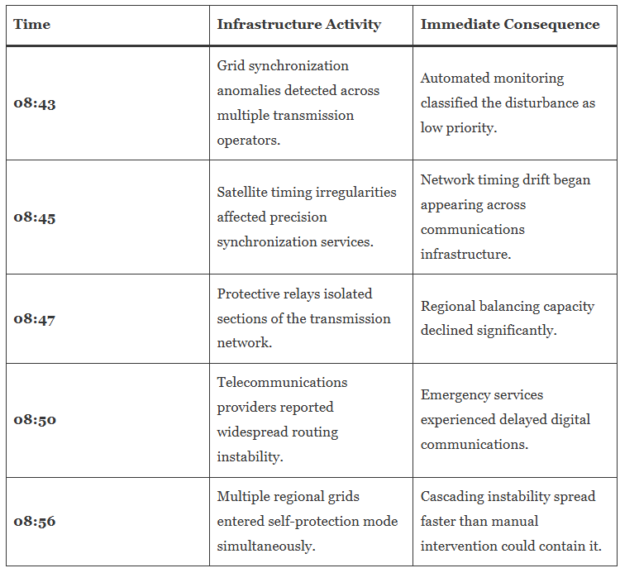
The timeline appears almost orderly when reduced to a table, yet the lived reality was anything but. Across countless cities, ordinary routines continued because almost nobody could perceive the invisible processes occurring beneath the surface of daily life. Financial institutions processed transactions more slowly than usual, hospitals switched briefly between redundant communication channels without interrupting patient care, and transportation networks quietly activated contingency software that had rarely been used outside controlled simulations. Even where warning indicators appeared, they were interpreted through the lens of previous experience. A railway dispatcher who had encountered signaling faults hundreds of times before saw no immediate reason to suspect that the issue belonged to a continental emergency. Likewise, a telecommunications engineer investigating unstable timing signals naturally searched for faults within his own network rather than imagining that identical symptoms were emerging across several countries at precisely the same moment.
 The Long Emergency: Su...
Best Price: $1.24
Buy New $1.99
(as of 10:49 UTC - Details)
Dr. Elena Varga would later describe those seventeen minutes as the most deceptive phase of the entire disaster. In her testimony before investigators, she argued that modern infrastructure had become exceptionally resilient against individual failures while simultaneously growing vulnerable to disturbances capable of affecting multiple sectors at once. The grid itself did not simply collapse; it attempted to preserve itself. Every protective decision made by automated systems reduced immediate risk within its own area of responsibility, but those local decisions gradually deprived neighboring regions of the stability they depended upon. It resembled thousands of watertight doors closing aboard a damaged ship. Each compartment protected itself exactly as intended, yet every sealed section made the vessel increasingly difficult to stabilize as a whole.
The Long Emergency: Su...
Best Price: $1.24
Buy New $1.99
(as of 10:49 UTC - Details)
Dr. Elena Varga would later describe those seventeen minutes as the most deceptive phase of the entire disaster. In her testimony before investigators, she argued that modern infrastructure had become exceptionally resilient against individual failures while simultaneously growing vulnerable to disturbances capable of affecting multiple sectors at once. The grid itself did not simply collapse; it attempted to preserve itself. Every protective decision made by automated systems reduced immediate risk within its own area of responsibility, but those local decisions gradually deprived neighboring regions of the stability they depended upon. It resembled thousands of watertight doors closing aboard a damaged ship. Each compartment protected itself exactly as intended, yet every sealed section made the vessel increasingly difficult to stabilize as a whole.
Beyond the control rooms, the first visible signs remained subtle enough that most people dismissed them as temporary inconveniences. Digital departure boards at railway stations displayed outdated schedules before freezing completely. Contactless payment terminals occasionally rejected valid cards despite functioning internet connections moments earlier. Navigation applications began calculating impossible routes as positioning data drifted beyond acceptable tolerances. In office buildings, secure access systems briefly denied entry to employees whose credentials had worked only minutes before. None of these incidents appeared alarming in isolation. Together, however, they reflected a common problem unfolding deep beneath the software that modern society depended upon but rarely acknowledged.
The situation changed irrevocably shortly after nine o’clock. Operators who had spent the previous twenty minutes attempting to understand scattered anomalies suddenly found themselves confronting a far more dangerous reality. Independent regions that normally exchanged enormous quantities of electrical power every second were no longer behaving as parts of a single synchronized network. Instead, they had begun separating into isolated electrical islands, each struggling to balance its own supply and demand without the support of neighboring systems. Some managed to stabilize temporarily through local generation. Others exhausted their available reserves within minutes, triggering automatic shutdown sequences designed to prevent catastrophic equipment damage. From that moment onward, the objective was no longer preventing the crisis. It was preventing the crisis from becoming irreversible.
 Resilia Odorless Aged ...
Check Amazon for Pricing.
Resilia Odorless Aged ...
Check Amazon for Pricing.
 Bronson Vitamin K2 D3 ...
Check Amazon for Pricing.
Bronson Vitamin K2 D3 ...
Check Amazon for Pricing.
 Nature Made Prenatal V...
Check Amazon for Pricing.
Nature Made Prenatal V...
Check Amazon for Pricing.
 OLLY Women’s Mul...
Check Amazon for Pricing.
OLLY Women’s Mul...
Check Amazon for Pricing.
Copyright © Preppgroup
 Trump & NATO Kiss and Make Up as Europeans Pledge To Buy More U.S. Weapons