


The Last Places in America That Might Survive the Collapse
June 19, 2026
Editor’s Note: This article was originally inspired by a simple question that has quietly found its way into countless conversations over the last few years. What would actually happen if the systems we take for granted suddenly stopped working? While nobody can predict the future, geography, history, climate, and demographics often tell stories that politicians and headlines prefer to ignore. This is not a prediction, nor is it meant to encourage fear. It is simply an attempt to examine a possibility that, until recently, most people dismissed as impossible.
Throughout history, civilizations have rarely collapsed in a single day. More often, they eroded gradually, with ordinary people realizing only in hindsight that they had been living through the beginning of the end. Perhaps the greatest illusion of every age is the belief that things will always continue exactly as they are.
 A Disease in the Publi...
Best Price: $7.17
Buy New $32.99
(as of 05:25 UTC - Details)
A Disease in the Publi...
Best Price: $7.17
Buy New $32.99
(as of 05:25 UTC - Details)
 Most Americans have spent their entire lives inside what may very well be one of the most sophisticated systems ever created. Electricity appears with the flick of a switch. Food arrives from thousands of miles away without anyone giving it a second thought. Water flows endlessly from taps, hospitals operate twenty-four hours a day, and millions of invisible processes work together so efficiently that society itself feels permanent. Yet permanence has always been one of history’s favorite lies. The Roman Empire believed itself eternal. So did countless kingdoms, economies, and governments that eventually became little more than paragraphs in history books. Looking back, historians often discover that the warning signs had been present for years. The people living through those moments simply failed to recognize them because collapse rarely announces itself dramatically. More often, it arrives disguised as inflation, shortages, political instability, cyberattacks, failing infrastructure, and a growing sense that something fundamental no longer works the way it once did.
By 2026, those concerns have become increasingly difficult to dismiss. From attacks targeting critical infrastructure to rising geopolitical tensions, prolonged droughts, supply chain disruptions, and growing distrust between institutions and the public, a surprising number of Americans have begun asking questions that would have sounded absurd twenty years ago. Not because they expect the world to end tomorrow, but because history has repeatedly demonstrated that societies are far more fragile than they appear at their peak. The uncomfortable truth is that civilization itself rests upon a network of systems so complex that most people never notice them until they begin to fail. When those systems remain functional, cities are miracles. When they stop, cities can transform into something very different.
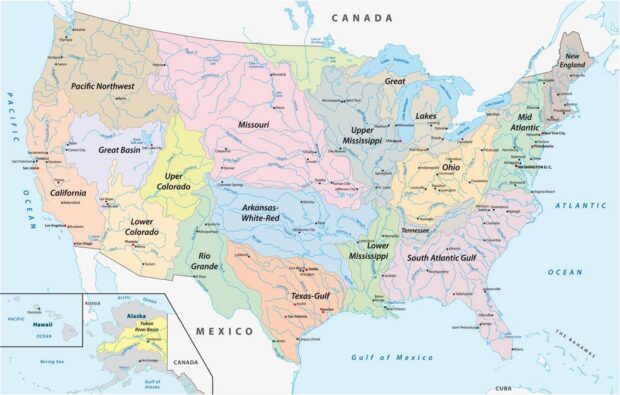
Hollywood has conditioned generations to imagine survival in terms of bunkers, zombies, or nuclear wastelands. Reality would almost certainly be less theatrical and far more unsettling. If modern America were ever confronted by a prolonged systemic failure, whether triggered by war, economic crisis, a cascading cyberattack, or a combination of multiple disasters occurring simultaneously, the greatest danger would not necessarily come from violence itself. It would come from dependency. The average supermarket contains only a few days’ worth of food. Most metropolitan areas rely upon an endless stream of trucks delivering supplies around the clock. Hospitals require electricity, fuel, medicine, and highly coordinated logistics. Municipal water systems depend upon treatment plants and infrastructure that few citizens ever think about. Remove enough pieces from that machine, and the illusion of stability can disappear with shocking speed.
Historians studying ancient societies have often noted that civilizations rarely die because of one catastrophic event. More often, they weaken under the weight of several problems occurring simultaneously until a tipping point is reached. It is this possibility that quietly concerns many analysts today. Not necessarily one disaster, but multiple crises overlapping at the wrong moment. A severe drought combined with economic instability. Political unrest occurring alongside cyberattacks. Natural disasters striking while already strained infrastructure struggles to cope. Individually, each problem can be managed. Together, they create something much more unpredictable.
 The Unseen Realm: Reco...
Check Amazon for Pricing.
The Unseen Realm: Reco...
Check Amazon for Pricing.
Perhaps this explains why preparedness, once dismissed as paranoia, has gradually entered mainstream conversations. Not because millions of Americans believe the apocalypse is imminent, but because recent years have exposed just how quickly assumptions can collapse. Empty shelves, fuel shortages, disruptions to supply chains, and infrastructure failures have reminded people of something previous generations understood instinctively. Modern society is incredibly powerful, but it is not invulnerable.
If such a scenario were ever to unfold, geography would suddenly become one of the most important factors determining who adapts and who suffers. Population density, freshwater availability, climate stability, agricultural potential, and natural barriers would matter far more than luxury or income. In many cases, some of the most expensive and desirable locations in America could become among the least favorable places to endure prolonged instability. Meanwhile, regions often overlooked by outsiders might emerge as unexpected sanctuaries.
Western Montana – America’s Quiet Fortress
Among preparedness experts, geographers, and even certain circles of retired military personnel, western Montana has quietly developed an almost mythical reputation. To outsiders, the fascination can seem exaggerated. After all, Montana is rarely the center of national attention. Its cities are relatively small, winters are long and unforgiving, and vast stretches of land appear empty compared to the crowded metropolitan corridors dominating the coasts. Yet that apparent emptiness may represent one of its greatest strengths. In an age defined by overcrowding and dependence, distance itself becomes a resource.
The region surrounding Missoula, Kalispell, and the valleys stretching beneath the Rocky Mountains possesses characteristics that civilizations have historically valued during times of instability. Freshwater is abundant, fed by rivers, lakes, mountain snowpack, and underground aquifers that remain among the most significant in North America. Fertile valleys support agriculture, wildlife populations provide additional food sources, and the mountainous terrain naturally limits large-scale migration. Geography, perhaps more than politics or economics, has always shaped the destinies of nations, and western Montana’s geography offers a level of isolation that cannot easily be replicated elsewhere.
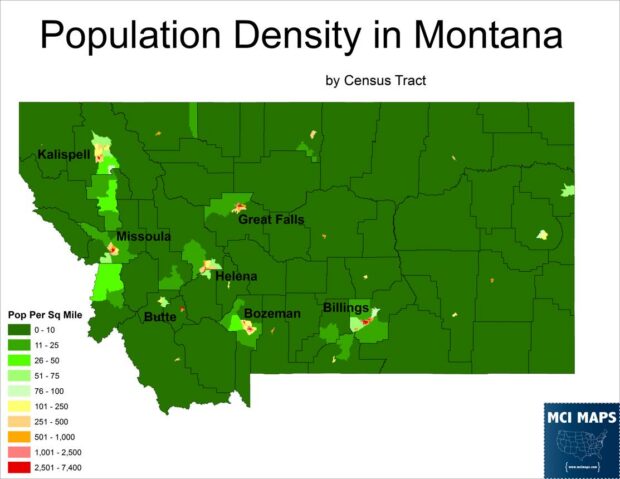
Ironically, the qualities that once discouraged rapid development now make the region particularly attractive to those concerned about long-term resilience. Harsh winters act as natural barriers, vast distances separate communities, and the state’s relatively low population density reduces the likelihood of overwhelming refugee movements. Throughout history, people fleeing chaos have almost always moved toward easier climates and major transportation routes. Montana lies far enough away from both that it occupies a peculiar position—accessible enough to sustain communities, yet isolated enough to avoid becoming the destination of millions.
Some survival researchers have gone so far as to describe the northern Rocky Mountain corridor as one of the last areas in the continental United States where geography itself still works in humanity’s favor. Whether such claims are exaggerated remains open to debate, but one fact is difficult to dispute. If fresh water becomes the oil of the twenty-first century, Montana may one day find itself possessing one of the most valuable resources on Earth.
Northern Idaho – The Forgotten Stronghold
 National Geographic Ro...
Check Amazon for Pricing.
If Montana has gradually acquired an almost legendary status among preparedness circles, northern Idaho remains something of a secret whispered about rather than openly discussed. Nestled between mountain ranges and surrounded by dense forests, the region possesses many of the same advantages as its neighbor while attracting considerably less attention. In a strange way, obscurity itself may become an asset. History suggests that places overlooked during prosperous times often fare surprisingly well when circumstances deteriorate.
National Geographic Ro...
Check Amazon for Pricing.
If Montana has gradually acquired an almost legendary status among preparedness circles, northern Idaho remains something of a secret whispered about rather than openly discussed. Nestled between mountain ranges and surrounded by dense forests, the region possesses many of the same advantages as its neighbor while attracting considerably less attention. In a strange way, obscurity itself may become an asset. History suggests that places overlooked during prosperous times often fare surprisingly well when circumstances deteriorate.
The counties surrounding Coeur d’Alene and extending deeper into the mountainous interior present a combination of factors rarely found together. Rivers and lakes provide water, forests offer resources, fertile valleys support agriculture, and relatively small communities maintain traditions of self-reliance that have largely disappeared elsewhere. Unlike sprawling metropolitan regions that depend upon millions of interconnected systems functioning perfectly every day, many communities in northern Idaho still retain a culture shaped by independence and practical knowledge.
There is another factor that receives surprisingly little attention. Human migration follows predictable patterns. During crises, large populations tend to move toward familiar routes, major highways, and regions capable of supporting enormous numbers of people. Northern Idaho, shielded by terrain and distance, lies somewhat outside those natural corridors. It is not impossible to reach, but it is difficult enough to discourage the kinds of mass movements that have accompanied nearly every major humanitarian crisis throughout history.
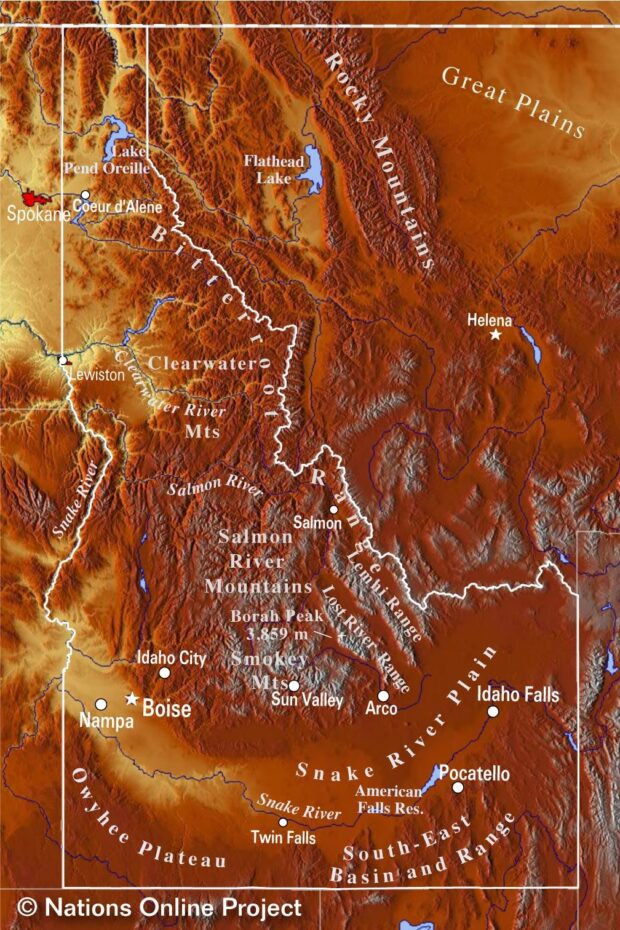
Perhaps that explains why stories surrounding the region have acquired an almost mysterious quality over the years. Some dismiss such discussions as little more than survivalist folklore. Others quietly point out that wealthy individuals, former intelligence officers, and business leaders have purchased land throughout parts of Idaho for decades. Whether coincidence or simply a reflection of the area’s natural beauty remains impossible to know. Yet patterns, once noticed, have a tendency to raise uncomfortable questions.
Far from the headlines and political noise that dominate America’s coastal cities, northern Idaho continues to exist much as it always has. Rivers flow, forests stretch endlessly across the landscape, and communities remain connected to traditions that modern society has increasingly forgotten. In an era when complexity defines nearly every aspect of life, there is something strangely reassuring about places that still remember how to function without it.
 Natureu2019s Bounty Hi...
Check Amazon for Pricing.
Natureu2019s Bounty Hi...
Check Amazon for Pricing.
 BioEmblem Triple Magne...
Check Amazon for Pricing.
BioEmblem Triple Magne...
Check Amazon for Pricing.
 Nature’s Bounty ...
Check Amazon for Pricing.
Nature’s Bounty ...
Check Amazon for Pricing.
 Natureu2019s Way Sambu...
Buy New $11.19
(as of 02:10 UTC - Details)
Natureu2019s Way Sambu...
Buy New $11.19
(as of 02:10 UTC - Details)
Copyright © Preppgroup
 The Church’s Most Controversial Dogma That Even Good Catholics Question