


Will Donald Trump's Iran War Crash the Global Economy?
April 21, 2026
Throughout most of our history leprosy has probably ranked as one of the most horrifying human conditions.
That slow, wasting disease lacked any cure and produced hideous deformities, leading to the creation of isolated confinement colonies for the afflicted. It’s hardly surprising that in the New Testament, Jesus extended his healing touch to lepers as a demonstration of his exceptional personal concern for those who were most despised by the rest of society.
According to Wikipedia, modern science has demonstrated that leprosy is caused by a bacterial infection that destroys the nerves that transmit pain. Lacking such sensations, the human body loses its warning system and therefore becomes greatly vulnerable to all sorts of minor injuries. These gradually accumulate, eventually producing the physical damage and grotesque disfigurement that represents the visible manifestation of the illness.
 The Debt Machine: How ...
Buy New $12.99
(as of 04:26 UTC - Details)
The Debt Machine: How ...
Buy New $12.99
(as of 04:26 UTC - Details)

Pain may be unpleasant, but it serves a vital role and its absence can be extremely dangerous for an organism.
I’m sure that if test animals were affixed with drug-patches that numbed any pain sensations and then released into the wild, their life expectancies would be drastically reduced.
There is often a close analogy between biological and social situations, and the absence of painful warning mechanisms in our society and economy may be just as dangerous to our future well-being as it would be for an animal or human.
These were some of the thoughts that came into my mind over the last few weeks as I noticed the astonishing, near-total equanimity with which our financial markets seemed to be treating the American-Israeli war against Iran.
Despite temporary dips, most of our major stock market indexes such as the S&P 500 are now considerably higher than they were before the fighting began, and have even set new records. This was hardly what we might have been expected.

President Donald Trump notoriously pays close attention to stock prices, and just a couple of days ago the Times described how these soaring market values led him to ridicule those who had urged him on economic grounds to avoid a war with Iran.
He also appeared to criticize advisers who had warned him against going to war with Iran because it would affect fuel prices. He described rising costs as “fake inflation.”
“We have consultants,” Mr. Trump said, recounting the conversation, “‘Sir, if you do this, fuel is going to go to $300 a barrel. The Depression is going to happen.’ That can’t happen because we just hit a brand new all-time high.”
 Perpetual War for Perp...
Buy New $28.94
(as of 04:16 UTC - Details)
Perpetual War for Perp...
Buy New $28.94
(as of 04:16 UTC - Details)
That was an apparent reference to the stock market, which hit a fresh record high this week, reflecting investors’ optimism that a peace deal would be reached before the war could inflict significant damage on corporate America.
While Trump is hardly known for the accuracy of his statements and I’d never heard any talk of oil going to $300 per barrel, his remarks were otherwise reasonably correct. Financial consequences of the Iran War have so far been very different than what most analysts had expected, or still predict.
John Mearsheimer is one of our most distinguished political scientists, and someone always quite careful and judicious in his remarks. But in his interviews during the last week or so he has regularly argued that the global economy was much like the Titanic, headed straight for an iceberg. Jeffrey Sachs, an equally distinguished international economist, has said very similar things.
Others have gone even farther. Following his long career in the British Navy, Cmd. Steve Jermy became an expert on energy transport and international trade matters. A few days ago he declared that we had already hit the iceberg, with the hole only getting larger every week that that the war continues. Given the long-term disruption of global supply-chain problems, he predicted an utter economic catastrophe.
All of these seemingly knowledgeable individuals and many others have agreed that the global economy is facing its worst crisis since the Great Depression nearly a century ago, but the financial markets have emphatically said otherwise. The same day that last, very sobering interview aired, American stock prices set a new record, and since then they have risen even higher.
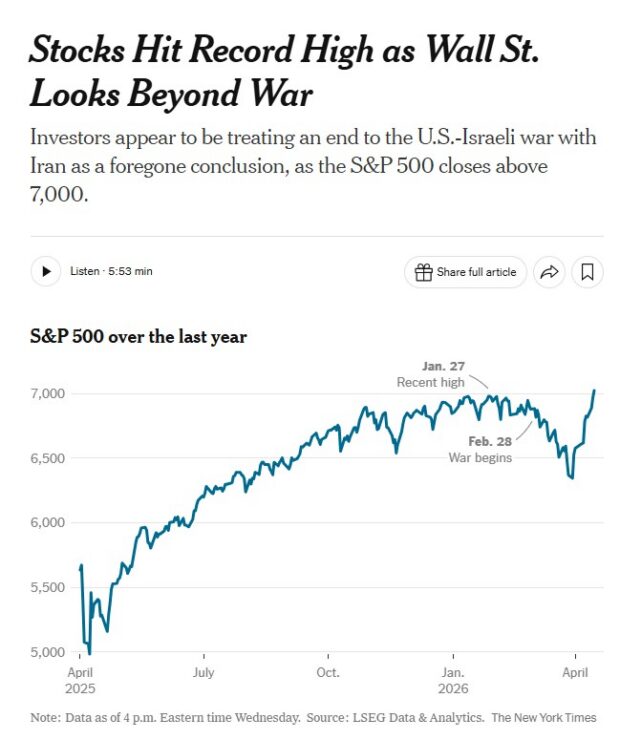
Trump may be an ignoramus while Mearsheimer and Sachs are outstanding scholars, but the consensus of investors is in the camp of the former rather than the latter, and surely it is foolhardy to totally disregard the views of those who put their money where their mouth is.
So we currently have two radically different perspectives on the global economic situation, with many experts crying “Doom!” but the stock markets saying “Don’t Worry—Be Happy!” and obviously only one of these predictions can be correct.
My original academic training was in theoretical physics, and according to the conventional interpretation of quantum mechanics, subatomic particles such as electrons may be interpreted as probabilistic waves, with their physical characteristics such as location or spin remaining indeterminate until they are measured. That latter process then collapses the wave function and thereby reveals where they have been and whether they are up or down. So in a very similar fashion, within a few weeks we shall discover whether all those notable experts or the aggregated wisdom of the financial marketplace was a better guide to the world’s economic situation.
There are certainly important historical precedents for stock markets not reflecting a looming economic catastrophe. For example, the Dow Jones Industrial Average and the S&P 500 both peaked on October 9, 2007 just a few months before the collapse of Bear Stearns initiated the massive 2008 Financial Meltdown that produced the Great Recession, the most serious global economic crisis since the Great Depression of the 1930s.
During that ensuing crisis, both those stock indexes dropped by well over 50% during the 18 months that followed. Yet for anyone who had been paying attention, by the date of that market peak there had already been numerous early warning signs of what was about to happen, with large financial institutions and major hedge funds collapsing throughout 2007, both before and after stock prices reached their zenith. Yet at the time investors had blithely ignored all that mounting evidence.
The obvious reason that traders and fund-managers have remained so insouciant is that contrary to all expectations, prices for oil and natural gas have risen much less than anyone had expected when the war began.
For example, the widely quoted benchmark price for crude oil is now only about 30% higher than the very low levels from earlier this year, showing none of the massive price spikes that had been widely predicted. So a price rise that has been rather modest and perhaps only temporary helps to explain why stocks have largely ignored the conflict.

For decades, Iran had always threatened that if were attacked it would close the Strait of Hormuz in retaliation, and it immediately did so. That strategic waterway normally carried some 20-25% of the world’s oil and natural gas exports, and an even larger fraction of other vital commodities such as fertilizer.
 Nature Made Vitamin D3...
Buy New $10.49 ($0.03 / Count)
(as of 06:15 UTC - Details)
Nature Made Vitamin D3...
Buy New $10.49 ($0.03 / Count)
(as of 06:15 UTC - Details)
Iran still exported its own oil and the Saudis were able to use a pipeline to redirect most of their crude to a port on the Red Sea But the Iranian blockade still took around 10 million barrels of oil per day off the world market, representing roughly 10% of total global consumption, and this was obviously an enormous, immediate shock to the system. Numerous experts had suggested that if this loss of supply continued for any extended period of time, a severe global recession would inevitably result, or even a worldwide depression.
An industry newsletter recently declared this to be “the largest energy supply disruption in modern history” and estimated that “more than 500 million barrels of crude and concentrate have been removed from the global market,” emphasizing that “the world has never seen anything like this before.”
It’s official:
We are now witnessing the largest energy supply disruption in modern history.
Since the start of the Iran War on February 28th, more than 500 million barrels of crude and condensate have been removed form the global market.
In other words, global supply has now… pic.twitter.com/E2pcjPh8yB
— The Kobeissi Letter (@KobeissiLetter) April 18, 2026
Prior to his attack on Iran, President Donald Trump had completely dismissed all the warnings of the potentially devastating economic consequences of an Iranian closure of the strait. Once it became apparent that it would be difficult or impossible to reopen that waterway to cargo traffic by military force, his administration turned to desperate measures to compensate for the sudden loss of world oil supplies.
 Resilia Softgels with ...
Check Amazon for Pricing.
The International Energy Agency soon declared that the Iran War was producing “the largest supply disruption in the history of oil markets.” Trump officials announced that that the 32 nations in the IEA were releasing 400 million barrels of oil and refined products from their reserves, which included 172 million barrels from our own Strategic Petroleum Reserve.
Resilia Softgels with ...
Check Amazon for Pricing.
The International Energy Agency soon declared that the Iran War was producing “the largest supply disruption in the history of oil markets.” Trump officials announced that that the 32 nations in the IEA were releasing 400 million barrels of oil and refined products from their reserves, which included 172 million barrels from our own Strategic Petroleum Reserve.
America also removed all previous sanctions on Russian oil, thereby allowing countries to easily purchase it, including the large quantities that had already been exported but were sitting at sea without buyers.
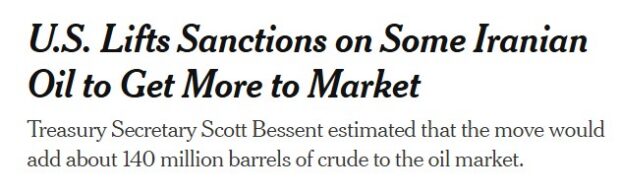
Even more remarkably, we did the same to Iranian oil, thereby allowing the country we were attacking and seeking to destroy to freely market the 140 million barrels of crude they had already shipped but been unable to sell, earning Iran a potential windfall of around $15 billion, twice its annual military spending. I’ve never previously heard of any country during wartime taking such a step to boost the government finances of the enemy it was seeking to defeat and destroy.
Iran also began furiously pumping and shipping additional oil, selling it at much higher prices than it had previously received. Trina Parsi, a prominent Iran expert, noted that as a result the oil revenues received by the Iranian government had more than tripled from what they had been before the missiles began firing.
Energy industry insider in Iran tells me the following, and it is STUNNING:
Before the war, Iran produced just shy of 1.1mn barrels of oil per day, and sold it at $65 per barrel minus $18 discount (i.e. $47)
Today, it produces 1.5mn barrels a day, and sells it at $110 with…
— Trita Parsi (@tparsi) March 23, 2026
All these factors temporarily mitigated the impact of the current supply shock that the Iranian action had produced. Some 500 million barrels had so far been removed from the market, but the releases from strategic national reserves and the removal of Russian and Iranian sanctions more than made up for those losses. Furthermore, large oil tankers often take weeks to reach their destination, so the global shortage of oil would only become fully manifest after the last tankers that had exited the Persian Gulf at the end of February unloaded their cargo and no additional ones arrived.
Taken together, this would explain why current oil prices had risen much less than otherwise expected. But we would still see a price spike in another month or two once these temporary sources of additional supply had been exhausted.
 Collagen Peptides Powd...
Buy New $27.95
(as of 10:50 UTC - Details)
Collagen Peptides Powd...
Buy New $27.95
(as of 10:50 UTC - Details)
 MARYRUTH’S Liqui...
Buy New $24.19
(as of 04:21 UTC - Details)
MARYRUTH’S Liqui...
Buy New $24.19
(as of 04:21 UTC - Details)
 Natureu2019s Bounty Zi...
Buy New $7.42
(as of 06:56 UTC - Details)
Natureu2019s Bounty Zi...
Buy New $7.42
(as of 06:56 UTC - Details)
 NatureBell Pure Magnes...
Buy New $17.95
(as of 11:42 UTC - Details)
NatureBell Pure Magnes...
Buy New $17.95
(as of 11:42 UTC - Details)
Copyright © The Unz Review
 Why Did the Government Lie About the COVID Vaccines?