


Will China Retaliate Against Donald Trump's Oil Blockade and Force an American Surrender?
April 14, 2026
As might have been expected, the peace talks in Islamabad between America and Iran quickly ended in complete failure, breaking up in less than 24 hours.
President Donald Trump had originally proposed peace negotiations based upon Iran’s 10-point proposal, but all of that was totally ignored when the talks actually began. According to media accounts, the American team led by Vice President JD Vance and New York City real estate developers Jared Kushner and Steve Witkoff instead issued unacceptable demands to the Iranians. These included that the Iranians must abandon all the nuclear enrichment activities to which they were legally entitled and also relinquish their control of the Strait of Hormuz, the strategic waterway that they currently control. Perhaps Vance and the others surprisingly expected to win at the negotiating table what their American military had completely failed to achieve in six weeks of warfare, and were disappointed when the Iranians stood firm.
 Faustian Man in a Mult...
Check Amazon for Pricing.
Faustian Man in a Mult...
Check Amazon for Pricing.

Astonishingly enough, a Washington Post columnist had recently called for the assassination of all of Iran’s leaders and negotiators unless they bowed to American demands, and this led some to suggest that the Iranian team should fly back to their own country on a Russian or Chinese airliner lest the disgruntled Americans shoot their plane down. America as a nation has sadly begun to resemble some unfortunate animal suffering from rabies, a pattern of behavior that also reflects what journalist Glenn Greenwald has decried as the increasing “Israelization” of our political system. But perhaps this merely demonstrates the remarkable extent of American desperation after more than six weeks of a lost war.
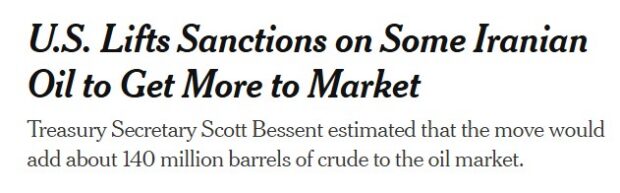
Meanwhile, the most substantive outcome of these failed talks was Trump’s announcement that he would impose his own blockade on the Persian Gulf, ordering his navy to seize all oil tankers that pass the Strait of Hormuz in order to eliminate Iranian oil revenues. Given the dangers of Iranian missiles, our warships will probably be forced to remain far from the Iranian shore and seize these vessels on the high seas, constituting blatant acts of illegal piracy. And even if successful, such a measure would remove at least 1.5 million barrels of oil per day from the international markets, thereby greatly driving up prices. Indeed, this was the exact reason that just last month America had suddenly lifted all sanctions on Iranian oil, allowing all of it to be sold internationally, but the Trump Administration is hardly notorious for its logical consistency.
China currently buys some 90% of Iranian oil and large quantities from the other Persian Gulf states, and by seizing China-bound tankers in international waters, Trump’s new action amounted to imposing an oil blockade against China, an obvious act of war. But two can play at the blockade game, and I wonder if Trump’s rash decision may finally prompt the notoriously cautious Chinese to retaliate with the sort of shrewd, calculated response that would force America into a rapid surrender, thereby putting an end to the dangerous Iran War before it further escalates.
Since I’m not involved in the inner discussions of the Trump Administration, I can’t say exactly why Vance and his team issued such aggressive demands to their Iranian interlocutors, and then immediately terminated the negotiations when those were refused. But it’s possible they were operating under the assumption that America was winning the war, and that the Iranians would therefore be forced to bend to their will. Given our massive bombing campaign against Iran and the very small number of casualties we have suffered, that might seem a reasonable conclusion, but it would be based upon a deep misunderstanding of the nature of war.
 Democracy Incorporated...
Check Amazon for Pricing.
Democracy Incorporated...
Check Amazon for Pricing.
Military analysts must always distinguish between the tactical, the operational, and the strategic levels of warfare, and only the last of these determines the ultimate victor in an extended conflict.
Unfortunately, this distinction has often been lost upon most ordinary Americans, who are often captivated by media coverage that focuses upon ephemeral combat operations while ignoring the bigger strategic picture.
This was notoriously the case in the Vietnam War that we fought more than fifty years ago. At its peak, we had a half-million troops stationed in that country. Given our enormous superiority in weaponry and munitions, we famously won every single battle that we fought but we ultimately lost the war. Exactly the same was the case in our much more recent wars in Afghanistan and in Iraq.
Even our top political leaders may easily be misled by this same distorted perspective. For weeks, President Trump has been loudly declaring that we have been winning endless, one-sided military victories against the Iranians, destroying all our targets without suffering any significant losses, and that only biased media naysayers have been willing to dispute this obvious reality.
Trump: “This war has been won. The only one that likes to keep it going is the fake news.” pic.twitter.com/YJMIm8Oik8
— Aaron Rupar (@atrupar) March 24, 2026
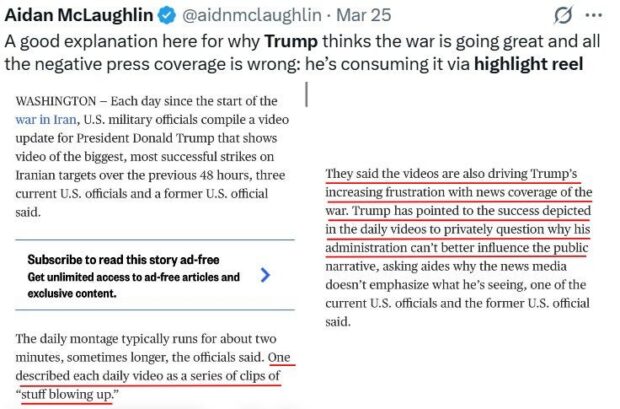
But it soon came out that his understanding of the war was largely based upon a daily highlight video reel that he received, showing the explosions of our biggest, most successful strikes on Iranian targets.
While Trump was enthralled by watching these large explosions, his more sophisticated Iranian adversaries had spent decades focusing upon strategic considerations as they prepared their defensive war-fighting plans against the future Israeli or American attack that they had always considered possible.
In recent years, annual American military spending has been more than 100 times greater than that of Iran. So if the Iranians merely invested in armed forces that were similar to our own but had only one percent of the same size and power, they surely would have been annihilated just as quickly as Trump had expected when he launched his massive surprise attack six weeks ago.
But the Iranians instead adopted a strictly asymmetrical strategy, investing their limited resources in producing an enormous arsenal of highly accurate ballistic missiles and powerful drones. They located these in widely dispersed sites across a mountainous country comparable in size to Western Europe and established a distributed command system intended to allow effective operation even following the destruction of their country’s top leadership. So when America and Israel launched their highly successful decapitating first strike at the end of February, the military response of the Iranians still began within an hour.
 Sports Researchu00ae O...
Check Amazon for Pricing.
Sports Researchu00ae O...
Check Amazon for Pricing.
In the cases of Vietnam, Afghanistan, and Iraq, our occupation forces were eventually defeated by guerrilla warfare movements that we could not overcome. The military situation with regard to Iran is obviously entirely different, but the importance of focusing upon the Iranian strategy is equally important.
In the case of Iran, several of these elements of Iran’s military toolkit have been of the greatest importance.
First, the huge Iranian arsenal of missiles and drones allowed them to quickly destroy most of America’s regional bases, an important step towards their goal of permanently expelling all our military forces from the Middle East. These strikes also destroyed several of our strategic radars at these locations, partially blinding our forces and those of Israel. These radar installations would require billions of dollars and years of effort to replace, and when we deployed one of our irreplaceable AWACS planes to temporarily fill the gap, the Iranians destroyed it as well.
Over the last decade, we had spent well over two trillion dollars on our naval forces, the most powerful in the world, and one of their most crucial missions had been protection of the vital sea lanes of the Persian Gulf. But our carriers and other warships were considered so vulnerable to attack and destruction by Iranian missiles and drones that we were forced to keep them many hundreds of miles away from the Iranian coast. This demonstrated that they were almost totally useless for the crucial task that justified that gigantic investment.
These same Iranian missiles and drones could very easily destroy the vital infrastructure of all the Gulf Arab states and Israel. During the weeks of the war Iran had repeatedly demonstrated this powerful retaliatory capability, with attacks on Iran’s energy or other civilian infrastructure invariably answered by tit-for-tat retaliatory strikes. So although America and Israel could destroy Iran, the Iranians could retaliate in kind, providing a considerable deterrent effect.
 WEEM Hair Skin and Nai...
Check Amazon for Pricing.
WEEM Hair Skin and Nai...
Check Amazon for Pricing.
 Sports Researchu00ae V...
Check Amazon for Pricing.
Sports Researchu00ae V...
Check Amazon for Pricing.
 Physician’s CHOI...
Check Amazon for Pricing.
Physician’s CHOI...
Check Amazon for Pricing.
 Naturebell Pure Magnes...
Check Amazon for Pricing.
Naturebell Pure Magnes...
Check Amazon for Pricing.
Copyright © The Unz Review
 Biting the Hand that Feeds Them