


The Regrettable Death of the Stupid Question
How Too Much "Knowingness" Kills Lively Intelligence
April 22, 2026
A couple of weeks ago, I asked a genuinely stupid question. I did not ask this truly stupid question in the privacy of my own living room, or on a phone call with a good friend. I asked it publicly, on the 12th largest social media platform in the world — X — to a potential audience of its 561 million plus monthly users.
My incredibly stupid public question was this:
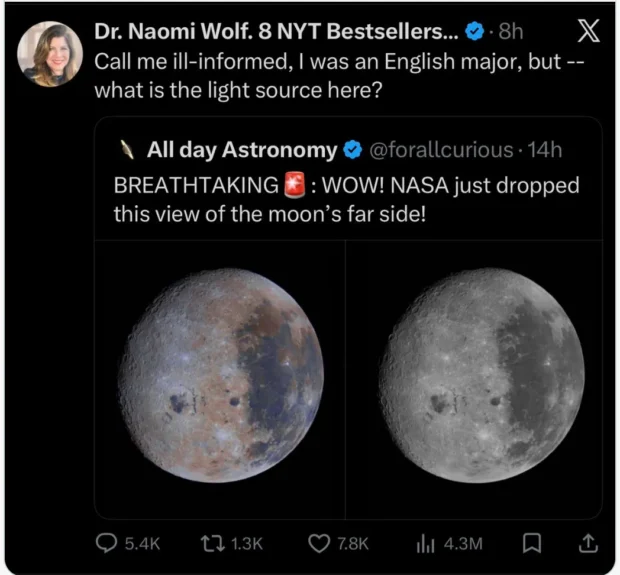
Of course, I was texting in haste, and I did not mean to post, “I have no idea that the light source in this image is the sun.”
Understandably, though, hundreds of thousands of people had a good chuckle at this obvious implication.
 Facing the Beast: Cour...
Best Price: $6.22
Buy New $9.87
(as of 05:51 UTC - Details)
Facing the Beast: Cour...
Best Price: $6.22
Buy New $9.87
(as of 05:51 UTC - Details)

What I had meant to spark, with my clumsy post, was the start of a whole set of questions crowding my wondering mind at witnessing this extraordinary image: What is the angle of the sun’s light in this image — that is, where is the sun in relation to this face of the moon? Where is earth in relation to both? What does earth look like when the far side of the moon looks like this? What does the sun look like on earth when the far side of the moon looks like this? What does it mean for the moon when the sun lights up the “dark” or “far” side of the moon — that is, for how long at a time is the far side of the moon lit in this way? How is the light here so fairly evenly distributed, so that only a sliver of the moon is in shadow? In other words, in this image, where is the sun in relation to the moon and the other planets? And where is Artemis 2 in relation to the sun, the moon and the other planets, in this image? In order to secure this image, is Artemis 2 directly opposite the far side of the moon, and if so, where is the sun? And where, then, is the shadow of Artemis 2? Is it imperceptible? And so on.
What I really longed for was a schematic showing all of the planets involved in this image, and explaining the behavior of light in relation to them and to Artemis 2, in this image.
I also yearned for a long back-and-forth with patient astronomers, who might be willing to answer every single one of many questions that I and other non-astronomers may have had in this unfathomable, amazing moment — some questions of which might be basic indeed, to astronomers. Or even to lots of other people.
What an incredible opportunity for learning, the internet could present at such moments in human history — that is, if we could engage with it in a state of public, vulnerable wonder at things we do not yet understand, asking everything; and if we could engage it ourselves with patience with others who may be asking about things we do understand better than do they, or about subjects in which we are experts.
Sadly, that is not the digital commons that is being created over and around us now, and that we in turn co-create; rather, we are creating and supporting, and tolerating the construction of, an increasingly developed digital architecture of knowledge and even a digital collation and curation of “proper questions” and “right answers”, that is, I would argue, designed to subdue and imprison us.
 Bodies of Others: The ...
Best Price: $6.22
Buy New $13.86
(as of 11:11 UTC - Details)
Bodies of Others: The ...
Best Price: $6.22
Buy New $13.86
(as of 11:11 UTC - Details)
Our knowledge practices now, both questions and answers, are being digitally herded into narrower and narrower avenues, with only one set of egress points, like formerly free-ranging cattle being herded into chutes before slaughter.
I would argue that this notion — of a canonical “right answer”, a “smart answer” to a “smart question” – threatens the end of actual wisdom and heralds the death of true intellectualism.
There are a lot of dangers right now, in the digital consolidation of who gets to ask questions, of what the questions “should” be, and of the production of “right answers”.
After hundreds of thousands of people had had a good laugh at my “stupid question” and had the satisfaction of pointing out to an Oxford D Phil that the source of the illumination was “the sun,”I posted this:
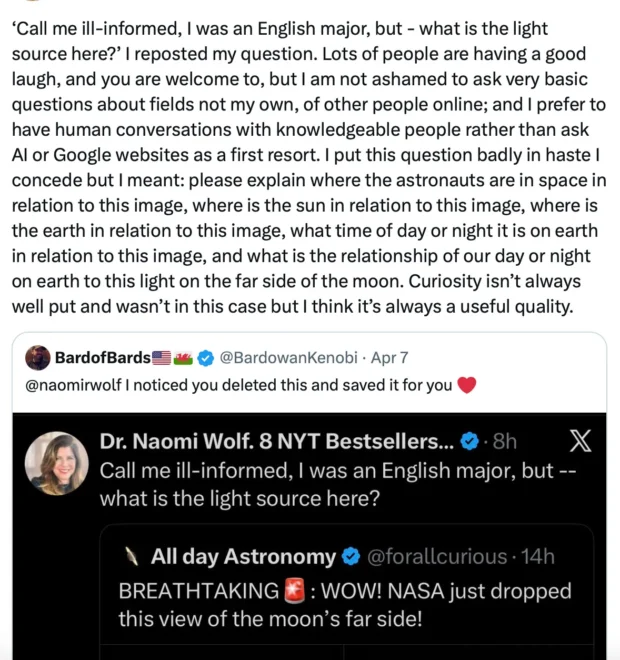
After my humble and transparent update, I received a great deal of support. A lot of people, it seemed, also miss a culture in which amateur human curiosity is okay. Many others kept trolling.
But in the midst of the reams of mocking comments, there were gems of patient illumination.
A friend who is a filmmaker who had trained with NASA, reached out via text:
 WEEM Hair Skin and Nai...
Buy New $29.71
(as of 12:06 UTC - Details)
WEEM Hair Skin and Nai...
Buy New $29.71
(as of 12:06 UTC - Details)
“Hey, did you post something about the moon? Was that really you? If you have questions about the lighting on the far side, I did train for space.”
“I put my poorly phrased questions in a later post in context,” I replied via text. “I was trying to find out about the angle of the sun’s light in relation to various planets…Like, how is the moon in darkness and the earth 1/8 in sunlight? Where is the sun in relation to both? How is the whole moon illuminated at once? Wouldn’t there be a very short moment at which all is illuminated as with our noon? Even with our noon the whole half of the globe is not illuminated all at once I believe…How would Artemis 2 be opposite the moon at just the moment the whole moon is illuminated? Wouldn’t that be very improbable?
“Where is the sun’s angle as its rays reach the moon — I thought the moon shone from reflected light from the sun, not direct light?
“There is no gas or planetary shadow and no haze-like atmosphere, as on earth? Why not? Even without life there is dust and even “weather” on the moon, correct? Or no?
Not even wind or gases or dust?
Those are my main Qs…” I concluded.
“The whole moon isn’t illuminated,” responded my friend. “Half of it is. The lunar day is 28 earth days. Which means the line between night and day moves very slowly. The far side of the moon is not the dark side of the moon. But it is always the far side. I’m guessing they timed the launch so that it was day on the far side since their intention was to study the far side. Apollo btw landed at lunar dawn on the near side. For temperature reasons.”
“Right,” I replied. “I mean that the whole circle is illuminated in the image — the whole “half “ of the moon. Even with our noon the whole half of the globe is not illuminated all at once, I believe?”
“Half of earth is illuminated at all times,” explained he. “Think of a light and a ping pong ball. No matter where you move that ball in your room half of it will always be hit with light.”
“How would Artemis 2 be opposite the moon at just the moment the whole moon is illuminated? Isn’t that very improbable?” I asked.
“See above. I’m guessing they intentionally launched to arrive when the far side was in full day to study the far side’s craters.”
 Physician’s CHOI...
Buy New $20.24
(as of 12:06 UTC - Details)
Physician’s CHOI...
Buy New $20.24
(as of 12:06 UTC - Details)
“So it must be the middle of the 28 day cycle? Where is the sun’s angle as its rays reach the moon? I thought the moon shone from reflected light from the sun, not direct light?”
“Direct sunlight hits the moon. What you are thinking about with ‘reflected’ is that on the near side at night it isn’t always pitch black because earth if lit up can cast an earth glow on the moon the way the moon casts a glow on earth at night when it is full (lit by the sun).”
“Really??! The earth can cast an earth glow?” I marveled.
“Re “There is no gas or planetary shadow and no haze…” No atmosphere on the moon. No wind. No dust (other than what is caused by men landing a rocket or meteor hitting the moon). No weather. Mars has weather and wind because it had an atmosphere. The moon has zero atmosphere,” explained my friend.
“Ok. Thank you very much. Amazing universe.”
“That’s the reason to go to space,” he texted. “So the rest of the world looks up and asks questions like yours.”
I pondered that inspiring sentence.
I concluded our exchange:
“Oh wow — thank you so much.
Glad I asked a stupid question on social media. :)”
After my humble and transparent update, I received a great deal of support. A lot of people, it seemed, also miss a culture in which amateur human curiosity is okay. Many others kept trolling.
But in the midst of the reams of mocking comments, there were gems of patient illumination.
A friend who is a filmmaker who had trained with NASA, reached out via text:
 Garden of Life Dr. For...
Buy New $29.25
(as of 09:16 UTC - Details)
Garden of Life Dr. For...
Buy New $29.25
(as of 09:16 UTC - Details)
“Hey, did you post something about the moon? Was that really you? If you have questions about the lighting on the far side, I did train for space.”
“I put my poorly phrased questions in a later post in context,” I replied via text. “I was trying to find out about the angle of the sun’s light in relation to various planets…Like, how is the moon in darkness and the earth 1/8 in sunlight? Where is the sun in relation to both? How is the whole moon illuminated at once? Wouldn’t there be a very short moment at which all is illuminated as with our noon? Even with our noon the whole half of the globe is not illuminated all at once I believe…How would Artemis 2 be opposite the moon at just the moment the whole moon is illuminated? Wouldn’t that be very improbable?
“Where is the sun’s angle as its rays reach the moon — I thought the moon shone from reflected light from the sun, not direct light?
“There is no gas or planetary shadow and no haze-like atmosphere, as on earth? Why not? Even without life there is dust and even “weather” on the moon, correct? Or no?
Not even wind or gases or dust?
Those are my main Qs…” I concluded.
“The whole moon isn’t illuminated,” responded my friend. “Half of it is. The lunar day is 28 earth days. Which means the line between night and day moves very slowly. The far side of the moon is not the dark side of the moon. But it is always the far side. I’m guessing they timed the launch so that it was day on the far side since their intention was to study the far side. Apollo btw landed at lunar dawn on the near side. For temperature reasons.”
“Right,” I replied. “I mean that the whole circle is illuminated in the image — the whole “half “ of the moon. Even with our noon the whole half of the globe is not illuminated all at once, I believe?”
“Half of earth is illuminated at all times,” explained he. “Think of a light and a ping pong ball. No matter where you move that ball in your room half of it will always be hit with light.”
“How would Artemis 2 be opposite the moon at just the moment the whole moon is illuminated? Isn’t that very improbable?” I asked.
“See above. I’m guessing they intentionally launched to arrive when the far side was in full day to study the far side’s craters.”
“So it must be the middle of the 28 day cycle? Where is the sun’s angle as its rays reach the moon? I thought the moon shone from reflected light from the sun, not direct light?”
 BIOptimizers Magnesium...
Buy New $33.96
(as of 02:06 UTC - Details)
BIOptimizers Magnesium...
Buy New $33.96
(as of 02:06 UTC - Details)
“Direct sunlight hits the moon. What you are thinking about with ‘reflected’ is that on the near side at night it isn’t always pitch black because earth if lit up can cast an earth glow on the moon the way the moon casts a glow on earth at night when it is full (lit by the sun).”
“Really??! The earth can cast an earth glow?” I marveled.
“Re “There is no gas or planetary shadow and no haze…” No atmosphere on the moon. No wind. No dust (other than what is caused by men landing a rocket or meteor hitting the moon). No weather. Mars has weather and wind because it had an atmosphere. The moon has zero atmosphere,” explained my friend.
“Ok. Thank you very much. Amazing universe.”
“That’s the reason to go to space,” he texted. “So the rest of the world looks up and asks questions like yours.”
I pondered that inspiring sentence.
I concluded our exchange:
“Oh wow — thank you so much.
Glad I asked a stupid question on social media. :)”
*****
I learned so much, ultimately, from having asked a “stupid question” on social media. And interestingly, the main takeaway was not about the stars and planets themselves, but about the nature of humanity.
And I had the privilege of re-tasting childlike wonder at our universe.
 Nature Made Vitamin D3...
Buy New $10.49 ($0.03 / Count)
(as of 06:15 UTC - Details)
Nature Made Vitamin D3...
Buy New $10.49 ($0.03 / Count)
(as of 06:15 UTC - Details)
But I fear the “stupid question” — the uncertain question, the vulnerable question, the open-ended question — is quickly and by design going the way of the Dodo.
I was very lucky in childhood; my parents raised me to be willing to ask any question and explore any issue, without hesitation, self-consciousness or anticipatory shame. If it was a thoughtless or ill-informed question, I would realize that soon enough for myself, when I received the answer. But blessedly, my parents, true educators, never ever pushed back on my, or my siblings’, curiosity.
This led, at least in my case, to a childhood that was sometimes weird. I was interested in what people ate in Chaucer’s time, for instance, so when I was about eight, my parents let me make an entire meal for the family, based on what I had been reading about meals in the Middle Ages. A skinned rabbit was involved — “jugged hare”, as I had read — which my matter-of-fact babysitter had helped me to braise, and it was an object which actually had horrified me.
The final meal was not delicious, but it was all definitely an educational experience.
On another day — probably a rainy day — I wanted to know what was inside a pillow. Feathers or foam? So my mom let me cut one open. (It was feathers, and they went everywhere).
My curiosity, at the age of about nine, about what would happen if I cut my own hair with scissors, led to a less successful experiment.
“You had these fancies that were taken from books,” explains my mom. “I thought you lived in the wrong century. You did a lot of experiments that involved water, and food coloring, and spices. You were trying to get it all to bubble…There was the famous bicarbonate of soda experiment…”
I was curious about Shakespeare, as another example, so my parents let us stay up late, leaping around the master bedroom. This room involved a couple of mattresses, covered with linens and scratchy grey-and-cream Mexican throws, on the floor of the attic of our old house. (Yes, my parents were hippies). My brother and I would act out the plays’ various roles.
Though he and I did not understand much of the text literally, we actually caught the drifts of, as I recall, both “The Taming of the Shrew”, and “The Tempest”, and got a lot more out of these performances than a sensible adult might think.
 Resilia Softgels with ...
Check Amazon for Pricing.
Resilia Softgels with ...
Check Amazon for Pricing.
A vivid memory I have is that we both often collapsed in mid-performance into gales of laughter. Even without fully understanding the language, we both realized in performing the plays, that Shakespeare could be incredibly funny.
No one ever, ever said, “You can read that when you are older and you can understand it.”
My brother’s curiosity, about everything in sight, but tending toward a different set of questions, was also treated by our parents in an open-minded way. I became a writer and he became a scientist. But if my parents had scoffed at our questions, at any point, I don’t know if either of us would have taken the risks we did, intellectually, to reach our respective chosen professions.
The image of the moon produced via Artemis 2, had led me to a state of intense curiosity that brought me back to the crowded-with-questions mind-state of a child.
For children, all questions and all conditions are new; all the world, for them, must feel the way that seeing the first image of the far side of the moon, feels for us.
That is why children’s questions are often so moving and beautiful — if parents and other adults have the patience to hear the children’s questions out. And that is one reason it is so trippy and fantastic, as most of us can still recall, to be a wondering child.
If our parents and our schools did not crush that wonderment out of us too young, most of us can still remember our former “child’s mind”, and recall the crush of questions that crowded it, alongside all the amazing new phenomena we encountered in childhood.
 Collagen Peptides Powd...
Buy New $27.95
(as of 10:50 UTC - Details)
Collagen Peptides Powd...
Buy New $27.95
(as of 10:50 UTC - Details)
 MARYRUTH’S Liqui...
Buy New $35.05
(as of 02:01 UTC - Details)
MARYRUTH’S Liqui...
Buy New $35.05
(as of 02:01 UTC - Details)
 Natureu2019s Bounty Zi...
Buy New $8.25
(as of 09:01 UTC - Details)
Natureu2019s Bounty Zi...
Buy New $8.25
(as of 09:01 UTC - Details)
 Natrol Melatonin 10 mg...
Buy New $10.42
(as of 12:06 UTC - Details)
Natrol Melatonin 10 mg...
Buy New $10.42
(as of 12:06 UTC - Details)
Copyright © Dr. Naomi Wolf
 Peaceful Nationalism as a Foundation for Economic Liberalism