


Morality On-Demand
March 14, 2026
“A society trained to believe catastrophe is always around the corner eventually stops asking whether the catastrophe is real.”
For most of American history, political disagreements involved tradeoffs. Citizens argued about taxes versus spending, economic growth versus regulation, or liberty versus security. Those debates could become heated, but they still assumed something basic: reasonable people might weigh the costs and benefits differently.
That assumption has been fading for some time.
 Walking Your Way to Vi...
Check Amazon for Pricing.
Walking Your Way to Vi...
Check Amazon for Pricing.

In modern political rhetoric, particularly within the Democrat Party, many issues are framed not as policy questions but as moral emergencies. Elections are described as existential threats to democracy. Environmental debates are portrayed as struggles to save the planet. Immigration disputes become humanitarian catastrophes or national survival crises, depending on the speaker.
Once an issue is cast in those terms, disagreement stops looking like disagreement. It begins to look like cruelty, ignorance, or bad faith.
This rhetorical shift has become one of the most powerful tools in modern politics. When every issue becomes a moral emergency, hesitation itself begins to look morally suspect.
When Politics Stops Being About Tradeoffs
Political decisions in a large and complicated country inevitably involve tradeoffs. Expanding one priority often requires sacrificing another. Governments cannot spend unlimited money without raising taxes or increasing debt. Environmental regulations may protect ecosystems while also affecting energy costs and employment.
Earlier generations of politicians acknowledged these limits openly. The debate centered on which tradeoffs were acceptable and which were not.
Emergency rhetoric removes that framework.
If a policy dispute is framed as a moral catastrophe, then tradeoffs disappear from the discussion. Anyone raising practical concerns can be portrayed as indifferent to suffering or blind to danger. The conversation shifts from weighing consequences to assigning blame.
This approach has grown steadily during the past decade. Political leaders now routinely warn that democratic institutions are collapsing, that the planet faces imminent destruction, or that fundamental rights will vanish if the wrong party wins an election.
When every issue is treated as existential, ordinary political reasoning begins to disappear.
Why Moral Emergencies Work
Moral language has always played a role in politics, but it carries unusual power because it discourages caution. A voter who believes a genuine emergency exists will rarely pause to examine competing evidence carefully.
 Breast Cancer and Iodi...
Best Price: $13.76
Buy New $13.77
(as of 03:05 UTC - Details)
Breast Cancer and Iodi...
Best Price: $13.76
Buy New $13.77
(as of 03:05 UTC - Details)
Delay begins to appear dangerous. Skepticism itself begins to look heartless.
Political movements throughout history have used this dynamic. During the French Revolution, opponents were not merely wrong but labeled enemies of the people. In the twentieth century, many revolutionary movements framed policy debates as moral struggles between oppression and liberation.
Modern American politics does not resemble those revolutions in scale, but the rhetorical pattern is familiar. What has changed is the frequency with which ordinary policy disagreements are described as existential crises.
The consequences are measurable. A 2023 Pew Research survey found that roughly seven in ten Americans believe political divisions are greater than at any time in their lives. Gallup polling shows public trust in major institutions such as Congress, the media, and the federal government falling below thirty percent.
A society repeatedly told that catastrophe is imminent eventually begins to believe it.
The Emergency Cycle
When observers step back from individual controversies, a pattern becomes visible. Many modern political disputes follow a recurring sequence.
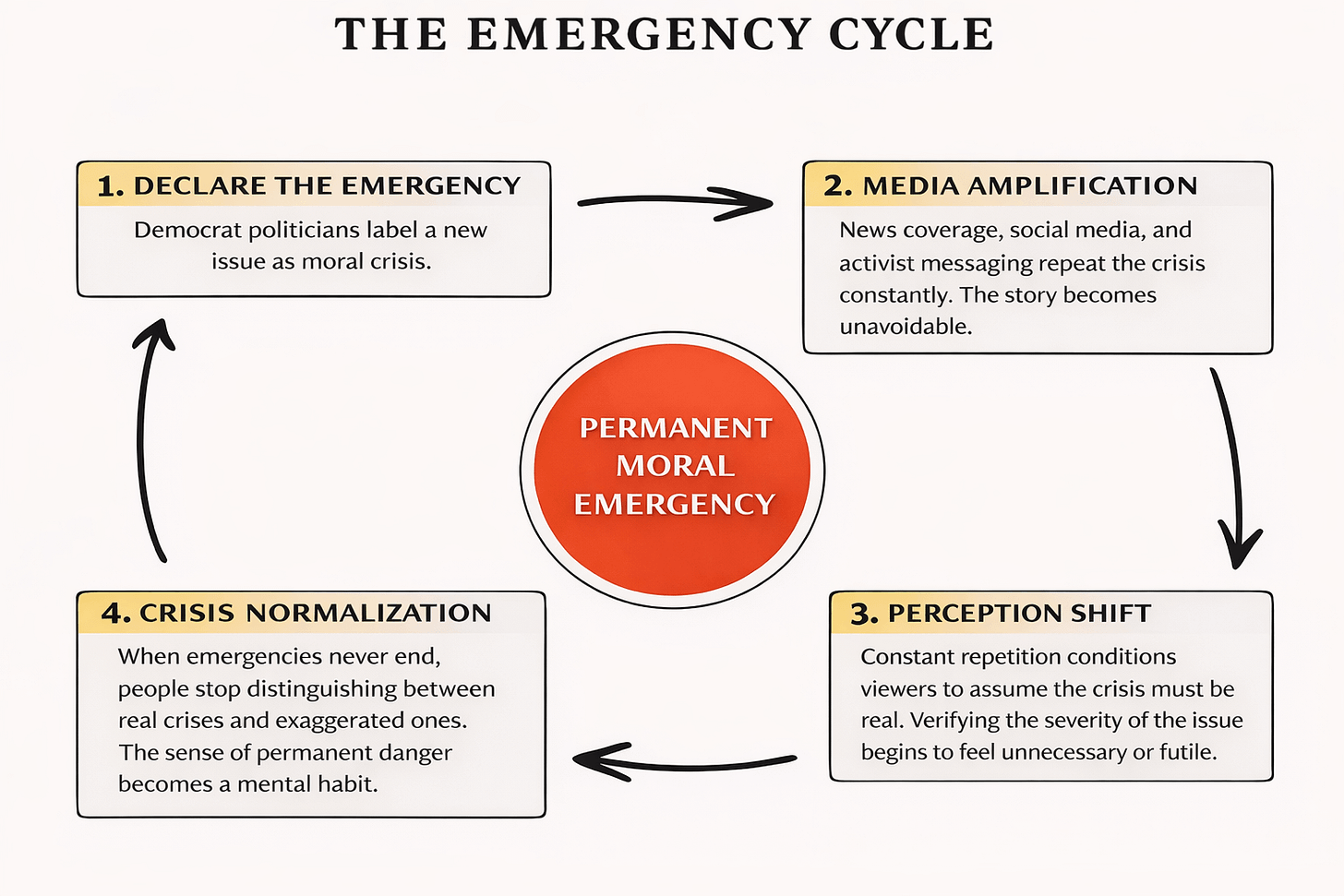
The Emergency Cycle of Modern Politics: An issue is declared a crisis, amplified through media and activism, repeated until public perception shifts, normalized through constant exposure, and then replaced by the next political emergency.
First, a political issue is declared an emergency. Activists and politicians describe the stakes in the strongest possible terms, replacing the language of debate with the language of crisis.
Second comes amplification. News coverage, advocacy groups, and social media networks repeat the warning constantly. The issue becomes nearly impossible for the public to ignore.
Third, perception begins to shift. When viewers hear the same message repeatedly, they begin assuming the crisis must be real. Few people have the time or resources to investigate each claim independently.
Finally, normalization sets in. When emergencies never end, the sense of crisis becomes habitual. Citizens gradually lose the ability to distinguish between severe problems and exaggerated ones.
The cycle then begins again.
 Amazon eGift Card - Ha...
Check Amazon for Pricing.
Amazon eGift Card - Ha...
Check Amazon for Pricing.
 Visa Physical Gift Car...
Check Amazon for Pricing.
Visa Physical Gift Car...
Check Amazon for Pricing.
 Roblox Digital Gift Ca...
Check Amazon for Pricing.
Roblox Digital Gift Ca...
Check Amazon for Pricing.
 $50 Visa Gift Card (pl...
Buy New $54.95
(as of 10:51 UTC - Details)
$50 Visa Gift Card (pl...
Buy New $54.95
(as of 10:51 UTC - Details)
Copyright © Ultimate-Survival
 Trump: Says 'Practically Nothing Left to Target'