


DMSO, AI, and the Great Transformation of Information
March 17, 2026
I feel one of the greatest issues in healthcare (which is a reflection of the society at large) is that things are so rushed that there isn’t time for doctors to connect with their patients. Because of this, a lot of the most critical parts of medicine get missed, and I’ve known so many patients who were harmed by the medical system because of the 15 minute visit model. As such, my original goal here was to connect with everyone who reached out to me, but now, due to the amount of work I feel obligated to put into the articles and just how many people contact me with urgent questions, that’s no longer possible.
I eventually decided that the best option I had was to try to address as many potential questions as possible in the articles post monthly open threads where anyone could ask what they wanted to, as that way I could efficiently get through the pressing questions I was not able to answer throughout my articles and then pair those threads with a topic that didn’t quite merit its own article.
For this month’s open thread, I wanted to talk about a topic that’s becoming an increasingly important part of our lives—artificial intelligence —given how much I’ve interacted with it over the last six months while researching DMSO.
 DMSO Healing Guide: Di...
Check Amazon for Pricing.
DMSO Healing Guide: Di...
Check Amazon for Pricing.

Note: this article builds upon a previous one (the Great Vanishing of Information), which highlights how certain types of information are being buried on the internet unless you know how to find it.
The DMSO Project
DMSO is one of the only therapies I know of which:
• Treats a wide range of common ailments.
• Frequently is able to treat conditions often otherwise viewed as “incurable.”
• If used correctly, it has a very high safety profile.
• Has extensive scientific literature corroborating its safety and efficacy.
• Is easily available and highly affordable.
Unfortunately, DMSO has languished in an unusual spot. It was widely used throughout the pharmaceutical industry, a component in many drugs and was the active agent in a few FDA approved therapies but simultaneously, despite decades of protest (including by Congress) and being widely used around the world, the FDA essentially banned DMSO from medicine in America, and few even know about it (demonstrating that medical policies is often the result of politics rather than science).
Because of this, I felt it was worth publicizing the mountain of forgotten literature showing DMSO worked, and once I did so, many people reported profound improvements and disbelief that something like DMSO existed, which they had never heard of (resulting in those articles receiving millions of views and thousands of readers sending in remarkable reports of what DMSO did for them). This took me by surprise, and I realized it reflected the fact that, since DMSO costs so little, no one would ever be incentivized to promote it. So, as time continued, I gradually felt that I had a responsibility to do the best I could to present the case for DMSO as more and more readers began relying upon me to do so, and it was unlikely anyone else would undertake the full scope of what that endeavor to publicize the extensive volume of literature corroborating its use.
Unfortunately, as I dove into all the books that had been published on DMSO, I quickly discovered that almost all the books that had been written on the topic simply copied previous books in the genre (rather than independently researching the topic), and as such, the DMSO field was essentially unaware of most of the pertinent DMSO literature.
Note: similarly, there was immense variation in the DMSO protocols authors proposed, leading me to conclude that many were largely arbitrary and not extensively researched by the authors.
To some extent, this makes sense, as there is an overwhelming amount of literature on DMSO (DMSO has many different spellings, and many general searches for DMSO returned thousands, tens of thousands, hundreds of thousands, or millions of results). So, as I started scouring the databases, I gradually came up with ways to simplify the immense task of finding the pertinent studies (e.g., title-only searches in Google Scholar for DMSO/dimethyl sulfoxide/dimethylsulfoxide plus a condition would dig up many relevant studies).
However, it simultaneously dawned on me that because there were so many different permutations, the only possible way I would actually be able to find many key studies for DMSO would be to search each database for each phrasing used for DMSO, collate all of the relevant studies which came up in the process into a document, and then sort that document by each condition. For a while I went back and forth on if I wanted to do this, as it would take an immense amount of time to do (requiring me to cut off every non-essential commitment in my life and significantly reduce my output here), but as time went on, I felt more and more obligated to do it due to the unprecedented support so many of you had given the series.
So, eventually, on October 25th, after I finished the last DMSO article, I set a goal to complete this in two months and hoped that this gap would not be too disruptive to everything else. However, as I began that project, I gradually realized searches I previously thought were impossible could be done, and kept extending my timeframe while simultaneously trying as hard as I could to get things done as fast as possible without cutting corners (which was very challenging for my body, mind, and spirit). A few days ago, I essentially finished, and because of that, I felt I owed the supporters of this newsletter some accounting of where all that time had gone.
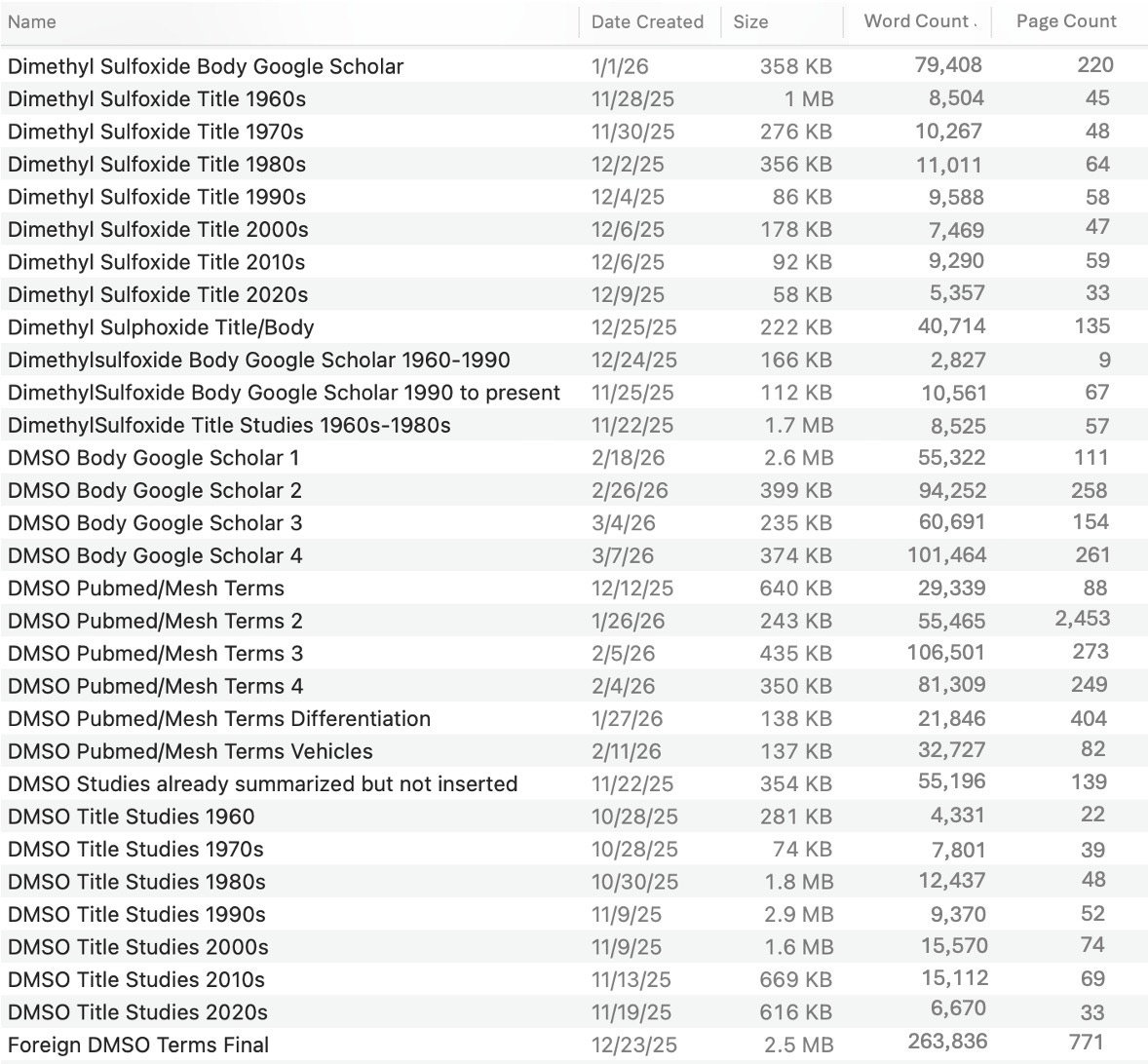
Note: in the “title” searches, the studies themselves are not yet summarized (that will be done later), whereas in the non-title ones, they have (as I needed to verify the articles contained pertinent DMSO information). Additionally, in the PubMed searches, I feel I need to re-read through about 30,000 results to flag some that were missed, as I used AI to flag that set (due to being too tired to manually read them), and I realized near the end that the approach I used missed some of the studies that should be flagged. Lastly, while I went through the main databases and most of the terms for DMSO, I know I missed some, which means even with this, there are still DMSO studies waiting to be discovered.
Additionally, one of the most challenging parts of this project was going through the Chinese database, as due to its numerous issues, I eventually realized the only viable option was to use a very rough filter of the 40,000 search results, then copy and paste each one’s title and abstract into a document, and then subsequently sort that document. Presently, that is the only remaining task, but it’s essentially done and will be this week.
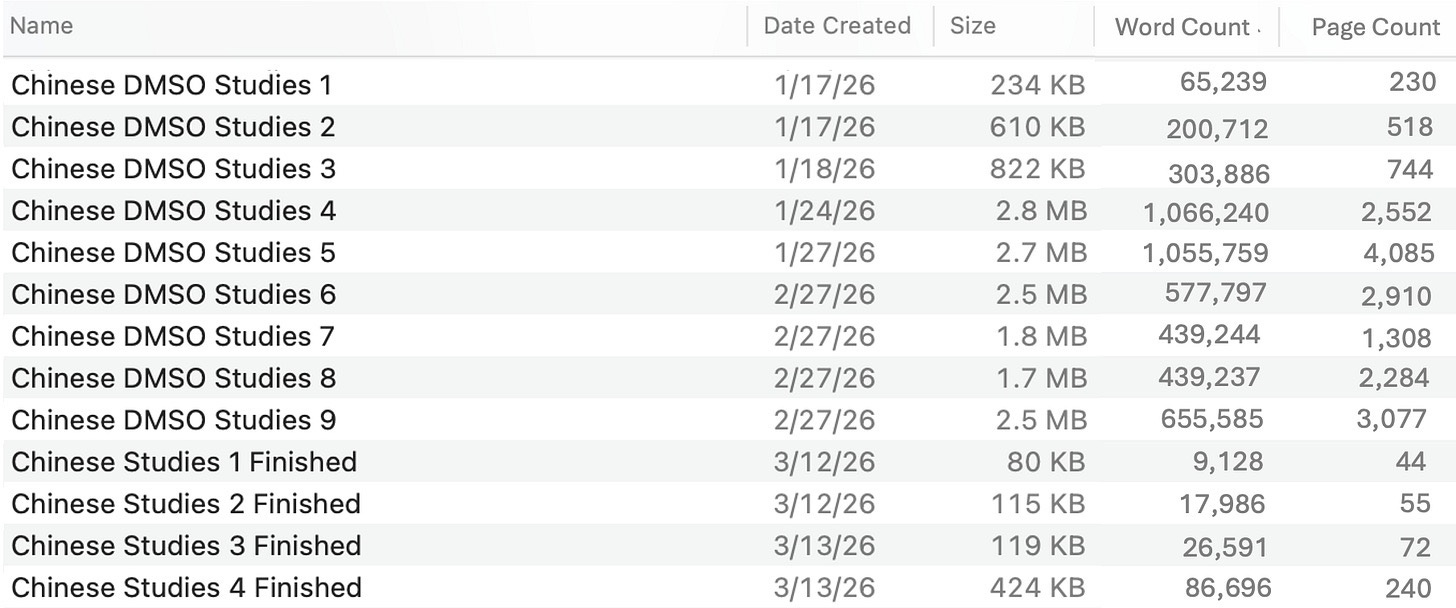
Fortunately, while all of the previous was quite challenging, the next step I’ve been waiting months to do (searching for specific keywords so the studies can be moved to other documents and sorted) is infinitely easier and faster to complete.
Note: in tandem with this, another member of the team is also doing a similar process with the 6,000 reader DMSO reports that have been received, so they can be turned into an easily accessible reference for individuals curious as to how DMSO interacts with a myriad of medical conditions (as it can be used in so many areas, it simply is not feasible to study every application so a synthesis of reader reports represent the best source of data which can practically be obtained in this regard).
Artificial Intelligence
Like many, I have begrudgingly accepted that AI is a part of life and I need to learn how to use it effectively (whereas initially I resisted it because I did not like how using it diminished my cognitive capacities). More than anything else, I believe the most important thing is that writing is not the information you present, but rather the heart and intention behind it (discussed further here). As this is somewhat of a spiritual process, I believe it is unlikely AI will ever be able to replicate it. In turn, I do not like the way AI text sounds or feels, and hence feel quite strongly about not using it (despite its potential to save a lot of time). Similarly, many of the edits AI proposes, while “correct,” break the flow of what I’m trying to convey within the writing, so I am very adverse to it (as how writing feels is very important to me).
Concisely, my perspective is that the currently existing AI has a lot of value if you use it to help you complete a task (or find out how to complete a task), but if you rely upon it to do a task for you, it will frequently create issues that outweigh the benefits it provides. Put differently, completing a task often requires completing a sequential series of steps, and if you understand each step well enough to quickly see if they are being done correctly, AI can greatly help you on the time consuming steps, but at the same time, if you task it with doing sequential steps in a row to do a task for you, rather than assigning something much more concrete (e.g., a single step or process), errors are inevitable which are not acceptable if accuracy is required.
For instance, in this task, I quickly realized:
•AI could not find most of the studies I wanted (e.g., because it wasn’t familiar with most of the databases I wanted), but simultaneously, it was very good at compiling generalizations of things repeatedly studied in the literature (e.g., how DMSO at different concentrations typically affects cells).
• With a bit of work, AI could accurately extract and summarize DMSO pertinent information from large studies (e.g., turn a 30-page paper into a one paragraph summary). This is essentially what made the project possible, as there was no other way I could have reviewed millions of pages of DMSO-related literature.
 The Natural DMSO Heali...
Check Amazon for Pricing.
The Natural DMSO Heali...
Check Amazon for Pricing.
• AI eliminates language and text recognition barriers, which otherwise made it prohibitively time consuming to ever review foreign studies.
• If you give AI a large volume of studies to filter for relevance, it is very difficult to have it have appropriate sensitivity and specificity (it either misses some or flags way too many), and this accuracy varies by the model. Because of this, I largely avoided doing this (instead manually reading through them) and primarily used this filtering on certain groups of foreign studies where it was otherwise prohibitively time consuming to go through them, and accepted a certain portion of studies being missed as a necessary trade off to finish the project. Likewise, in many cases, it was effectively impossible to functionally filter results, as you had to be familiar enough with the DMSO literature to know how DMSO was likely used in a study based on its title (if DMSO was not within the title).
• There are a lot of tricks that exist within word processors and databases, which made projects like this a lot easier to do, and generally, while there were issues with executing them directly, the AI systems were very good for telling you how to do them. For example, Google Scholar only lets you view the first 1,000 search results, so I had to find very creative ways to sequentially break up 4,130,000 results (what you get for searching it for “DMSO”) into relevant chunks that were under that cap and throughout the process, I needed to write small lines of code to facilitate certain steps which they showed me how to do and I could then tweak.
• There are a lot of things AI will reliably screw up, to the point you simply cannot assign those tasks to it. Nonetheless, if 10 steps need to be done and AI can do 3-4 for you, that still saves a massive amount of time.
In short, AI as a tool made this entire project (which would have otherwise been impossible for anyone to ever do) possible to do, but simultaneously, it still required a lot of work on my end, and given the constraints I ran into, I feel it will be a long time (if ever) that functional AI systems can replicate what I did here. I wish it were not that way (the last 5 months were miserable), but that’s just the way it is, and I’m primarily grateful there was actually a way to do this.
Note: throughout this process, I was constantly learning and changing how I approached this compilation. One of my major regrets was that the moment the war with Iran started, my mental bandwidth was stretched to the point it did not occur to me to immediately switch to going through all the remaining Iranian studies (by adding site:.ir to the search query), as shortly after, Iran’s internet was cut off, and it became impossible to access anything on their servers.
Furthermore, because of all the time I’ve spent trying to understand how to effectively use AI to facilitate this task, I’ve also had a lot of time to reflect on how I think AI will affect humanity, particularly with regard to cognition.
 Amazon eGift Card - Ha...
Check Amazon for Pricing.
Amazon eGift Card - Ha...
Check Amazon for Pricing.
 Visa Physical Gift Car...
Check Amazon for Pricing.
Visa Physical Gift Car...
Check Amazon for Pricing.
 Roblox Digital Gift Ca...
Check Amazon for Pricing.
Roblox Digital Gift Ca...
Check Amazon for Pricing.
 $50 Visa Gift Card (pl...
Buy New $54.95
(as of 10:51 UTC - Details)
$50 Visa Gift Card (pl...
Buy New $54.95
(as of 10:51 UTC - Details)
Copyright © A Midwestern Doctor
 Just Get Out! Now!