


The AI Depression
March 26, 2026
Either way AI goes–replacing human labor or failing to meet today’s lofty expectations–the result is the same: an economic Depression.
Either way AI goes–replacing human labor en masse, or failing to meet today’s lofty expectations–the result is the same: an economic Depression with no way out.
In effect, AI is self-liquidating: if it follows the projections of its most ardent promoters and replaces most human workers, it collapses the economy and society, and if it underperforms, it’s an enormous waste of capital and resources that sinks the economy into Depression.
Let’s break down each pathway to Depression.
 Nineteen Eighty-Four
Best Price: $8.96
Buy New $14.39
(as of 10:41 UTC - Details)
Nineteen Eighty-Four
Best Price: $8.96
Buy New $14.39
(as of 10:41 UTC - Details)

To its promoters, AI is unstoppable and will generate super-abundance in whatever it creates for near-zero cost, and this abundance will effortlessly be shared with everyone because AI is super-productive.
Here is an example of this projection:
The Displacement of Cognitive Labor and What Comes After.
Ai agents will replace cognitive (i.e. creative / white-collar) labor, and AI-powered robots will replace manual labor, freeing humanity to find meaning not in work but other activities that replace work as the source of meaning.
What’s striking about this projection is it doesn’t mention the physical-world constraints of Growth At Any Cost / Waste Is Growth such as energy, fresh water, fertile soil, etc. We are left presuming AI will magically eliminate all such material constraints by means unknown but guaranteed to manifest because AI can solve anything–we’re constantly assured it’s already a super-intelligence.
This is the magical thinking at the heart of The Mythology of Progress: that all new technology is always positive, and every physical limit can be overcome by innovation / ingenuity, the only impediment to super-abundance is the naysayers.
The essay also doesn’t present a plausible source of the trillions of dollars needed to fund Universal Basic Income (UBI) for everyone who no longer earns a living from work.
The common assumption here is that AI’s productivity will automatically be profitable: since AI can grow all the food, it will be cheap. But if there is insufficient water and the soil has been depleted, AI will grow no more food than humans because the constraints are physical, not cognitive.
As for profitability, consider this comprehensive overview of the rapid advances in robotics / AI in China:
“As government subsidies flood the robotics sector, Chen and his peers are bracing for the usual pattern: price wars and cost cutting maneuvers that leave companies barely able to turn a profit.”
In other words, as private capital and state funding pour money, resources and talent into the hot new sector, profitability vanishes: there’s an oversupply of everything and a customer base that’s too narrow to generate demand enormous enough to absorb all the products at prices that generate profits.
The idea that AI will generate trillions in “free wealth” that can then be distributed to the hundreds of millions of displaced workers in sufficient sums to enable a vast free-spending consumer class is not just unrealistic–it’s a pipe dream.
Put another way: if displaced workers are getting barebones Universal Basic Income or equivalent–subsidized energy and food, etc.–then the number of people who will be able to buy a robot-assembled new vehicle or a household robot-servant will be far too limited to support a scale of production that offers economies of scale.
This is the Henry Ford insight: if workers (or displaced workers) have minimal incomes, they can’t afford the products capitalism is producing.
 Liberty and Nature: An...
Best Price: $21.50
Buy New $26.49
(as of 10:27 UTC - Details)
Liberty and Nature: An...
Best Price: $21.50
Buy New $26.49
(as of 10:27 UTC - Details)
Karl Marx viewed these dynamics–declining profits as capital expands and seeks a return while immiserating the workforce to reduce costs, reducing demand for expanding production–as self-liquidating: capitalism’s core gearing collapses capitalist economies. It is ironic that Marx’s description may finally reach fruition in the end-game of AI.
Another element that the AI promoters never dare mention is much of the “cognitive work” AI will do is what David Graeber memorably called BS Work–tasks without any real productive value, busy-work demanded by unproductive, complex organizations that reached this level of dysfunction as their initial modest cost structure transmogrified into bloated, extractive fiefdoms (higher education, healthcare, defense, etc.) whose share of the economy has soared as administrative costs (i.e. BS Work) generate make-work.
Consider this chart of healthcare employment (via J.F. MD). As Healthcare’s share of the economy has soared from 5% to nearly 20%, the quantity of BS Work (administrative tasks) and the workforce to perform this work have also soared. (The chart of professors and university administrators is a close match for this: flatlined number of professors, monumental increases in administrative staff.)
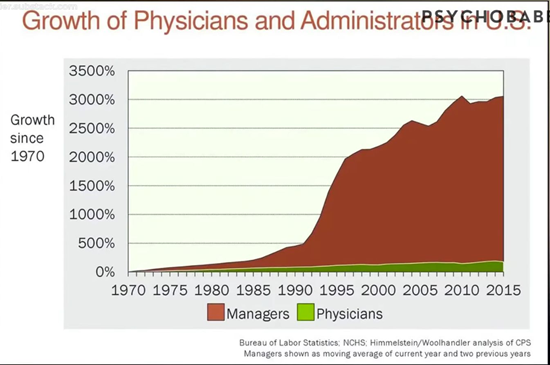
Now the proponents of AI are salivating at the prospect of charging the same absurdly high fees while eliminating all those high-cost human physicians and technicians.
 Amazon eGift Card - Pl...
Buy New $50.00
(as of 06:27 UTC - Details)
Amazon eGift Card - Pl...
Buy New $50.00
(as of 06:27 UTC - Details)
 Visa Physical Gift Car...
Buy New $105.95
(as of 11:21 UTC - Details)
Visa Physical Gift Car...
Buy New $105.95
(as of 11:21 UTC - Details)
 Roblox Digital Gift Ca...
Buy New $50.00
(as of 04:31 UTC - Details)
Roblox Digital Gift Ca...
Buy New $50.00
(as of 04:31 UTC - Details)
 $50 Visa Gift Card (pl...
Buy New $54.95
(as of 10:51 UTC - Details)
$50 Visa Gift Card (pl...
Buy New $54.95
(as of 10:51 UTC - Details)
Copyright © Charles Hugh Smith
 Why Won't Pam Bondi Release All Epstein Files?