


Why the Deep State Will Always Need the Underworld as an Outsourcing Partner.
February 7, 2026
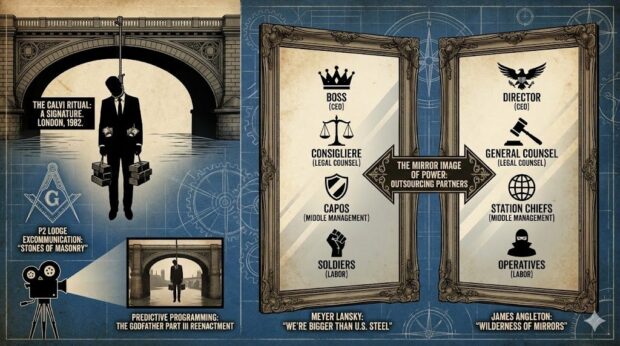
London, June 18, 1982. A postal clerk is walking to work across Blackfriars Bridge. He looks over the edge and sees a man hanging from the scaffolding. The man is wearing an expensive gray suit, but his pockets are weighed down with bricks and nearly $15,000 in cash.
The man was Roberto Calvi, chairman of Banco Ambrosiano. The press called him “God’s Banker.”
Days earlier, Calvi was frantic. He told anyone who would listen that he wasn’t a criminal mastermind; he was a pawn. He was trapped in a massive game involving the Vatican Bank, the Mafia, and a shadowy Masonic lodge called Propaganda Due (P2). The authorities didn’t listen. They ruled it a suicide.
But look at the details. They scream ritual. Calvi was found hanging under Blackfriars Bridge. In Masonic lore, the “Black Friars” are significant symbols. And those bricks in his pocket? They weren’t just weights to drown him. In the rituals of the P2 Lodge, initiates were often told that traitors would be weighed down by ‘stones of masonry.’ As investigative journalist Rupert Cornwell noted in God’s Banker, the scene was too theatrical to be a simple hit. It was a signature. The P2 Lodge wasn’t just silencing a witness; they were excommunicating a heretic.
If you’re a film buff, you know this scene. It’s the climax of The Godfather Part III. We watch the corrupt banker swing from a bridge as the Corleones settle their family business. But Coppola didn’t invent that scene. He reenacted it.
Here’s the paradox I want to explore with you. People watch these films for the violence and the opera. But look closer. These films are telling us something uncomfortable about how the world actually works. The Godfather, Casino, and The Irishman aren’t just escapism. I believe they’re Predictive Programming—a glimpse into a world where the line between the criminal underworld and the “legitimate” overworld dissolves.
The Mirror Image of Power
We tend to think of Organized Crime as a cancer on a healthy society. We imagine the Government on one side (Law & Order) and the Mob on the other (Chaos).
But the best movies reveal the truth: these two aren’t enemies. They’re mirror images.
Look at the structure of a Mafia family. You’ve got the Boss (CEO), the Consigliere (Legal Counsel), the Capos (Middle Management), and the Soldiers (Labor). It’s a perfect corporate hierarchy designed for one purpose: to compartmentalize liability. The Boss orders a hit but never holds the gun. Layers of buffers shield him.
This corporate ambition wasn’t subtle. Meyer Lansky, the financial genius behind the Syndicate, viewed his operation as identical to any Fortune 500 company. He told his biographer:
“We’re bigger than U.S. Steel.”
He wasn’t bragging about violence. He was bragging about scale.
Intelligence agencies use this exact structure. Legendary CIA counter-intelligence chief James Jesus Angleton described his world as a “wilderness of mirrors”—a landscape where deception is so layered that truth and fiction blur. In this wilderness, the “Good Guys” and the “Bad Guys” use the same tactics. When the CIA needs to move funds off the books to finance a coup, or when they need “heavy lifting” done in a foreign port, they don’t send a bureaucrat. They use assets who operate in the dark.
The Mob isn’t an enemy of the Deep State. It’s merely the Deep State’s outsourcing partner.
Operation Underworld and the Handshake
Let’s dig into some history. The partnership began during World War II with “Operation Underworld.”
Naval Intelligence feared Axis saboteurs on the New York waterfront. They reached out to the only man who controlled the docks: Charles “Lucky” Luciano. Luciano sat in a cell in Dannemora, but he gave the order. The docks were secured. In return, the government commuted his sentence.
The “Good Guys” shook hands with the “Bad Guys,” and they never let go.
You might ask: Why on earth would the government do this? Michael Graziano answers this in Errand into the Wilderness of Mirrors. He argues that the early CIA didn’t just view religion as a belief system, but as a “strategic weapon.” As OSS chief “Wild” Bill Donovan popularized, religion was seen as “everywhere, free, and individual: a natural ally in war and diplomacy.” In a holy war against Godless Communism, you use any weapon you can find.
This relationship deepened during the Cold War. As you see in The Irishman (and as the Church Committee hearings confirmed), the CIA recruited mafia figures like Sam Giancana and Santo Trafficante Jr. to kill Fidel Castro. Why? An intelligence agency can’t be seen killing a head of state. But the Mob? They kill people every Tuesday. It provides the perfect cover.
The government didn’t even hide this philosophy—if you knew where to look. General Walter Bedell Smith, an early Director of Central Intelligence, admitted to the sheer scale of the deception needed to fight the Cold War. He told a government commission that the CIA had to operate with a completely different moral rulebook. He said:
“We have to be just as clever, just as unadvertised, and just as ruthless as they are.”
“Unadvertised” is the key word there. It’s the bureaucratic term for ‘illegal.’ And who is better at unadvertised violence than the Mob?
The lines blurred. Mobsters often felt like patriots. Sam Giancana, the Chicago Outfit boss, vented his frustration when the government turned on him:
“Listen, I’m an American citizen, and I’ve been a good one… The CIA and the FBI, they’re all the same. They use you when they need you, and they throw you away when they don’t.”
The P2 Lodge: Infiltrating the Church
This brings us back to Roberto Calvi and the bridge.
The most disturbing part of this matrix isn’t that the Government uses the Mob. It’s that these networks infiltrate the sacred.
In the 1970s and 80s, the Propaganda Due (P2) Lodge rocked Italy. This clandestine Masonic lodge functioned as a shadow government. It included journalists, generals, MPs, and spies. Their goal: shift Italian politics to the right to stop a Communist takeover—a goal shared by NATO and the CIA.
But they needed untraceable money. They found it in the Vatican Bank.
Through Roberto Calvi, the P2 Lodge used the Institute for the Works of Religion (the Vatican Bank) to launder mafia money and fund political operations. This is the ultimate inversion: men of power hijacking the sacred symbols of the Church.
Archbishop Paul Marcinkus, the Chicago-born prelate who ran the Vatican Bank, summarized this cynical attitude best. When reporters pressed him on his aggressive deals, he retorted:
“You can’t run the Church on Hail Marys.”
The rot was internal. Before his death, Roberto Calvi gave a desperate interview warning the public about the forces inside the Vatican:
“The Vatican is a microcosm of the world… It is a state within a state, and it has its own laws, its own police, its own secret service. But it is also a bank.”
Francis Ford Coppola centered The Godfather Part III on this dynamic. The Corleones try to “legitimize” their billions by buying into the Vatican’s massive property company, Immobiliare. The movie suggests the corruption inside the Vatican ran just as deep as the corruption in Las Vegas.
Copyright © Preppgroup
 All Is Well or Is It?