


Israel’s Global Doctrine of Fragmentation
How Covert Operations and Strategic Instability Shape the Modern World
January 6, 2026
At the UN, Netanyahu held placards, declaring himself “The Blessing” as a leader destined to guide the Economic Corridor. Yet the reality was relentless assault on every nation along that path—everywhere but one. And then, as I traced this unfolding doctrine, the Somali fraud story went viral in America. What seemed like a random scandal revealed itself as a fragment of the same architecture of manipulation.
This Doctrine File uncovers, through documents, secret operations, and media orchestration, that Netanyahu is not “THE BLESSING,” but the “THE CURSE.”
I didn’t doubt the Somali fraud story. I had already read about it weeks earlier — in November 2025, in the New York Times— and initially reacted to it like many others. What began to trouble me was not the substance of the case, but the timing and intensity of its resurrection. As I was writing about Somalia’s growing strategic exposure, quiet diplomatic moves toward Somaliland recognition surfaced almost in parallel. At the same time, old investigations were repackaged as revelations, prosecuted cases reframed as discovery, and the outrage began to move faster than the evidence.
Elon Musk, newly rehabilitated after his early, costly dissent over Gaza, was suddenly boosting the story alongside Laura Loomer and a constellation of pro-Israel media accounts. The pivot was unmistakable: from Gaza’s unbearable clarity to a familiar moral panic about “Radical Islam,” precisely the reframing Israel’s own leaked research — as reported by DropSite News — later admitted it needed to survive the collapse of global sympathy.
The amplification was no longer proportional to the facts, nor to their novelty. It traveled along familiar routes—through the same media figures, platforms, and political actors who had spent months struggling to redirect public attention away from Gaza. What appeared to be a domestic corruption story was being asked to do geopolitical work.
That realization reframed the entire inquiry. The question was no longer what happened, but why now, and to what end. Once Israeli TBN reporting—by former Israeli intelligence officer Mati Shoshani—openly confirmed that Mossad had assisted in promoting the story inside the United States (check video below), the logic ceased to be speculative. It became structural. That conclusion was further corroborated when Ynet, Israel’s largest newspaper, went even further on December 26, 2025, publishing an article explicitly titled “Behind Israel’s recognition of Somaliland: years of quiet Mossad involvement,” effectively confirming that the episode was not an anomaly, but part of a long-running intelligence architecture operating beneath the public narrative.
This was not a one-off scandal, nor a media coincidence. It was an entry point. What followed, and what this doctrine file documents, is how that same pattern—strategic amplification, selective moral panic, and narrative synchronization—reappears across regions and decades. From Somalia to Yemen, from Gaza to Syria, from Africa to Latin America, the same doctrine emerges: fracture states, elevate proxies, redirect outrage, and present the outcome as inevitability. This doctrine file does not chase headlines. It excavates the system beneath them.
This is not an essay about a viral fraud case. This is an investigation into how crises are curated, how outrage is routed, and how a single doctrine—applied globally—turns distraction into strategy and fragmentation into power.
The Doctrine of Fragmentation
Geopolitical chaos rarely emerges spontaneously. It is cultivated, financed, and—most importantly—designed. For more than half a century, Israel has pursued a doctrine that treats regional stability not as a goal, but as a threat. The logic is simple and has remained remarkably consistent across decades: unified states can resist pressure; fragmented ones cannot. From this premise flows a strategy that privileges militias over governments, separatism over sovereignty, and perpetual insecurity over negotiated settlement.
This doctrine did not originate with Netanyahu, nor did it emerge from the post-9/11 security environment. Its roots lie in Israel’s early strategic thinking, particularly Israel first prime minister David Ben-Gurion’s “Periphery Doctrine,” which sought alliances with non-Arab or marginal actors to encircle and weaken Arab majorities. Over time, the doctrine evolved from diplomatic alignment into something far more aggressive: the active encouragement of state fracture as a tool of dominance.
What distinguishes Israel’s approach from traditional imperial intervention is not scale but method. Rather than direct occupation everywhere, Israel exports techniques—counterinsurgency models, surveillance systems, AI (“Pax Judaica”), population control strategies, and arms flows—that allow conflicts to sustain themselves. War becomes self-maintaining. Reconstruction is deferred indefinitely. Refugees become leverage. Fragmentation becomes normal.
Israel does not export stability. It exports controllable chaos.
This is not conjecture. It is observable in pattern, repetition, and outcome—from Gaza to Syria, from Sudan to Nigeria, and from Venezuela to Mexico.
Somalia and Somaliland: Recognition as a Weapon
Somalia’s civil war is often described as a tragic failure of governance. That framing omits a crucial truth: the war was prolonged, intensified, and strategically manipulated by external actors who benefited from its continuation.
Since Somalia aligned with Arab states hostile to Israel, Tel Aviv’s interference was neither peripheral nor incidental— it was deliberate, strategic, and central to the shaping of the conflict that would define the Horn of Africa for decades.
Israel, operating through its proxy partner Ethiopia, did not merely observe Somalia’s internal conflicts—it actively engineered and amplified them. By funneling arms (including cluster munitions and napalm), intelligence, and strategic support to Ethiopian-backed Somali separatist factions, Israel helped ignite a conflict that spiraled into the broader Somali Civil War of 1991 onward, a catastrophe that claimed between 350,000 and 1 million lives through fighting, famine, and disease. The fallout created a mass exodus: thousands of Somalis forced to flee, seeking refuge in Europe and the United States, yet not a single refugee found asylum in Israel, revealing a cold calculus in which Israel profited from the chaos it helped create while offering no sanctuary to its victims. This is the Doctrine of Fragmentation in its starkest form: manufacture instability abroad, control the narrative, reap strategic gain, and evade responsibility
Chaos abroad is policy. Safety at home is selective. Israel helped manufacture Somalia’s collapse—then sealed its borders while the fallout was exported to America and Europe.
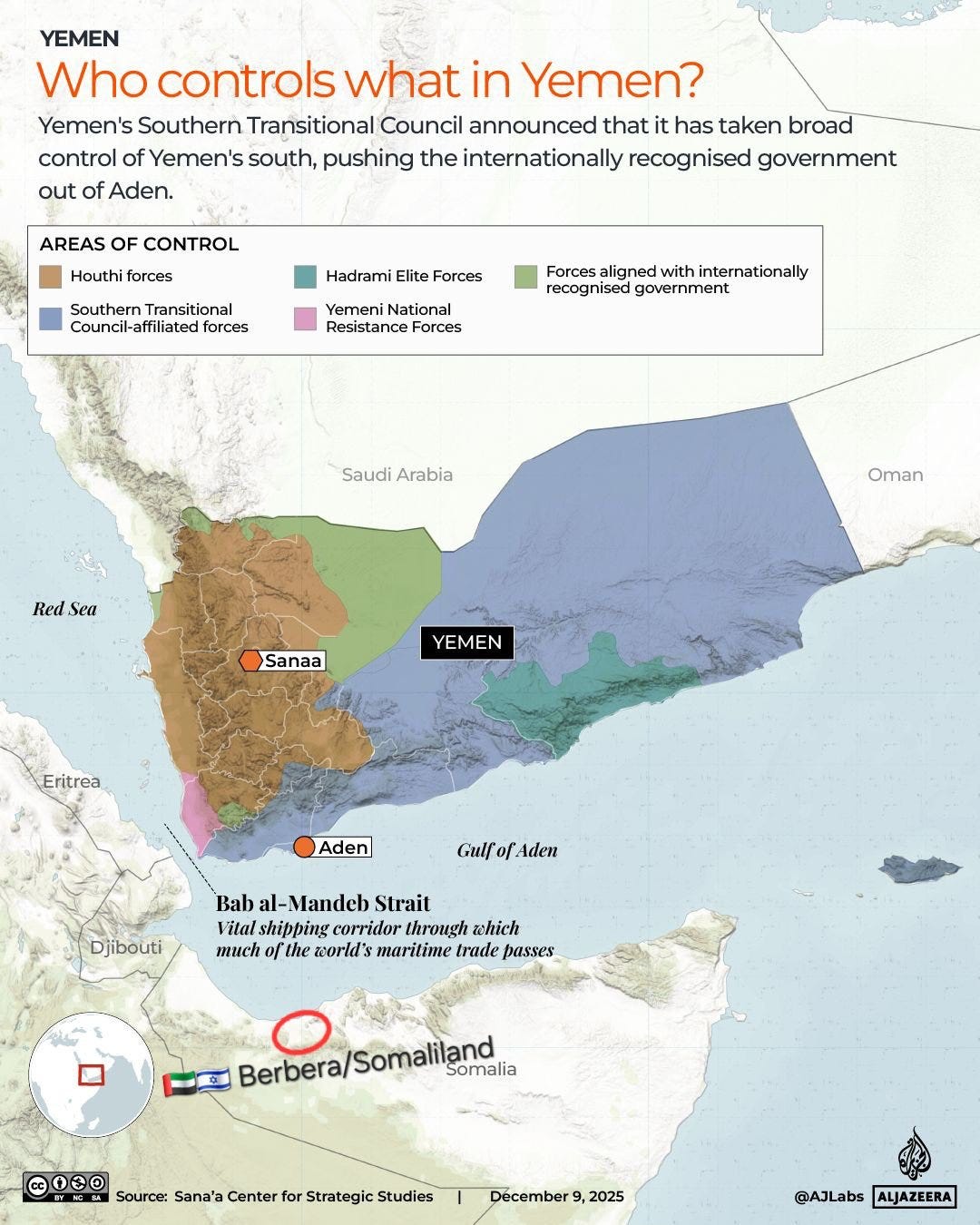
Fast-forward to the present, and the pattern repeats with modern tools. Israel’s recognition of Somaliland is far from a diplomatic courtesy—it is a calculated, strategic provocation. Somaliland commands the Gulf of Aden and sits adjacent to the Bab el-Mandeb Strait, one of the world’s most critical maritime chokepoints. Recognition is not symbolic: it authorizes fragmentation. Fragmentation authorizes basing rights. Basing rights authorize control.
Fragmentation is power; chaos is leverage; Somaliland is both.
Somalia’s government immediately condemned the move, calling it blatant interference and warning against forced Palestinian displacement schemes tied to the recognition. The condemnation was echoed globally, with Saudi Arabia and Algeria pushing for a UN Security Council session to address the issue. This is not mere rhetoric. Israeli strategists had already explored Somaliland as a potential destination for Palestinians expelled from Gaza, revealing a broader, deliberate pattern of engineered displacement, regional destabilization, and territorial manipulation. Establishing chaos in the Horn of Africa is not an isolated event; it is part of a calculated strategy to fracture alliances and create openings across the Middle East—We will explore this more in later sections.
Copyright © Phantom Pain
 Somalians, IQ, and the Fraud of Diversity