


We Can Discern Cycles and Waves, But Not the Outcomes
January 8, 2026
Which brings us to the present and the cycles and waves that have yet to reach the concluding third act, where the dramatic climax leads to resolution.
We can discern cycles and waves in the past and posit them in the present, but not the outcomes. A great many phenomena follow cyclical patterns, from sunspots to Peter Turchin’s 50-year cycle of human history, while others form waves.
Author David Hackett Fischer (The Great Wave: Price Revolutions and the Rhythm of History) described the difference between cycles and waves:
“Cyclical rhythms are fixed and regular. Their periods are highly predictable. Great waves are more variable and less predictable. They differ in duration, magnitude, velocity, and momentum. One great price wave lasted less than ninety years; another continued more than 180 years. The irregularities in individual price movements make them no more (or less) predictable than individual waves in the sea.
Even so, all great waves had important qualities in common. They all shared the same wave-structure. They tended to have the same sequence of development, the same pattern of price relatives, similar movements of wages, rent, interest rates; and the same dangerous volatility in later stages. All major price revolutions in modern history began in periods of prosperity. Each ended in shattering world crises and was followed by periods of recovery and comparative equilibrium.”
Examples of waves range from rogue waves in the sea to bond yields / interest rates which arise and decline over periods of time that vary too much to qualify as cycles but match the dynamics of waves described by Fischer. Bond yields have gone from peaks to troughs in less than 20 years to the recent span of about 40 years–at the outer duration boundary of previous interest rate/yield waves.
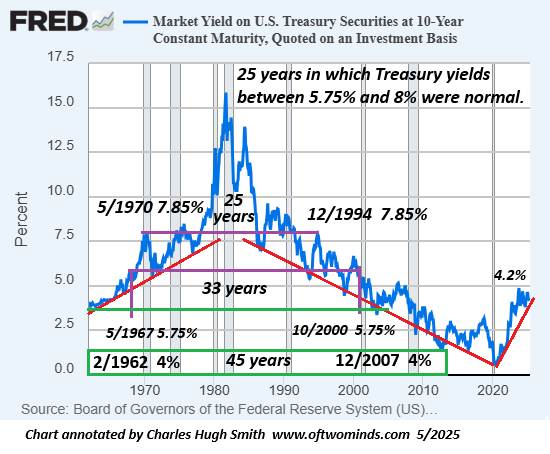
In other words, the cycles described by historian Peter Turchin (50 year cycles that can generate 100-year, 150-year and 200-year cycles), along with many other cycles–the business cycle, the Kondratieff credit cycle, the Debt Super-Cycle, etc.–are defined not solely by time but by their internal dynamics and measurable qualities. Waves and cycles share many of the same dynamics and are easily confused.
As Fischer observed, waves of human history share characteristics with ocean waves, which can accrete energy and become giant rogue waves that cannot be predicted even as they can be foreseen as recurring phenomena.
I posted a list of dynamics currently accreting in self-reinforcing feedback loops last January:
Catch-20: The 20 Dynamics That Will Shape the Next Decade (1/15/25).
Both waves and cycles tend to follow the dynamics of S-curves in which a trend takes off in a boost phase, matures into a peak and then decays or reverses.
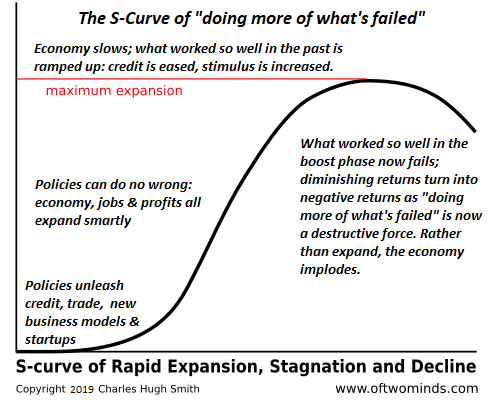
What cannot be discerned are the consequences and outcomes. An economic cycle or wave might culminate in an excess-clearing recession that sets the stage for an ultimately positive rebalancing of risk and debt, or the outcome might be an excess-clearing Depression that lays waste to the entire status quo.
Two cycles have attracted much commentary over the past decade: The Fourth Turning posited by William Strauss and Neil Howe in their 1997 book The Fourth Turning: An American Prophecy (subtitled What the Cycles of History Tell Us About America’s Next Rendezvous with Destiny) which laid out an 80-year cycle of four generational turnings (High, Awakening, Unraveling, Crisis) that culminate in a system-changing Fourth Turning.
This 80-year cycle aligns with the nation-changing crises of 1781 (the end of the Revolutionary War and the founding of the United States), 1861 (the start of the Civil War) and 1941 (America’s entry into an existential global conflict, World War II). This cycle suggests a nation-changing crisis began around 2021.
Strauss and Howe took pains to note that the outcome of each crisis isn’t pre-ordained to be positive. Complacency based on the idea that it will all turn out wonderfully due to the nation’s destiny could be fatal.
 What the Venezuelan Constitution Says About Changing the President