


The "Phantom Legion" Problem
February 13, 2024
Everything is presented as rock-solid until it falls apart.
Of the many signs of systemic decay in the late Roman Empire, one of particular relevance to our era is the Phantom Legion, military units that on paper were at full strength–and paid accordingly–but which were in reality no longer there: the paymaster collected the silver wages and recorded the unit’s roll of officers and soldiers, but it was all make-believe.
 Egalitarianism as a Re...
Best Price: $3.44
Buy New $8.95
(as of 07:55 UTC - Details)
Egalitarianism as a Re...
Best Price: $3.44
Buy New $8.95
(as of 07:55 UTC - Details)

When the Empire’s wealth seems limitless, graft, embezzlement and fraud all seem harmless to those skimming the wealth. Look, the Empire is forever, what harm is there in my little self-interested skim?
This rot starts at the top, of course, and then seeps into every nook and cranny of the system. When those at the top are getting fabulously wealthy on modest salaries while claiming to serve the public, the signal is clear: go ahead and maximize your own private gain at the expense of the public and the state. Civic virtue–the backbone of the Empire–decayed into self-interest, incompetence and indulgence.
The “Phantom Legion” Problem has another wrinkle: the legion is reported at full strength, but the actual number of soldiers is far lower than the reported number, and the competence of the officers is so low that the legion is incapable of performing its duties. In other words, the numbers don’t reflect the actual utility-value of the legion as a combat unit: the soldiers may be ill-trained, ill-equipped and poorly fed, and the officers inexperienced, corrupt or just waiting for their term of duty to end.
 The Unprotected Class:...
Buy New $20.74
(as of 07:27 UTC - Details)
The Unprotected Class:...
Buy New $20.74
(as of 07:27 UTC - Details)
In the present day, this is how The Phantom Legion Problem manifests: the agency / institution is reported at full strength and fully capable of performing all its duties, but beneath the surface it’s lacking experienced staff and competent leadership, and much of the staffing is in unproductive, dead-wood administrative positions.
Taking healthcare as an example, we find experienced frontline caregivers are retiring and not being replaced with equivalent numbers of staff with the equivalent experience. We find caregivers are burning out due to crushing workloads, or quitting the profession in order to have a family and get their life back.
Meanwhile, the number of administrators increases, soaking up the system’s funding with endlessly expanding compliance data entry, reports, etc., all of which adds additional burdens on those actually providing care.
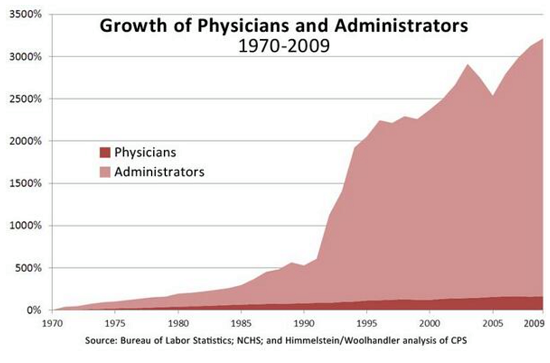
There’s always enough money to increase administrators’ salaries, but not enough to maintain essential systems or hire more caregivers.
 Think About It