


Why the Jews of Khazaria, the Himyarites, and GokTurk Empire Are Keys to Universal History
October 21, 2023
This article was also presented by the author as a class, as part of the RTF Lecture Series “The Renaissance Principle Across the Ages“.
With the fires of potential global war once again erupting across the Middle East, and with obvious anti-jewish rage amplifying to an extreme degree, I would like to take a moment to follow up on a previous essay titled ‘The Peace of Westphalia as a Lesson in Solving Religious Wars Past Present or Future’.
The purpose of this investigation into the deep structure historical dynamics shaping our present world is not to simply romanticize bygone ages but to help clarify the principled dynamics that feudalist oligarchs have been obsessively trying to destroy over the course of the past two millenia. I here refer to the dangerous outbreak of peace through cooperation that has tended to occur between religious rivals in never-ending wars across the ages.
In this location, I would like to go a little deeper into the longer wave of history shaping our presently confused age by taking a look at the Jewish Kingdom of Khazaria (8-11th century CE).
Taking the time to investigate this important part of world history is additionally important as China’s New Silk Road currently represents the greatest hope for peace amongst various faiths and cultures not only in the Middle East, but globally. This is not the first time that the Silk Road ushered in a hope for a new age of reason amongst diverse cultures and as we shall soon see, the Kingdom of Khazaria played a major role in that endeavor which St Augustine called a City of God well over a millennium ago.
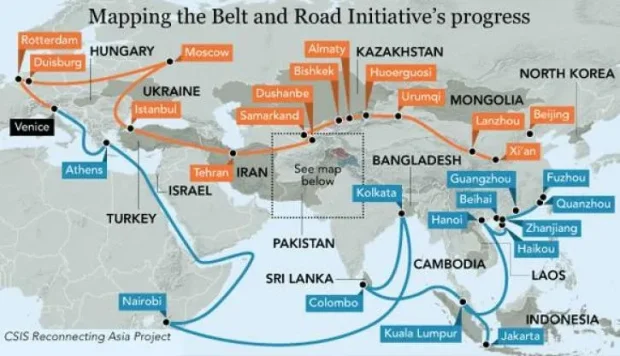
Figure 1 Today’s New Silk Road
Typically well informed readers who frequent alternative media either have never heard of the Jewish Khazar Kingdom that dominated central Europe, southern Russia and the Caucuses in the 7-10th century or IF THEY HAVE heard of it, they tend to believe that this Kingdom was the source of everything evil up until modern times. Many mainstream scholars tend to simply deny all evidence that this Jewish kingdom ever even existed.
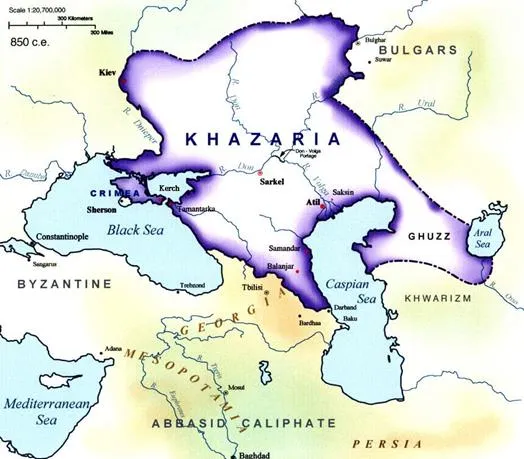
Figure 2 The Kingdom of Khazaria
I would like to take a novel approach to this anomalous matter of Khazaria and the broader role of Judaism in world history. Not only do I assert that bountiful evidence allows us to conclude that this Jewish Kingdom certainly did certainly exist, but all existent evidence points to the fact that it was the very opposite to a hotbed for “evil Ashkenazi Jewry” as so many lazy researchers have claimed. Instead, this report will attempt to prove that the forgotten kingdom was not only a beautiful phenomenon uniting all three major Abrahamic faiths under one ecumenical alliance of cooperation for well over a century, but also served as a keystone to the newly reborn Silk Road trade routes uniting Asia with Europe through the Confucian Tang Dynasty (618-912 CE).
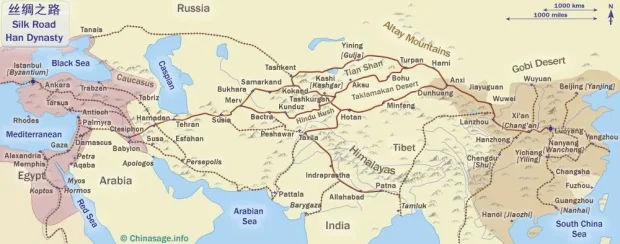
Figure 3 The Ancient Silk Road with a trade route through Russia
Much of the following report was made possible by the pioneering work of historian Pierre Beaudry in his online book The Charlemagne Ecumenical Principle.
Under a primitive version of Samuel Huntington’s Clash of Civilizations doctrine, the Venetian Empire and the Ultramontane Church which were the heirs of the recently collapsed Roman oligarchy hated the rise of the Carolingian Empire under Charlemagne and the Augustinian humanist educational and economic reforms enacted during Charlemagne’s reign. More importantly, they hated the brilliant alliances Charlemagne oversaw alongside his co-thinker Harun al Rashid (Caliph of the Abassid Dynasty of Baghdad who ruled from 786-809 CE) and the new King Bulan of Khazaria who converted his kingdom to Judaism in the mid-8th century.
Much of the following report was made possible by the pioneering work of historian Pierre Beaudry in his online book The Charlemagne Ecumenical Principle.
Under a primitive version of Samuel Huntington’s Clash of Civilizations doctrine, the Venetian Empire and the Ultramontane Church which were the heirs of the recently collapsed Roman oligarchy hated the rise of the Carolingian Empire under Charlemagne and the Augustinian humanist educational and economic reforms enacted during Charlemagne’s reign. More importantly, they hated the brilliant alliances Charlemagne oversaw alongside his co-thinker Harun al Rashid (Caliph of the Abassid Dynasty of Baghdad who ruled from 786-809 CE) and the new King Bulan of Khazaria who converted his kingdom to Judaism in the mid-8th century.
Copyright © Matthew J.L. Ehret
 Reflections on Israel and the United States