


Contractual Community
July 11, 2018
It is often offered that agreement by contract would be sufficient to form a libertarian community: the terms of admission would be spelled out and agreed to voluntarily; the rights and responsibilities are covered; mechanisms for dispute resolution are spelled out. I would like to raise a few concerns with this idea.
I was prompted to this post via a discussion with Victor July 6, 2018 at 3:37 PM. The relevant discussion:
Victor: Yeah bionic some sort of private club model could play the behavioral / disciplinary role now played crudely and ineptly by the state. Hoppe’s private and privately supervised residential neighborhoods come to mind. If you have a bad reputation you are denied admittance. If you behave badly you get thrown out. Private club based society really encourages developing a good reputation and makes it very costly and inconvenient not to.
bionic mosquito: Victor, I believe for such a “private club model” to remain “libertarian” requires something transcendent, something beyond the values of the living members.
Think about organizational transition; think about all of the think tanks that have lost their way after the founder or first generation has passed on.
The examples are countless and demonstrate clearly, it seems to me, that absent something transcendent – something guiding the leadership beyond the goodwill of the existing members – such “private clubs for liberty” will not last long.
The Free Society Best Price: $13.55 Buy New $17.54 (as of 04:55 UTC - Details)

Sure, they all had Articles of Incorporation, By-Laws, etc. – in other words, the exact requirements for a “contractual private law society” envisioned by many libertarians: “oh, just sign a contract.”
Yet these “contracts” failed to protect the Mission beyond one lifetime.
The issue: how to stay true to the mission through various transitions, etc. An example might be helpful:
Ford Foundation: Today [8 November 2015] I’m excited to announce that the Ford Foundation’s two-year transition is over… Back in June, I shared the news that we would focus on combating inequality and that we had landed on a set of thematic areas aimed at addressing what we have identified globally as the five key drivers of inequality.
The initial purpose of the foundation?
The foundation was established January 15, 1936, in Michigan by Edsel Ford (president of the Ford Motor Company) and two other executives “to receive and administer funds for scientific, educational and charitable purposes, all for the public welfare.”
And how soon did the mission change…the first time?
After the deaths of Edsel Ford in 1943 and Henry Ford in 1947…[t]he board of trustees then commissioned the Gaither Study Committee to chart the foundation’s future. The committee, headed by California attorney H. Rowan Gaither, recommended that the foundation become an international philanthropic organisation dedicated to the advancement of human welfare and “urged the foundation to focus on solving humankind’s most pressing problems, whatever they might be, rather than work in any particular field….” The board embraced the recommendations in 1949.
So much for the focus on science and education; the focus is now “equality.”
While less relevant, one could also examine the for-profit world. Why I say “less-relevant”? The non-profit / foundation world is a world of ideas – an organization is funded and sustained in pursuit of an idea. Libertarianism is nothing if not an idea. If there was money to be made in the NAP, why are so few people making it? So…I see the for-profit world less relevant to this discussion, but will address it.
Victor offers a possibility in the for-profit world:
Big corporations deal with this problem by bidding up the price of good CEO’s. Or good CEO’s vie for control of companies which have lost their way.
Examples can certainly be offered about CEOs who have changed course from that which even their predecessor had set – Google’s “Don’t be evil” or whatever they said along these lines (HT Nick) is one of many examples, flushed down the toilet when the hypocrisy became obvious to all.
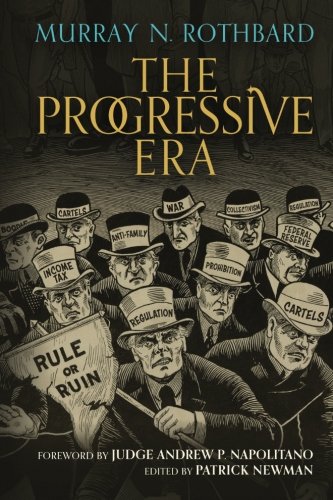 The Progressive Era
Best Price: $17.74
Buy New $11.33
(as of 07:25 UTC - Details)
But this isn’t my main objection to this idea. My main objection is that this idea is nothing other than restating the need of hiring the right strongman: “if only we elect the right leader.”
In any case, one can examine contracts: this vehicle for a contractual community has a sufficient history worthy of examination. Anyone with any experience dealing with such matters knows the following about contracts: no matter how detailed, one can never capture beforehand all possibilities; no matter how well thought-out, contracts are modified and revised.
No matter how well delineated, achieving a “meeting of the minds” between two people is often complex enough, let alone amongst a community of people.
Conclusion
At its core, what is a contractual community but a community in which all residents have signed onto the constitution? And how well have constitutions – a piece of paper – been respected by even those who have signed or drafted it? In any case, constitutions have virtually always been more effective at protecting those in power from the people as opposed to the other way around.
The longest lasting and most (relatively) libertarian society had law that was supported by something transcendent, something not human and more than human; call it respect for culture and tradition or call it God. In its place, we have tried constitutions and we have tried strongmen.
Neither has worked very well at securing and maintaining liberty.
Reprinted with permission from Bionic Mosquito.
 Will The End of May Come in July?
