


50 Things You Might Not Know About Star Wars
May 6, 2017
The best way to celebrate Star Wars Day is to learn something new about a galaxy far, far away. So here are 50 fascinating facts about Hollywood’s most iconic space epic.
1. LUKE SKYWALKER IS THE HERO WITH A THOUSAND FACES.
Though equally inspired by fairy tales, westerns, and 1930s sci-fi serials, George Lucas based the framework of the story for the original Star Wars (1977) around the theories of Joseph Campbell’s book, The Hero with a Thousand Faces.
The book tracked common mythological motifs and argued that myths from around the world that have been passed down through generations—like Beowulf or King Arthur—share a basic structure. According to Campbell, “A hero ventures forth from the world of common day into a region of supernatural wonder: fabulous forces are there encountered and a decisive victory is won; the hero comes back from this mysterious adventure with the power to bestow boons on his fellow man.” Lucas simply grafted these ideas onto his story, with Luke as the main hero.
2. LUCAS ALSO RELIED ON AKIRA KUROSAWA FOR THE STORY’S P.O.V.
Lucas struggled with just how to tell this massive sci-fi space opera on a personal and relatable scale, and he found the answer in director Akira Kurosawa’s 1958 film The Hidden Fortress. Telling the story of a roguish general protecting a beautiful princess from an evil clan behind enemy lines, “the one thing I was really intrigued by was the fact that the story was told from the two lowest characters,” Lucas explained in an interview for The Criterion Collection’s release of the Kurosawa classic. “I decided that would be a nice way to tell the Star Wars story. Take the two lowliest characters, as Kurosawa did, and tell the story from their point of view. Which, in the Star Wars case is the two droids, and that was the strongest influence. The fact that there was a princess trying to get through enemy lines was more of a coincidence than anything else.”
 Star Wars Trilogy Epis...
Best Price: $1.99
Buy New $57.01
(as of 09:35 UTC - Details)
Star Wars Trilogy Epis...
Best Price: $1.99
Buy New $57.01
(as of 09:35 UTC - Details)

Perhaps not coincidentally, the word “Jedi” is allegedly derived from the Japanese word Jidaigeki meaning “period dramas,” or the types of films Japanese directors like Kurosawa would typically make (the kind of movies that clearly influenced Lucas).
3. LUCAS’S INITIAL DRAFT OF THE SCRIPT WAS TOO LONG.
In 1973, Lucas submitted a 13-page treatment of his story, originally titled “The Star Wars,” to Universal Studios and United Artists following the success of his movie American Graffiti (which was nominated for five Oscars, including Best Picture and a Best Director nod for Lucas) the same year. Both studios passed, saying the far-flung sci-fi extravaganza was too confusing.
The treatment was eventually picked up by 20th Century Fox head Alan Ladd Jr., who gave Lucas a preliminary deal in 1974 to eventually make the movie. But the “final” screenplay Lucas turned in was more than 200 pages long (the average length of a screenplay is between 95 and 125 pages), so Lucas excised the final two acts and presented the first act of the screenplay as the finished story. The script was made into Star Wars, and the final two acts of the initial giant screenplay were eventually expanded and fleshed out into what would become The Empire Strikes Back and Return of the Jedi.
4. LUCAS USED VISUAL AIDS TO SELL THE MOVIE.
To get 20th Century Fox to approve the then-massive budget of almost $10 million (though the final budget eventually came in at around $11 million), Lucas pitched Star Wars with a series of 21 drawings he commissioned from illustrator Ralph McQuarrie. These included scenes of C-3PO and R2-D2 crash-landing on Tatooine, Vader confronting Luke (then with the surname of “Starkiller”) with his lightsaber, the Mos Eisley cantina, the Millennium Falcon in Docking Bay 94, the attack on the Death Star trench, and a view of a floating city that would eventually become Bespin in The Empire Strikes Back.
 Star Wars The Force Aw...
Check Amazon for Pricing.
Star Wars The Force Aw...
Check Amazon for Pricing.
5. LUCAS INITIALLY PLANNED ON MAKING EXTREME CASTING CHOICES.
Lucas toyed with the idea of many different casting variations at points during pre-production. He flirted with the idea of casting only African-American actors, then possibly using only Japanese actors (such as Akira Kurosawa favorite Toshiro Mifune as Obi-Wan Kenobi), and then possibly using only little people. Of the latter, Lucas said, “I think that idea was a little influenced by The Lord of the Rings .”
6. HARRISON FORD WAS CAST AS HAN SOLO BY ACCIDENT.
Lucas shared the seven-month-long casting sessions for Star Wars with his friend and fellow director Brian De Palma, who was casting for Carrie at the same time. Lucas was looking for unknown faces that he had never worked with before, and initially brought in Harrison Ford—who had appeared as the antagonist street racer Bob Falfa in Lucas’s American Graffiti—to feed lines to the auditioning actors.
Lucas saw dozens of actors—including a young Kurt Russell—for the part of Han, but liked Ford’s delivery feeding lines to the other actors so much that he caved and cast him in the part.
7. SOUND DESIGNER BEN BURTT CREATED A WHOLE NEW WORLD OF SOUNDS.
Now-legendary sound designer Ben Burtt got his start on Star Wars fresh out of USC film school. He was tasked with coming up with a completely new and organic soundscape for the movie, which was at odds with the trend of creating intentionally electronic and “futuristic” sounds for sci-fi movies at the time.
The first sound effect he created was Chewbacca’s voice, which is a blend of bear, lion, walrus, and badger vocalizations. R2-D2’s “voice” was made using loops on a synthesizer matched with beeps and boops modeled after baby coos performed by Burtt himself. Darth Vader’s infamous breathing was recorded by putting a microphone inside a regulator on a scuba tank. The Tusken Raider yowl is a mixture of mule sounds and people imitating mule sounds. The lightsaber whoosh was made by blending the hum of an idle 35mm film projector and passing a slightly broken microphone cable by the tubes of an old television set.
8. THE NAME “DARTH VADER” WASN’T ANYTHING SPECIAL TO LUCAS.
“That’s just another one of those things that came out of thin air. It sort of appeared in my head one day,” Lucas said in J.W. Rinzler’s The Making of Star Wars. He later told Rolling Stone: “‘Darth’ is a variation of dark. And ‘Vader’ is a variation of father. So it’s basically Dark Father.”
9. ORSON WELLES WAS ALMOST DARTH VADER.
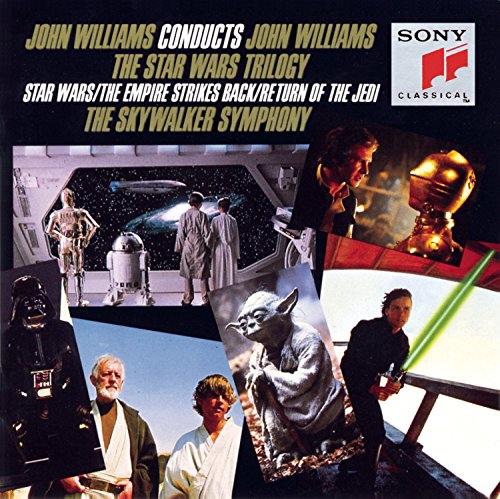 John Williams Conducts...
Best Price: $1.48
Buy New $19.07
(as of 08:25 UTC - Details)
John Williams Conducts...
Best Price: $1.48
Buy New $19.07
(as of 08:25 UTC - Details)
George Lucas originally wanted Orson Welles as the voice of Darth Vader, but dropped the idea when he thought Welles’s famous baritone would be too recognizable.
10. JAMES EARL JONES PUT IN LESS THAN A DAY’S WORK.
Lucas chose Jones as the voice of Darth Vader because of the actor’s unmistakable baritone. He was given only $7500 for his services, and completed all of his lines in two and a half hours. “Vader is a man who never learned the beauties and subtleties of human expression,” Jones said. “So we figured out the key to my work was to keep it on a very narrow band of expression—that was the secret.”
11. THE MOVIE’S ICONIC OPENING CRAWL WAS CREATED WITH PRACTICAL EFFECTS.
The opening crawl for the original movie (which was cribbed from the Flash Gordon serials that also inspired the film) was done practically, by carefully placing 2-foot-wide die cut yellow letters over a 6-foot-long black paper background with a camera making a slow pass over them to mimic the crawl. In total, it took three hours to shoot.
12. LUKE AND LEIA’S SWING ACROSS THE DEATH STAR CHASM WAS FOR REAL … KIND OF.
The relatively small production of Star Wars at England’s Elstree Studios meant that corners had to be cut wherever possible, even for the main actors. When it came time for Luke and Leia to perform the iconic swing over the Death Star chasm, Mark Hamill and Carrie Fisher had to do it themselves because the production couldn’t afford stunt doubles.
The actors, who were secured with safety harnesses, swung across the platform 30 feet above the studio floor in one take, which is what you see in the final movie (though the drop was lengthened to seem bottomless in post-production using a matte painting).
13. THE ORIGINAL MILLENNIUM FALCON LOOKED COMPLETELY DIFFERENT.
The original concept model of the Millennium Falcon was long and cylindrical—very unlike the flat design we know now. The model makers complained the design was too similar to the spacecraft from the 1970s British TV series Space: 1999, so Lucas told them to create something completely different that looked like a flying hamburger and sailed like a sunfish.
A variation of the Falcon prototype did, however, end up in the movie. It’s the Rebel Blockade Runner seen fleeing the Imperial Star Destroyer in the opening scene.
14. LUCAS USED REAL-LIFE WAR FOOTAGE FOR THE SPACE BATTLES.
Industrial Light and Magic is now one of the preeminent special effects companies in the world, but back in the late 1970s it was just a group of artists in an empty warehouse in Van Nuys, California. The company, which invented technology like special computer-controlled camera rigs in order to create the special effects for Star Wars, was tasked with completing a year’s worth of work in just six months.
To give them ideas for the type of high-intensity and cutting-edge sequences he wanted, Lucas used old newsreels to cut together footage of World War II dogfights. ILM eventually matched many of the sequences frame by frame—including the space battle in the Millennium Falcon between Han, Luke, and the TIE fighters—directly to the footage Lucas provided.
15. THEATERS DIDN’T WANT TO SHOW THE MOVIE.
Less than 40 theaters agreed to book showings of Star Wars after its release date was moved up to before Memorial Day (the studio thought it would bomb in a crowded summer movie slate).
Around the same time, 20th Century Fox was going to release an eagerly anticipated adaptation of a bestselling book called The Other Side of Midnight, which theaters were eager to show. Fox then stipulated that any theater showing The Other Side of Midnight must also show Star Wars, which inflated the number of screens for the movie. Needless to say, Star Wars eventually became the highest-grossing movie ever made up to that time, while The Other Side of Midnight didn’t even break the $25 million mark. And as requiring movie theaters to show one movie in exchange for another movie was actually illegal, 20th Century Fox ended up being fined $25,000—for forcing theaters to show The Other Side of Midnight.
Copyright © 2017 Mental Floss
 The Velikovsky Heresies