


Pistols at Dawn Do We Need More Political Duels?
June 23, 2009
 Pistols at Dawn: Two H...
Best Price: $0.60
Buy New $43.20
(as of 10:20 UTC - Details)
Pistols at Dawn: Two H...
Best Price: $0.60
Buy New $43.20
(as of 10:20 UTC - Details)

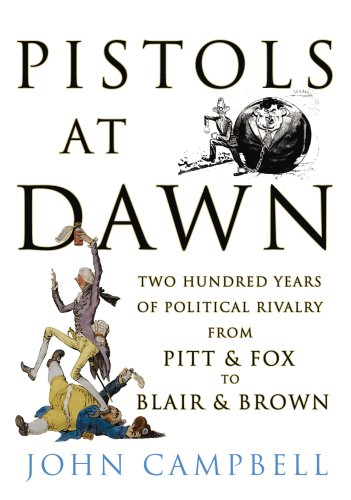
This book gives an entertaining account of eight famous political feuds, starting with Fox and Pitt and ending with Blair and Brown. Other reviewers have compared one rivalry with another. I want to concentrate on the idea raised by the book’s title, that of the duel.
In only one of the eight stories (which also include Gladstone vs Disraeli and Heath vs Thatcher) were “pistols at dawn” literally employed. Exactly 200 years ago, in the middle of the Napoleonic wars, Britain launched a military and naval expedition to Walcheren in Holland. It failed. George Canning, the foreign secretary, sought covertly to blame his rival, Lord Castlereagh, and to have him removed from the War Office.
When Castlereagh discovered what was going on, he wrote to Canning: “You continued to sit in the same Cabinet with me, and to leave me not only in the persuasion that I possessed your confidence and support as a colleague, but you allowed me to… proceed in the Execution of a new Enterprise of the most arduous and important nature, with your apparent concurrence… You were fully aware that if my situation in the government had been disclosed to me, I could not have submitted to remain one moment in office, without the entire abandonment of my private honour and public duty. You knew I was deceived, and you continued to deceive me.” Castlereagh demanded “satisfaction”, by which he meant a duel. The two men met on Putney Heath. Both missed with their first shots, but Castlereagh insisted on a second round and wounded Canning in the thigh, without doing him serious injury.
There was a public scandal: duelling was against the law. Both men resigned, but both later returned to high office: Castlereagh’s career, which had been expiring, revived, while Canning ultimately, though briefly, became prime minister.
In the autumn of 2004, Tony Blair announced his intention to fight the next election as prime minister and, if victorious, to serve the whole of the subsequent term. Gordon Brown, who thought he had been told the opposite the day before, felt betrayed. The “understanding” that the two had sealed at the Granita restaurant in 1994 – that Brown would succeed Blair – had, he thought, been broken. “There is nothing that you could say to me now that I could ever believe,” the chancellor told the prime minister.
So for Mr Brown, as for Castlereagh, it was a matter of honour. But of course it did not occur to Mr Brown to challenge Mr Blair to a duel. Instead, the modern equivalents of the duellists’ “seconds” were the rival armies of spin doctors, and so the contest was carried on, at public expense, through the media.
June 23, 2009
 Cigarettes, Whiskey, and Wild, Wild Woman The world's oldest man shares his secrets