


Intervention and Economic Crisis
February 26, 2010
No supporter of the market economy could have been surprised when the recent financial crisis was inevitably blamed on “capitalism” and “deregulation.” The free market, we were told, was a recipe for financial instability. “Advocates of the free market must confront the fact that both the Great Depression and the current financial chaos were preceded by years of laissez-faire economic policies,” wrote Katrina van den Heuvel, editor of The Nation, and author Eric Schlossel, in September 2008.
It is not enough to call this a distortion of the truth. It is a grotesque distortion, worthy of the Soviet politburo. The crisis is in fact the altogether predictable fruit of massive government and central-bank distortions of the economy. That may be why the free-market economists of the Austrian School were practically the only ones to have seen it coming.
 The Theory of Money an...
Best Price: $5.95
Buy New $8.50
(as of 03:00 UTC - Details)
The Theory of Money an...
Best Price: $5.95
Buy New $8.50
(as of 03:00 UTC - Details)

There has been much discussion on right-wing radio and in the conservative press about Fannie Mae, Freddie Mac, and the Community Reinvestment Act (CRA), which have been described as forms of government intervention that contributed to the financial crisis. To a certain extent that is all well and good: Fannie and Freddie enjoyed special government-granted privileges, along with an implicit bailout guarantee, that allowed them to become much more substantial actors in the secondary mortgage market than would have been possible in a free market. Furthermore, politicizing the lending process and cajoling banks into abandoning traditional standards of creditworthiness cannot make a positive contribution to the health of the banking industry.
But although there is no question that those factors exacerbated the problems that led to the crisis, they are not the primary culprits. Britain has also experienced a housing collapse, even though there is no British analogue of Fannie, Freddie, and the CRA. Moreover, no matter what encouragements these and other institutions may have given to home purchases, where did all the money come from to buy all those houses and drive up their prices so high so quickly?
We should instead focus on the Federal Reserve System, an institution few Americans know much about but which, in addition to systematically undermining the value of the U.S. dollar — which has lost at least 95 percent of its value under the Fed’s supervision — gives rise to the boom-bust business cycle.
 Money, Bank Credit, an...
Best Price: $74.18
Buy New $237.04
(as of 09:50 UTC - Details)
Money, Bank Credit, an...
Best Price: $74.18
Buy New $237.04
(as of 09:50 UTC - Details)
A business-cycle primer
Economist F.A. Hayek wanted to understand why the economy moved in a boom-bust pattern — why there was, in the words of the British economist Lionel Robbins, a sudden “cluster of error” among entrepreneurs. Why should the people the market has rewarded in the past for their skill at anticipating consumer demand suddenly commit serious errors and all in the same direction?
Hayek won the Nobel Prize for his answer.
Building on the insights of Ludwig von Mises, who first began to develop what is known as Austrian business-cycle theory in his book The Theory of Money and Credit in 1912, Hayek pinpointed the central bank’s artificial creation of credit as the nonmarket culprit in the business cycle. (Economist Jess Huerta de Soto applies Austrian business-cycle theory to cycles that occur in countries that have lacked a central bank in his treatise Money, Bank Credit, and Economic Cycles.)
 The Mystery of Banking
Best Price: $2.23
Buy New $7.57
(as of 07:55 UTC - Details)
The Mystery of Banking
Best Price: $2.23
Buy New $7.57
(as of 07:55 UTC - Details)
To understand Hayek’s point, which exonerates the free market, consider two scenarios.
Scenario 1. Consider what happens when the public increases its savings. Since banks now have more funds to lend (namely, the saved funds deposited by the public), the rate of interest it charges on loans will fall. The lower interest rates, in turn, stimulate an expansion in long-term investment projects, which are more sensitive to interest rates than short-term projects are. (Think of the difference in the decline in monthly payments that would occur between a 30-year mortgage and a 1-year mortgage if interest rates came down by even 2 percentage points.)
Lower-order stages of production are those stages closest to finished consumer goods: retail stores, services, and the like. Wholesale and marketing are examples of higher-order stages. Mining, construction, and research and development are of still higher order, since they are so remote from the finished good that reaches the consumer. When people’s consumption spending contracts, it is a perfect time for higher-order stages of production to expand: because of people’s additional saving, there is relatively less demand for consumer goods, and the resulting contraction of lower-order stages of production will release resources for use in the higher-order stages.
Scenario 2. Government-established central banks have various means at their disposal to force interest rates lower even without any corresponding increase in saving by the public. (For more on this, see The Mystery of Banking, by Murray N. Rothbard, or his shorter classic, What Has Government Done to Our Money?) Just as in the case in which public saving has increased, the lower interest rates spur expansion in higher-order stages of production.
 What Has Government Do...
Best Price: $1.83
Buy New $25.00
(as of 08:05 UTC - Details)
What Has Government Do...
Best Price: $1.83
Buy New $25.00
(as of 08:05 UTC - Details)
The difference, though, is a critical one and guarantees that these artificially low interest rates will not yield the happy outcome we saw in Scenario 1. For in this case, people have not decreased their consumption spending. If anything, the low interest rates encourage further consumption. If consumption spending is not constricted, the lower-order stages of production do not contract. And if they do not contract, they do not release resources for use in the higher-order stages of production. Instead of harmonious economic development, there will instead ensue a tug of war for those resources between the higher and lower stages. In the process of this tug of war, the prices of those resources (labor, trucking services, et cetera) will be bid up, thereby threatening the profitability of higher-order projects that were begun without the expectation of this increase in costs.
 How the Catholic Churc...
Best Price: $3.25
Buy New $30.80
(as of 06:30 UTC - Details)
How the Catholic Churc...
Best Price: $3.25
Buy New $30.80
(as of 06:30 UTC - Details)
As the workers in the newly expanded higher-order stages of production begin to spend their incomes, they spend according to the same saving-to-consumption ratio they did in the past. Their desire to save, and thereby to sustain all this long-term investment, turns out to be not as great as the distorted structure of interest rates led entrepreneurs to believe. It becomes ever clearer that society is not prepared to support the expansion of time-consuming higher-order stages of production. They do not wish to save enough resources to make the completion of all the new projects possible. The lower-order stages will win the tug of war. Expansion in the higher-order stages will have to be abandoned. Some of the resources deployed there will be salvageable; others will have been squandered forever or will be of little to no use in later stages of production.
Preventing correction
The economywide discoordination that reveals itself in the bust is not, therefore, caused by the free market. To the contrary, it is intervention into the free market, in the form of distortions of the structure of interest rates — which are crucial coordinating mechanisms — that causes the problem.
As the boom turns into bust, the economy tries to readjust itself into a configuration that conforms to consumer preferences. That is why it is so essential for government to stay entirely out of the adjustment process, because arbitrary government behavior can only delay this necessary and healthy process. Wages and prices need to be free to fluctuate, so labor and other resources can be swiftly shifted away from bloated, bubble sectors of the economy and into sustainable sectors of the economy where consumers want them. Bailouts obstruct that process by preventing the reallocation of capital into the hands of firms that genuinely cater to consumer demand, and by propping up instead those firms that have deployed resources in ways that do not conform to consumer preferences. Fiscal and monetary stimulus do nothing to address the imbalances in the economy, and indeed only perpetuate them.
 CHURCH & THE MARKET (S...
Best Price: $6.04
Buy New $101.04
(as of 04:20 UTC - Details)
CHURCH & THE MARKET (S...
Best Price: $6.04
Buy New $101.04
(as of 04:20 UTC - Details)
Most observers cheered in the months following 9/11 when it seemed as if Alan Greenspan had successfully navigated the economy through the dot-com bust at the cost of only a relatively mild recession. The man the New York Times identified as “the infallible maestro of our financial system” had lived up to the expectations of those who treated him with a distinctly creepy reverence. But all he had done was hold off the inevitable recession, and make the current downturn all the worse. The recession of 2001 was the only one on record in which housing starts did not decline. Thus people drew the false conclusion — amplified by the alleged experts, including Fed economists — that the housing sector is robust through thick and thin, housing prices never fall, a house is the best investment someone can make, and so on.
 The Ethics of Money Pr...
Best Price: $13.59
Buy New $19.99
(as of 07:45 UTC - Details)
The Ethics of Money Pr...
Best Price: $13.59
Buy New $19.99
(as of 07:45 UTC - Details)
Because Greenspan would not allow the full correction to take place, clearing out entrepreneurial errors caused by his previous intervention, market actors persisted in their errors for years thereafter. With the economy having continued along its unsustainable trajectory all that time, the bust that inevitably came was that much worse. Although market decisions were distorted in countless areas of industry, it was housing whose disproportionate growth was most obvious in the most recent boom. Easy money by the Fed, combined with government regulations that made mortgage loans especially easy and attractive, gave rise to a housing bubble — in other words, an array of prices that were unsustainably high. Housing is a durable consumer good generally purchased with long-term financing, so it fits in perfectly with the Austrian analysis that artificially low interest rates give undue stimulus to long-term projects.
Moral hazard
There has been much discussion of moral hazard in connection with the flurry of bailouts that began in 2008. “Moral hazard” refers to people’s readiness to act with an artificially elevated level of risk tolerance because they believe that any losses they may incur will be borne by other people. Hence the bailouts will tend to make major market actors even less likely to behave prudently in the future, since if they believe they are likely to be considered “too big to fail,” they have more reason than ever to believe that they will not be allowed to go out of business, and therefore that they may continue to make risky bets.
This critique is correct as far as it goes, but it overlooks the related problem that the very existence of a central bank such as the Federal Reserve aggravates — indeed, institutionalizes — moral hazard. Since there is no physical limitation on the creation of paper money, firms know that no natural constraint exists on the power of the central bank to bail them out of any serious trouble. (Even if the supply of paper should be exhausted, the monetary authority can always add zeroes to existing notes.) In our own case, financial commentators spoke of the “Greenspan put,” the implied promise that the central bank would intervene to assist the financial sector in the event of a serious downturn. No one has a right to be surprised when market actors behave accordingly.
 Meltdown: A Free-Marke...
Best Price: $0.25
Buy New $20.00
(as of 02:20 UTC - Details)
Meltdown: A Free-Marke...
Best Price: $0.25
Buy New $20.00
(as of 02:20 UTC - Details)
Arguments over regulation and deregulation by and large miss the point. According to Guido Hülsmann, in his valuable book The Ethics of Money Production,
The banks must keep certain minimum amounts of equity and reserves, they must observe a great number of rules in granting credit, their executives must have certain qualifications, and so on. Yet these stipulations trim the branches without attacking the root. They seek to curb certain known excesses that spring from moral hazard, but they do not eradicate moral hazard itself. As we have seen, moral hazard is implied in the very existence of paper money. Because a paper-money producer can bail out virtually anybody, the citizens become reckless in their speculations; they count on him to bail them out, especially when many other people do the same thing. To fight such behavior effectively, one must abolish paper money. Regulations merely drive the reckless behavior into new channels.
One might advocate the pragmatic stance of fighting moral hazard on an ad hoc basis wherever it shows up. Thus one would regulate one industry after another, until the entire economy is caught up in a web of micro-regulations. This would of course provide some sort of order, but it would be the order of a cemetery. Nobody could make any (potentially reckless!) investment decisions anymore. Everything would have to follow rules set up by the legislature. In short, the only way to fight moral hazard without destroying its source, fiat inflation, is to subject the economy to a Soviet-style central plan.
Since 2007 the typical pattern has unfolded before our eyes: a financial crisis whose ultimate cause is the government’s own central bank is blamed on anyone and everyone else, while the central bank itself is portrayed as our savior rather than the culprit. This version of events is then used to justify still more expansions of government power.
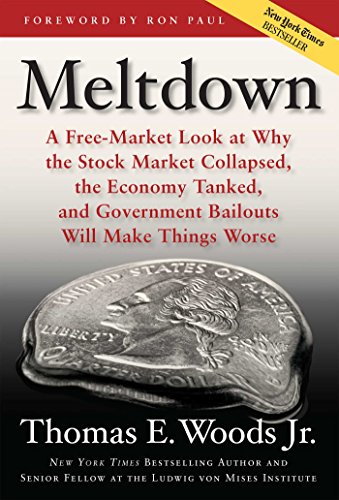
It is urgently necessary for Americans to inoculate themselves against the relentless propaganda in behalf of the government’s version of the story. That’s why I wrote my book Meltdown earlier this year: to set forth a persuasive free-market explanation of the crisis that laymen can understand and use. It spent ten weeks as a New York Times best-seller, but the Times has refused to review it. That, in turn, is about the best endorsement I could have asked for.
 War Über Alles