

Someone handed me a book the other day — a cult classic among music geeks — and urged me to read it, and, when I had finished, sign my name in the front cover. That way I could be added to the already long list of readers in the front cover, each of whom add added his or her scrawl to the book after having read it.
How charming!
Except for one thing: this is complete violation of the spirit of intellectual property law. All these readers were sharing the same book instead of buying a new copy. Think of the revenue lost to the publisher and the royalties lost to the author! Why, if this gets out of hand, no one will ever write or publish again! These readers are all pirates and thieves, and they should probably be subject to prosecution.
So goes the rationale behind intellectual property law. It’s what economists call a “producers’ policy,” design to create maximum revenue for one side of the economic exchange, consumers be damned. In that sense, it is exactly like trade protection, a shortsighted policy that stymies growth, robs consumers, and subsidizes inefficiency. It’s Bastiat’s “petition of the candlemakers against the sun” all over again.
Apply the IP principle consistently and it’s a wonder we tolerate public libraries, where people are encouraged to share the same copy of a book rather than buy a new copy. Isn’t this also an institutionalized form of piracy?
The defenders of IP would have to admit that it is. They are often driven to crazy extremes in sticking the claim that copying is a form of theft.
I asked one emphatic correspondent about the ethics of the following case. I see a guy in a blue shirt and like it, so I respond by wearing one too. Is this immoral?
No, he said, because the color blue occurs in nature.
What if a person draws a yellow happy face on the blue shirt? Can I copy that? No, he said, this would be immoral. I must ask his permission and gain his consent. Actually, it’s even worse than this case suggests. If even one person had previously worn a blue shirt with a happy face, no one else on the planet would be able to do that without seeking consent.
It should be obvious that if everyone were required to seek the permission for the use of every infinitely reproducible thing that “belongs” to someone else — every word, phrase, look, vocal inflection, chord progression, arrangement of letters, hair style, technique, or whatever — or if we were really to suppose that only person may possess the unique instant of any of these things, civilization would come to a grinding halt.
 We are at a prohibition-style moment with regard to IP, just as with liquor in the 1920s. The war on the banned thing isn’t working. Those in power face the choice of stepping it up even further and thereby imposing a militarized state in place of anything resembling freedom, or they can admit that the current configuration of law has no future and bring some rationality to the question. Other societies have indeed crushed innovation with this very impulse.
Do you know why we celebrate Columbus Day instead of Cheng Ho Day? Cheng Ho was a great Chinese explorer who, in the early 15th century, took his fleets to Africa and the Middle East, but he was forced to stop when the elites in the home country began to feel threatened by his discoveries. The Chinese government won the war on exploration, and became static and inward. You can win a war on progress but the gains over the long term are few.
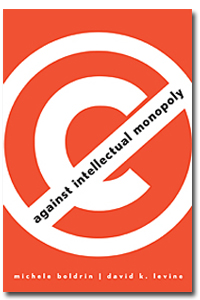
In addition to relaying the above story, the authors of Against Intellectual Monopoly, in the last chapter of their fantastic book, make a case for the complete dismantling of the law. “Intellectual property is a cancer,” they write. “The goal must be not merely to make the cancer more benign but ultimately to get rid of it entirely.”
Is change possible? Of course. It was thought in the middle ages that most all products required monopoly production. The salt producer would enter into an agreement with the ruler. The ruler would promise a monopoly in exchange for a share of the revenue. It was thought that this would guarantee access to a valuable commodity. How can anyone make a buck without a guarantee that his hard work would be compensated?
Well, it took time but eventually people realized that competition and markets actually do provide, as implausible as it may seem. As the centuries moved on, markets became ever freer, and we no longer believe that the king must confer a special status on any producer. They still do it, of course, but mostly for open reasons of political patronage.
And yet in this one area of “intellectual property,” all the old mercantilist myths survive. People still believe that a state grant of monopoly privilege is necessary for the market to work. The myth has now been crushed with this book. So now the laws can be beaten back and they are being beaten back in the age of digital media.
Realize that for young people today, the initials RIAA and MPAA are the most hated on the planet — the equivalent of the IRS of a past generation. The heck of it is that these are private entities. Think what this means.
Capitalists of the world, please pay attention: you have a serious problem when an entire generation is being raised to HATE private, capitalistic institutions. Now, you and I know that these institutions are doing something illegitimate, namely enforcing “intellectual property,” which is really nothing but state coercion. Still, this besmirches the reputation of free markets. So too is a generation of socialists being raised to hate U.S. foreign policy on the belief that its export of IP is a form of capitalist imperialism.  For these reasons, no one has a stronger interest in abolishing intellectual property than supporters of capitalism.
I said at the beginning of this series that it has taken me fully six years to think through these issues. The book by Boldrine and Levine broke through the reservations I had that remained. In the meantime, I’ve received hundreds of messages to the effect that other readers have made the jump too. Whatever is holding you back, I beg to you read this account. I personally consider it to be one of the most mind-blowing books I’ve ever encountered, and so now I join the armies of people who are demanding an end to a system that threatens our way of life in the most fundamental way.
For this reason, this book is seminal, not only for our times, but for the entire history of liberty. It has clarified a point that has been a source of confusion for many years, and put it front and center in the current debate. It might need correcting in places and I have my own knits to pick over their neoclassical framework and talk of social costs and the like, but these are petty concerns as compared with the overall framework. What they have done is marvelous and extremely important.
Jeffrey Tucker [send him mail] is editorial vice president of www.Mises.org.

