"(I)t all seems so one-sided Opinions all provided, the future pre-decided Detached and subdivided in the mass production zone Nowhere is the dreamer or the misfit so alone… Drawn like moths we drift into the city The timeless old attraction Cruising for the action lit up like a firefly Just to feel the living night… Any escape might help to smooth The unattractive truth But the suburbs have no charms to soothe The restless dreams of youth" Rush, Subdivisions
Perhaps you have noticed a decreased level of freedom in American (and, indeed, world) society. You might have read about restrictions on freedom to travel, destruction of long-standing legal protections, police excesses perpetrated against citizens, maintenance of torture as federal policy, and a whole host of other depredations. If you are unfortunate, you may have been singled out for violating one of the rules scribed on the hundreds of thousands of pages of Federal Regulations and suffered more directly from a loss of freedom. Or you might simply have backtracked economically from the decline of economic freedom, in 1998 the fifth-freest economy in the world, 2001 sixth, and in 2005, twelfth (link behind the WSJ’s site walls).
Though you might blame any number of obvious villains and historical processes for this, the name Ebenezer Howard would probably not come to mind. Howard created the Garden City idea of moving population out of concentrated urban areas like London and into a country setting, (inspired by the socialist polemic Looking Backward) and proved a major influence on urban planning; Radburn, NJ, where perhaps the cul-de-sac was invented, is an example of a place constructed to his ideal. He is one of the villains of Jane Jacobs’ magisterial classic, The Death and Life of Great American Cities, although she takes pains early on in the book to avoid overt criticism of his motives.
Jacobs sees cities as the locus of economic creation; her first chapters detail the critical function played by commerce in the maintenance of order, an order she contends in Death and Life (and later also in The Economy of Cities) that arises spontaneously where conditions permit it. She shows that ancient cities were crippled economically by the large proportion of the populace whose work was considered unimportant economically (women and slaves), so that no improvements to the economic functioning could arise from them. This contrasted markedly with medieval European cities, about which serfs and peasants were known to remark that "Stadtluft Macht Frei," or city air makes one free.
Hilaire Belloc, in The Servile State, retraces the process by which Roman-era slaves were gradually emancipated to the level of serfs and then free peasants, a process he deplores disintegrating because of the Reformation. Jacobs, following Pirenne, credits the founding of medieval cities to vagabonds and other outcasts; they formed what she called depot cities (located at transport hubs or transshipment points) that became the nuclei of the new trading centers. Both agree that the city was a place of escape from manorial control, and provided an outlet for offspring of peasants whose inheritance did not include land.
Jacobs emphasizes, in Systems of Survival, that the Law created by the merchant classes to insure fair dealing encouraged new freedoms. (Similarly, Tim Case sagely contends that it was not the code of Justinian, but the code of the trader that guaranteed individual liberties.) She shows that commercial law is the basis of the later legal systems that grew upon the metropolitan economies. Importantly, because the city law was meant to serve commerce, rather than the State, it was infrequently used for oppressive purpose. A person’s freedom and rights did not arise in the countryside at Runnymede, but in the City of London, so despised of Ebenezer Howard.
Howard returns several times in Death and Life, most prominently in the chapter titled Unslumming and Slumming, in which Jacobs details how wealth creation and class-transcendence arise in the process of neighborhood improvement. She writes:
"The processes that occur in unslumming depend on the fact that a metropolitan economy, if it is working well, is constantly transforming many poor people into middle-class people. … Unslumming…has to do with the vigor…and choices…that these energetic economies produce. This energy and its effects — so different from immemorial peasant life — are so obvious in great cities… that it is curious that planning fails to incorporate them."
Why, you might wonder, do planners not account for the energy and vitality of cities? She continues:
"These odd intellectual omissions go back, I think, to the Garden City nonsense… Ebenezer Howard’s vision of the Garden City would seem almost feudal to us. He seems to have thought that members of the industrial working classes would stay neatly in their class, and even at the same job within their class; that agricultural workers would stay in agriculture; that businessmen (the enemy) would hardly exist as a significant force in his Utopia; and that planners could go about their good and lofty work, unhampered by rude nay-saying from the untrained. It was the very fluidity of the new nineteenth-century industrial and metropolitan society, with its profound shiftings of power, people and money, that agitated Howard so deeply…" (emphasis added)
Jacobs had started Death and Life by looking at her own neighborhood (Greenwich Village, where Mises worked at NYU at the same time that Jacobs was writing) and seeing it as a microcosm. Her first chapters contain delightful observations of street-level life which demonstrate how the urban environment stimulates the safe mixing people of different ages and backgrounds through the wonder of commerce. She stood aghast that Howard and his ilk would object to this much richer world and try to impose feudal strictures on it. She opposed policies she called "the sacking of cities." Many of these were local in nature, like the depredations of Robert Moses, who was barely stopped by community organization in Greenwich Village from plowing through what is today the tony SoHo district with an elevated expressway (indeed, Jacobs’ chapters on creating ideal urban neighborhoods build on the geographical and economic features of Greenwich Village to demonstrate how proper formation can create communities that can withstand political meddling), or Euclidean zoning, which segregates industry and housing.
However, Federal disruptions of community were both more severe and widespread. Jacobs offers the example of standardized housing mortgages under Fannie Mae that specified housing lot sizes and building coverages, effectively redlining urban areas and preventing the creation of dense new cities, making Atlanta or Dallas the ultimate expression of post-war Federal policy. Additional examples include the Federal interstate system, agencies like the TVA that drained urban areas through taxation, the "progressive" income tax itself that takes a higher proportion of urban dwellers’ gross income before expenses (like more costly housing) are paid, and flat-rate USPS postage that uses profits from dense urban areas to subsidize unprofitable RRD districts.
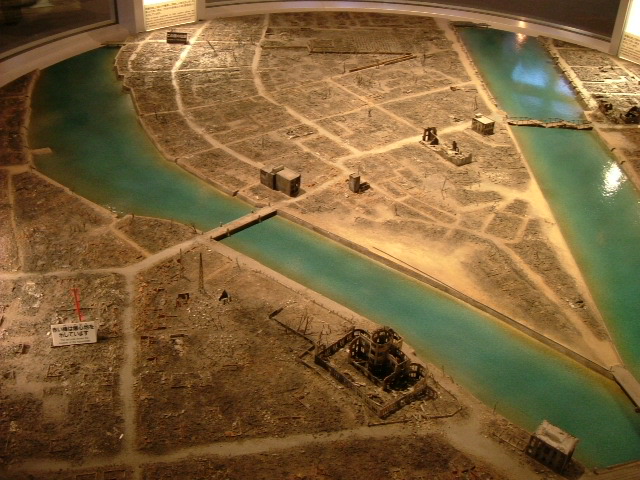
The greatest Federal contribution to the sacking of cities, of course, was made on August 6, 1945, when the danger to mass concentrations of people caused by homicidal megalomaniacs was made brutally clear. Whether Federal policy was inadvertent or systematic, Howard’s socialist-novel-derived dream was made concrete in the post-war suburb; that its car dependency and economic stratification atomizes people would not be considered a disadvantage by feudal Federal masters.
New York and other urban areas were not completely obliterated, however. 1989 saw the turning point; the collapse of the Berlin wall helped lower the threat of nuclear annihilation, one of the underpinnings of urban decentralization. Tiananmen Square led to an uneasy peace in China wherein economic freedom was to be permitted, but political freedom not immediately. In 1997 when China assumed political control of Hong Kong local businessmen made the argument that Hong Kong, in fact, was taking over China; the fact that the Chinese economy accumulated increasing surpluses over the following 10 years is testimony to this idea. Whether Hong Kong can free China faster than the US Federal Government can suppress New York should be an interesting footrace in coming years.
Jacobs’ idyll, Greenwich Village, remains the "happiest" part of New York. Its positive wealth feedback effects have caused it to outgrow its original boundaries and enliven nearby SoHo, the meatpacking district and the East Village, and through the lifeline of the L train, several neighborhoods in northern Brooklyn like Williamsburg, Greenpoint and Bushwick. Given time, the same commerce and open-exchange-based ethic could radiate outward to restore economic functioning and resistance to centralized political meddling. Because economic independence and political irascibility do not favor the Federal masters, they will do everything to prevent this; savvy lovers of liberty must always know which side to favor in the struggle between the market writ large in New York, and the court writ hypertrophic, in DC.
(Special thanks to "wonderful old curmudgeon" Jeff Zervas for feedback and editing.)