

Real Money Saving Tips in a Turbulent Economy
by Bill Sardi by Bill Sardi
No sense letting thousands of hard-earned dollars slither away at the time when they are becoming more scarce. The cost of food has risen 6% and energy 29% in the past year. Here is a list of suggestions I have developed on how to save money, mainly by buying products of better value and durability.
-
Many years ago drug stores used to sell razor blades that lasted a whole year or more. Consumers had to ask for them as they were kept behind the counter. Eventually these durable razor blades were no longer made. Today you can purchase longer-lasting razor blades that have been cryogenically tempered (frozen) down to —300 F to improve the durability of the blade. These are the same blades you now buy (Gillette, Schick, etc) but cold treated. They last for many months says the manufacturer, depending upon the thickness of your beard.
-
Have you ever bought a pair of Mephisto shoes? Try their loafers. These are pricy shoes, around $370, but they are built to last a long time and not look worn.
- OK, it’s time cut your own hair. Saves on gasoline and time too. Wahl hair clippers will show you how.
-
It’s also time to think about doing more of your own home repairs. A common one is opening a clogged drain or toilet. All the plumber brings with him for this chore is a "snake" which can be purchased at most hardware supply stores. For instructions how to unclog drains, read here.
-
Care to gain 15 more miles per gallon, or 200 miles per tank of gasoline without fuel additives or adding parts to your carburetor? Read here.
- Strange how often we overlook putting into practice known ways to save money. Energy-saving light bulbs (compact fluorescent lamps or CLFs) are an example. A friend of mine bought these bulbs at Walgreen’s on special at 35 cents each and replaced 42 of them in his home. The projected energy cost savings are $47 over the 10,000-hour life of the bulb. So 42 CFL bulbs will produce $1,974 in savings for a $14.70 total purchase. $14 produces $1,900! In this instance, there are 8760 hours in one year. And of course, most of the light bulbs in my friend’s home are on only 3 to 4 hours a day. Since they burn only for a portion of the day or night, he assumes those savings will be earned over a 4-year period. This means he saves $494 a year for 4 years for an original investment of $14. We bought a large house a few years ago and were shocked at our first electric bill — ~$700! The house has 230 overhead lights. We swapped out conventional light bulbs for the compact fluorescents and saved ~$300 a month.
- Large families can purchase bigger packages (25—50 lb bags) or even smaller boxes of pancake mixes, cereals, beans and mixes, saving in the process. A good source is Honeyville Grain. Here’s the really good part, Honeyville ships your entire order anywhere in the contiguous United States for only $4.49. That’s right, you pay just $4.49 for shipping regardless of how much you order. Another economical source for grains, seeds, beans, and cereals is Bob’s Red Mill.
-
Vitamin pills are a part of most Americans daily health regimen. Most Americans will opt for the convenience of vitamin C, fish oil, and magnesium, in pills. However, there are great savings when purchasing powdered vitamin C or magnesium, or liquid fish (lemon flavored) or flaxseed oil (lemon flavored) consumed by the spoonful rather than as encapsulated supplements.
-
Many people are considering higher deductibles for their health insurance policy. Health insurance just pays the bills, you aren’t any healthier for buying insurance. A day in sickbay is costly. In lieu of problematic antibiotics and vaccines, and costly doctor’s office visits, particularly in the winter cold and flu season, learn to provide your children with vitamin D3 tablets, 1000 international units every day, and more when ill (2000—5000 IU). Only recently has it been discovered that vitamin D produces antibiotic peptides in the body that attack germs (viruses, bacteria, fungi). Fifteen vitamin D experts just published a paper saying every child in America ought to be given 1000 IU of vitamin D3 per day. A recently published report shows 2000 IU of vitamin D3 completely abolishes the occurrence of upper respiratory infections in adults during winter months. [Annals Otology, Rhinology & Laryngology Vol. 117: pages 864—70, 2008] Your family will need 1000 IU vitamin D3 tablets for the kids (6 cents per tablet), or liquid vitamin D3 for infants, or 5000 IU vitamin D3 capsules (7.3 cents per capsule) — the adult dosage suggested by The Vitamin D Council — all which are difficult to find in retail stores. By shopping online here you can obtain all these vitamin D products. A free family guide to Vitamin D written by this author is available here. (My wife operates this business.) By the way, vitamin D3 does not cause germ resistance as does penicillin or other man-made antibiotics.
-
I’ve bought a lot of business suits over my lifetime. They don’t all seem to last. The threads only can endure so many dry cleanings. I never knew this before, but the most important quality of a good suit is a jacket that has a full canvas layer between the fabric and lining. Michael Ostrove, senior vice president at men’s retailer Paul Stuart, explains this in a recent issue of Forbes Magazine online. Cheaper suits have a lining that is fused or glued to the fabric. “Full canvas conforms better to the human body after multiple wears,” Ostrove says. “When the jacket is glued or fused it doesn’t fit or wear as well.” Ostrove says you can test to see if the jacket is full-canvas. Pinch the layers of fabric between the button holes. If you feel three layers it is full canvas, two layers is half canvas and one layer means the lining is fused or glued. Read more here.
-
Over the years I hated having to take even a half-day to go to the shop to have a new set of tires put on my car. Time is money. I found that Michelin tires often lasted the life of my cars and were worth the extra price. Michelin loves to brag about its Premier HydroEdge® passenger tires and their 90,000-mile warranty, over 30,000 miles better wear than competing brands (that’s a whole set of cheap tires for free). Money well spent. I got 150,000 miles out of one set of Michelin tires, with tread left to spare.
-
Grocery stores often lure shoppers with loss leaders. Wise shoppers can follow these economical offers, stock up on these items and save money. This follows an old dictum: "Store what you eat, and eat what you store."
-
 Venturing into the subject of how to buy wine can be treacherous. But here’s my take on wine buying. Wine should be purchased for its medicinal value as well as its bouquet, dryness or taste. Wine is the world’s best medicine. There is no pharmaceutical drug that can do what wine does. Wine is an antibiotic, an anti-aging beverage, a heart tonic, a brain booster, a weight control aid, a stomach settler, a sleeping aid, and much more. Its primary medicinal properties emanate from its mix of polyphenols (resveratrol, quercetin, catechin, kaempferol, gallic acid, ferulic acid) that are concentrated in fermented wine (the alcohol serves to extract these molecules from grape skin) so they are 1000-fold more concentrated than grape juice. The corked, dark glass bottle serves to preserve these otherwise perishable molecules. Not all bottles of red wine deliver the promised health benefits. Only the dark aged red wines provide the full 60 milligrams of polyphenols per 5-ounce glass that deliver these health benefits. Among the best dark reds are wines made from a variety of grapes called malbec. The darkest, richest of these come from the Mendoza region of Argentina and can be purchased for as little as $10 per bottle online or at some stores like Trader Joe’s (I even found a malbec red for $2.99 at Trader Joe’s). Remember, "wine in moderation." Over-imbibe and the health benefits disappear.
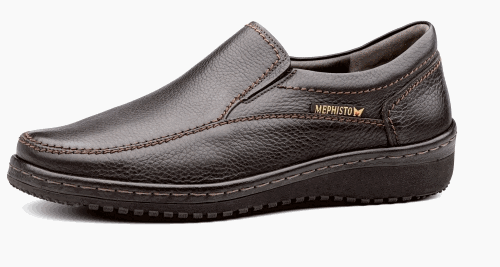 The $370 Mephisto shoe: but it looks like new for years
I’ve had a pair of Mephisto loafers I wear often, particularly when I travel (easy on, easy off at airport security check points) and they look like new 8 years after I purchased them. Mephisto will also re-sole and re-condition your shoes after years of use.
 Plumber’s snake saves calling the plumber
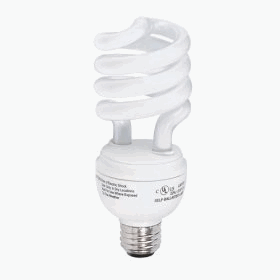 Compact Fluorescent Bulb vs Bulb Standard Bulb (Source: GE) 15w=60w 20w=75w 26w—29w=100w 38w—42w=150w 55w= 250w—300w
This is my short list of money-saving shopping tips. I’d like to hear a few of yours. Email me.

