

Recently by Joseph Mercola: Caution: Wearing These Can Sabotage Your Health
Story at-a-glance
- Some foods you think are good for you actually have more sugar than a Twinkie! Yogurt, tomato sauce, granola bars, fat-free salad dressing, muffins, and canned fruit are just several examples …
- Sugar is a leading contributor to the climbing rates of overweight and obesity in developed countries, as well as a culprit in premature aging and chronic diseases like heart disease, diabetes and cancer
- If you are seeking to lose weight and optimize your health, foods that contain added sugar, as well as grains like bread, rice and pasta should comprise very low percentages of your diet
Of all the foods capable of inflicting damage in your body, sugar is one of the most damaging of all.
Sugar, and the type of sugar known as fructose, in particular, is an extremely potent pro-inflammatory agent that creates advanced glycation end products (AGEs) and speeds up the aging process.
It also promotes the kind of dangerous growth of fat cells around your vital organs which is the hallmark of diabetes and heart disease.
Sugar also increases your insulin and leptin levels and decreases receptor sensitivity for both of these vital hormones, and this is another major factor of premature aging and age-related chronic degenerative diseases such as heart disease, as well as a leading cause of the climbing rates of overweight and obesity in developed countries.
That sugar is bad for your health is probably old news to you by now, but what may surprise you is just how much sugar is lurking in foods that are often passed off as “healthy.”
 Many supposedly “good for you” foods have more sugar than a Twinkie!
Are You Eating These Sugar-Laden “Health” Foods?
The Huffington Post recently outed several foods that are so high in sugar, you may as well be eating a candy bar.
All of these also have more sugar than a Twinkie …
- Yogurt: Most commercial yogurt is loaded with sugar – as in, over 30 grams for 6 ounces! This, along with the fact that commercial yogurt is pasteurized (and some also contains artificial colors and flavors), is why you should walk right on by the yogurt section at your supermarket. Watch out, too, for “light” yogurt brands that boast less sugar due to toxic artificial sweeteners.
- Tomato Sauce: A cup of tomato sauce can add up to over 20 grams of sugar, and considering that most people eat that tomato sauce on top of pasta, another carb source, this could send you into sugar overload. Watch out, specifically, for brands that contain added sweeteners. Tomato sauce is a far better choice than a candy bar, but, ideally, make your own sauce at home, and serve it over shredded spaghetti squash instead of noodles.
- Granola Bars: Sugar is often one of the top ingredients in granola bars, and, in fact, most are not much different than a candy bar, nutritionally speaking. Even the granola is simply another form of “hidden sugar” that most people eat far too much of. Remember, sugar and dietary carbohydrates (including grains like granola, which break down into sugar) lead to excess body fat, obesity and related health issues. No amount of exercise can compensate for this damage because if you eat a lot of sugar, it could be “reprogramming” your body to become fat.
- Fat-Free Salad Dressing: When manufacturers take the fat out of a food, sugar is often added back in as a replacement. Fat-free French or Thousand Island dressings can contain over 40 grams of sugar as a result, turning a would-be healthy salad into something more resembling a dessert. Don’t be fooled by the “fat-free” label – it’s the carbs that are the culprit in weight gain and chronic disease.
- Muffins: The high amount of carbs in most muffins will profoundly interfere with your leptin and insulin levels, and that is true even if it’s a “healthy” muffin, like a bran muffin. Of course, in order to make a bran muffin palatable, it probably contains quite a bit of added sugar, on top of the grains it’s made with. Many muffins are also jumbo-sized, easily packing over 30 grams of sugar, or more.
- Canned Fruit: Fruit in and of itself can be problematic if eaten in excess, as it’s a source of naturally occurring fructose. But many canned fruits are also packed in sugary syrup, loaded with high fructose corn syrup. Just one cup of canned peaches or pears can contain over 30 grams of sugar. You’re far better off with a fresh piece of fruit instead, but use moderation. I recommend restricting your consumption of fructose to no more than 25 grams per day, with a maximum of 15 grams a day from fresh fruit. If you’re already overweight, or have cancer, heart disease or diabetes (or are at high risk of them), then you’re probably better off cutting that down to 10-15 grams per day – fruit included.
On the other hand, yogurt that is made from raw organic milk, and which you eat either plain or only minimally sweetened with some berries or liquid stevia, is a true health food. This is something you can easily do at home and use the healthiest raw ingredients, including organic grass-fed raw milk as the starter.
Why a High-Sugar Diet Will Make You Fat
If you are seeking to lose weight and optimize your health, foods that contain added sugar, as well as grains like bread and pasta should be eliminated or else comprise very low percentages of your diet. Most people who bought into the “high-carb, low-fat” dietary recommendations has likely struggled with their weight and health, wondering what they’re doing wrong.
The problem is that overeating carbohydrates can prevent a higher percentage of fats from being used for energy, and lead to an increase in fat production and storage. Your body has a limited capacity to store excess carbohydrates. This is one of the reasons why elevated blood sugar follows their overconsumption. If you are not able to immediately use the sugar as a result of intense physical activity then one of the ways your body avoids dangerously elevated blood sugar is through converting those excess carbohydrates into excess body fat primarily in your belly.
The way it works is that any carbohydrates not immediately burned by your body as fuel are stored in the form of glycogen (a long string of glucose molecules linked together). Your body has two storage sites for glycogen: your liver and your muscles. Once the glycogen levels are filled in both your liver and muscles, excess carbohydrates are converted into fat and stored in your adipose, that is, fatty tissue.
So, although carbohydrates are “fat-free,” this is misleading because excess carbohydrates end up as excess fat. When you see refined grains on a food label, think of them as “hidden sugar,” and when you see sugar, think of it as “hidden fat.”
But that’s not the worst of it.
Any meal or snack high in “complex” carbohydrates, i.e. starch is actually a complex of glucose molecules, will also generate a rapid rise in blood glucose. To adjust for this rapid rise, your pancreas secretes insulin, which then lowers your levels of blood glucose. The problem is that insulin is essentially a storage hormone, evolved to put aside excess carbohydrate calories in the form of fat in case of future famine. So the insulin that’s stimulated by excess carbohydrates aggressively promotes the accumulation of body fat! This was enormously useful in ancient times when calories were frequently scarce, but today this setup is a disaster waiting to happen.
In other words, when you eat too much sugar, bread, pasta, and any other grain products, you’re essentially sending a hormonal message, via insulin, to your body that says “store more fat.” This is actually a highly beneficial response in certain scenarios such as when calories are very scarce. This provides a major survival advantage – but for nearly everyone reading this, having insufficient calories is not an issue, so this protective mechanism actually sabotages your health.
If you’re having trouble getting your mind around this, a wonderful infographic created by Column Five for Massive Health, based on Why We Get Fat by science writer Gary Taubes, explains exactly why eating fat doesn’t make you fat – but eating carbs like sugar can kill you …
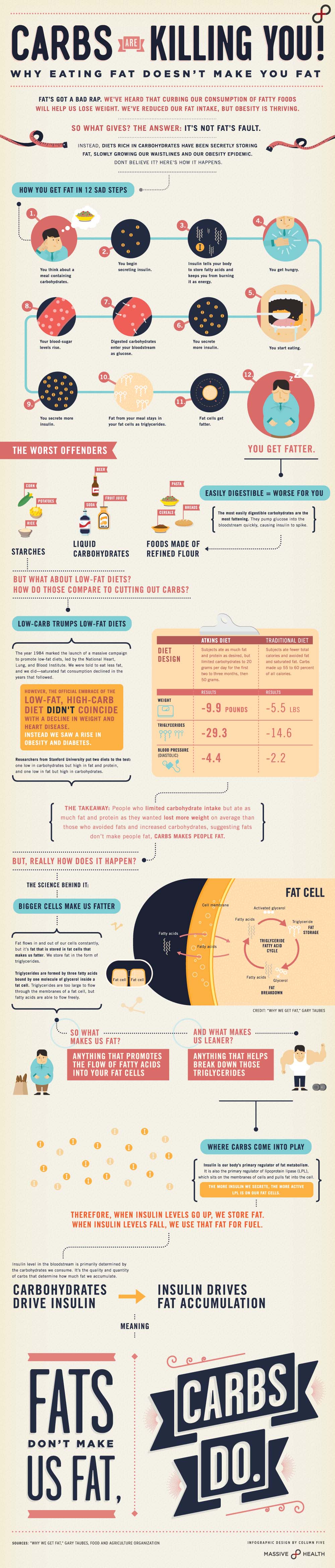
IMAGE COURTESY OF MASSIVE HEALTH. READ ABOUT THIS INFOGRAPHIC
Is It Possible to Cut Out Dietary Sugar and Still Feel Satisfied?
Based on USDA estimates the average American consumes 12 teaspoons of sugar a day, which equates to about TWO TONS of sugar during a lifetime. Why we eat this much sugar is not difficult to understand – it tastes good, and it gives us pleasure by triggering an innate process in your brain via dopamine and opioid signals.
What it is doing to us on both a physical and emotional level is another story entirely, and most people stand to reap major improvements in their health by cutting back on, or eliminating, sugar altogether from their diets. Many do not realize this, but frequent hunger may be a major clue that you’re not eating correctly. Your body needs fuel regularly and if you don’t provide it with the proper amounts of fats and protein and overload on sugars, you will not fill your energy reserves properly. This sets up a vicious cycle of cravings for the sugar that will solve the problem in the short run but serve to radically shorten your life in the long term.

