

A House of Cards
Book Review by Ryan McMaken
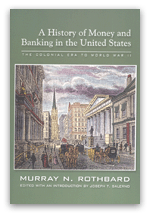 A History of Money and Banking in the United States: The Colonial Era to World War II By Murray N. Rothbard Ludwig Von Mises Institute Press 2003
One would be hard pressed to find an industry in America more highly regulated than the banking industry. Why is this? Ludwig von Mises often pointed out that money, in a free market system, is like any other commodity: subject to economic laws, and equally subject to distortion in the face of government interference. In reality, of course, money has rarely gone unregulated by governments. Since the earliest days of civilization, governments have sought out ways to manipulate the money supply whether it be through clipping coins, schemes of bimetallism or outright fiat currency. Governments have always done this, and they have realized the great power that comes with control of the money supply. The government that controls its money supply has gone a long way toward controlling its subjects. As a modern State, the United States has never escaped this impulse itself. In fact, from almost day one of the Washington administration, the American government has meddled with and manipulated the American systems of money and banking.
Murray Rothbard’s new book, A History of Money and Banking in the United States examines the development of the American State’s control of the money supply and its economic consequences. This posthumously released book of Rothbard’s is a collection of five essays on the history of banking in America that together span American history from the colonial period to the institution of the Bretton Woods system in the 1940’s. Four of the essays are re-published either from journals or out-of-print and obscure reports and books, and one essay is newly published. Placed together, however, they do offer fairly seamless transitions from one historical period to another, and offer excellent insights into both American history in general, and as a primer on the roots of the American banking system. Just as any good biographer educates the reader on the entire time and context of his subject’s life, Rothbard provides an economic history that examines banking in light of the simultaneous religious, cultural, and especially political developments in America that the American banking system both changed and was changed by.
As Joseph Salerno notes in the introduction, a key to Rothbard’s analysis is his concern with the question of Cui bono? — or Who benefits? — from changes in how the American money supply is regulated and manipulated. While the 8th grade version of American history that most people cling to dictates that no public figure in the history of American civilization has ever been motivated by mere self-interest, Rothbard seems to believe that policies that benefit one group greatly over another just might be the result of design rather than mere good intentions gone awry. At the very least, this makes for better reading. The method employed by Rothbard here, known as "power elite" analysis, examines the inner workings of those in power with the greatest financial and/or ideological interests in controlling the money supply. This method has often been derided as a kind of conspiracy theory, yet such criticisms rest on an assumption that all political actions are somehow without motive, sinister or otherwise. Daily experience would tend to argue against such assumptions, not to mention the entire body of "pressure group" research in political science. Such detractors simply do not want to admit that "democratically elected" governments, like all governments, are made up of (and influenced by) individuals who think primarily of their own interests.
The fact that this book is a collection of essays tends to be helpful to the reader in the fact that Rothbard reiterates several key themes in each essay. Taken as a whole, we can identify a few concepts that come up again and again in American monetary history. The most central of this is "Gresham’s Law" which states that when government compulsorily overvalues one money and undervalues another, the undervalued money will leave the country or disappear into hoards. In other words, when a government inflates its own money supply without allowing that money’s price relative to another money supply (like gold) to readjust itself, the latter form of money will consequently be undervalued, and flow out of that government’s jurisdiction or out of circulation altogether.
The government overvalues and undervalues money in a number of ways. It can regulate the value of gold versus silver or some other hard money. It can regulate the value of hard money versus paper money backed by hard money, and it can regulate the value of one paper money against other paper money. As with the world in general, American monetary history is the history of money moving progressively away from hard money and toward fiat paper money, although, as Rothbard points out, this was not accomplished worldwide through simultaneous undermining of hard currency, but through concerted political and public relations pressure on the part of primarily paper money governments against relatively hard money governments. Due to the reality of Gresham’s law, governments are limited in their ability to inflate by the presence of other currencies in the world. If a government inflates too much, its own money becomes less valuable relative to another country’s money supply or to a competing form of money like gold. Such devaluation is unacceptable for governments who benefit from inflating the supply of the overvalued currency; thus, expanding political control over all money supplies whether it be through legal tender laws or through gunboat diplomacy, becomes of paramount importance to governments and their supporters who benefit from the largesse.
Rothbard, of course, is not so naïve as to think that the American government is a monolithic force united against the general American population. He examines the numerous political and personal conflicts that occurred over how to administer the money supply and the ideological and personal interests that competed at the highest levels of the American monetary system. Conflicts over the bi-metallic standard, the paper-money value of an ounce of gold, and the role of American central banks versus the state banks all raged between organized interests and specific banking empires like those of J.P Morgan and the Rockefellers. Rothbard examines who benefited from the free minting of silver, the elimination of the gold standard, the triumph of the Federal Reserve, and how these important changes in American public policy would lead to profound changes in how the American economy would function and how the American government would control the lives of its populations.
Not all interests were financial, Rothbard notes, as ideology sometimes got in the way. American economic fortunes would be greatly affected, for example, as demographic and ideological changes in the Republican and Democratic parties would change the Democrats from gold standard enthusiasts into opponents of gold, or as the Anglophile policies of the Federal Reserve under Benjamin Strong — who inflated the dollar to prop up the British pound — would give way to economic nationalism under Franklin Roosevelt.
All of these changes, Rothbard writes, took place because powerful individuals wanted them to happen, not because of determinist laws of "rational choice" or through nebulous accidents of history. Andrew Jackson destroyed the Second Bank of the United States because he believed it to be in the interest of his countrymen on the Frontier. Herbert Hoover supported the Federal Reserve because it validated his belief in the scientifically planned society. And William Jennings Bryan denounced the hard money policies of Grover Cleveland because, well, he was a fool. But all of these men were guided both by personal interest and ideological fervor. Some of them did things that increased American prosperity and liberty, and some of them did not.
Something that Rothbard makes clear however, is that the control of the money supply is indeed profoundly powerful, and this is why for so many centuries, governments everywhere have benefited from that control, and have always sought to increase it not just over their own subjects, but over foreign lands as well. The United States has never been any different; not even in the earliest days of the Republic.
Nor is the United States any different from any other country in that some day, like has happened to a thousand other regimes, confidence in the American money supply will collapse, and when that day comes, woe to those whose life savings, incomes, and investments are dependent on the value of the dollar. The reckless inflation and runaway deficit spending of the past century guarantee it. America has been fortunate in that no other currency has arisen to replace it, but this fortuitous situation cannot last forever, for if the Euro takes hold as a viable currency, forever may be right around the corner. The United States has picked a curious time to make enemies of those European nations who hold much of the American government’s debt and might find it to their advantage to dump the dollars that now flood every corner of the globe. Just as the currencies of Latin America are now tied to the value of the dollar, so too will American money — as long as it continues to be fiat money — one day be tied to some other government’s money. And then, Argentina might not look like such a bad place to live.

