


Did You Hear the One About...
August 26, 2009
Did you hear the one about bobbing heads on Sunday agreeing that the cause of the Great Depression was the absence of government guidance? "The Great Depression would never have happened if there had been any economic regulations," agreed the policy wonks.
Oh, really?
So you think a free society generated that monstrosity?
It is accurate to say that in 1900 a free society did exist. The government still approximated a minimal state, exerting minimal guidance, and commanding minimal economic regulation. But, after 1900, virtually all public policy proposals called for more extensive governmental guidance.
Perhaps the television talksters could benefit from a bit of homeschooling. An excellent source of data is Crisis and Leviathan: Critical Episode in the Growth of American Government by Robert Higgs (1987). The time frame of the period up to and into the 1920s, in other words those years before the Great Depression, included WWI. That dramatic episode birthed government expansion and intervention, much of which remained in regulatory force after the generating crisis had past.
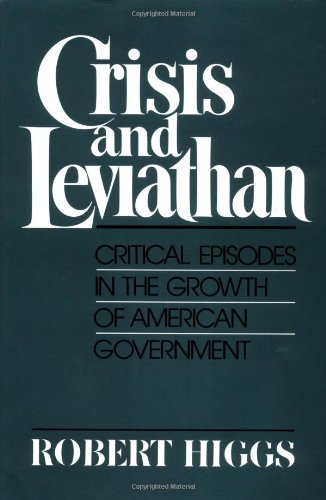 Crisis and Leviathan: ...
Best Price: $3.99
Buy New $24.09
(as of 09:45 UTC - Details)
Crisis and Leviathan: ...
Best Price: $3.99
Buy New $24.09
(as of 09:45 UTC - Details)

A partial list of interventions — those government economic regulations — would include:
- Bureau of Corporations (1903)
- Interstate Commerce Act major amendments (1903, 1906, 1910)
- Meat Inspection Act (1906)
- Pure Food and Drug Act (1906)
- Corporation Tax (1911)
- Sixteenth Amendment to the Constitution (1913) (Income Tax)
- Federal Reserve System (1913)
- Clayton Antitrust Act (1914)
- Federal Trade Commission (1914)
- U.S. Immigration (cut to a trickle during 1915—1920)
- Adamson Act (1916) (railroad labor wage rates)
- Shipping Act (1916)
- National Defense Act (1916)
- Army Appropriations Act (1916) (later took over railroads)
- Selective Service Act (1917)
- Espionage Act (1917)
- Lever Act (1917) (food and fuel) (prohibited alcohol)
- Overman Act (1918) (executive powers)
- War Finance Corporation Act (1918)
- President’s Mediation Commission (1917) (labor relations)
- Federal Control Act (1918)
- Sedition Act (1918)
Does this look like a laissez-faire list?
 Higgs summarizes just exactly how guided and regulated all economic activities were:
The two years, 1916—1918, witnessed an enormous and wholly unprecedented intervention of the federal government in the nation’s economic affairs. By the time of the armistice, the government had taken over the ocean shipping, railroad, telephone, and telegraph industries; commandeered hundreds of manufacturing plants; entered into massive economic enterprises on its own account in such varied departments as shipbuilding, wheat trading, and building construction; undertaken to lend huge sums to businesses directly or indirectly and to regulate the private issuance of securities; established official priorities for the use of transportation facilities, food, fuel, and many raw materials; fixed the prices of dozens of important commodities; intervened in hundreds of labor disputes; and conscripted millions of men for service in the armed forces. It had, in short, extensively distorted or wholly displaced markets, creating what some contemporaries called war socialism.
Additionally, Higgs documented that,
The public debt, which had been slightly more than $1 billion before the war, was over $25 billion at the end of the war and remained almost $17 billion as late as 1929.
While their heads were bobbing, my head was shaking.
This all had to have been a joke. Right?
 Consumer Strain: Pens and Notebooks Put On Layaway