


More Dismal than Ever
June 29, 2009
Economics is well known as the Dismal Science. In my opinion it is more dismal than ever as the world economy is being looted, pillaged, and run into the ground by a group of frauds and hucksters. The intellectual cover for this heist is being provided by people who call themselves economists but are really propagandists. Perhaps in these times the best quantitative measure of health for a society is the ration of true economists to propagandists. I would estimate that it is less than 1 to a 1000 today reflecting the current dire circumstances. It is disgusting that the likes of Krugman, Bernanke and Geithner have power, wealth and influence, while the likes of Guido Hülsmann, Bob Higgs, and others associated with the Ludwig von Mises Institute are relatively obscure.
With his wonderful ability to laugh in the face of disaster, Bill Bonner reports on the essentials of the situation.
06/26/09 London, England This just in…Ben Bernanke and Tim Geithner have rushed to Los Angeles. If they can revive an entire world economy…why not the "King of Pop?"
Fans are hopeful…but we take a discouraging view of these revival efforts. We admire the achievements of science and technology; as for the works of economists and central bankers, well…we’ll wait to see how things turn out.
Yesterday, we took up the biggest illusion of the Bubble Era. We held it up to the light…and noticed:
So deeply rooted is this illusion that it will take more than a strong wind to uproot it.
We’re talking about the idea that government bureaucrats can do a better job of allocating capital than free markets. Everyone seems to believe it. They’re allowing a handful of economists — who failed the critical test; not one of them noticed the market tsunami coming last autumn — to direct the flow of trillions worth of savings. They’ve already put at risk more than $12 trillion. Right now, they’re denying the need for more "stimulus," but that is likely to change.
Recently Lew Rockwell gave a speech on economic understanding. He eloquently described how people with the knowledge of Austrian economics have a clear view of the economic scene in spite of the turbulence of fast-changing events. Of course he is right. Lew is the 1 in a 1000 true economist, even more so because I imagine he does not even call himself an economist.
But there are occasions when Lew’s insight is not comforting. As a regular reader and occasional writer for LRC, and a longtime follower of the Austrian school, I have been trying to prepare my own finances to withstand the expected crisis for several years. I was out of the market before the crash. I bought Krugerrands from Camino Coin at $400. But it is difficult to completely prepare. I bought a little 100-year-old duplex in 2005 for $120,000 with full knowledge we were near the peak of the bubble. But I needed a house, so my thinking was that at that price even under the worst circumstances I would never lose my shirt. Another problem is that my retirement savings are locked in dollars (primarily the TIAA annuity) for at least 8 more years.
As it happened, I was recruited for a job in France just after I purchased my house. So I only lived there for a few months and the two units have been rented on and off for three years. Thus, I now also have substantial savings in euros. But the euro is just another fiat currency, so I have scoured the gold shops near the Paris bourse searching for more Krugerrands with no luck. I recently returned to the US for the first time since the economic collapse to visit my family and friends and to take care of personal business (the IRS still requires a return and it gets quite complicated with the dreaded alternative minimum tax). My trip was sobering in that my family and friends are not properly prepared for the hard times that I believe are in store for the US.
 The Mill on the Floss ...
Best Price: $3.59
Buy New $4.98
(as of 10:10 UTC - Details)
The Mill on the Floss ...
Best Price: $3.59
Buy New $4.98
(as of 10:10 UTC - Details)

So the analogy that comes to my mind regarding a follower of the Austrian school in the bubble era is like the witness to a coming of a train wreck. I know the train is heading for the washed out bridge at excessive speed. In fact I have just jumped off. But my luggage is still aboard, I have a few scrapes and bruises, and I don’t know how I will return to civilization. Even worse, my friends and family are still on the train.
At this point it seems hard to believe that newly struggling masses will ever understand the causes for their distress. While Austrian economics is readily understandable compared to the confused, ridiculous theories of the Keynesians, socialists and Greens of all stripes, I think what is most likely to stick in the heads of people is good writing that is explanatory about everyday experience. I have recently read a couple of examples of what I have in mind.
Here is George Eliot from her novel The Mill on the Floss (1860) on the subject of debt. "Mrs Tulliver carried the proud integrity of the Dodsons in her blood, and had been brought up to think that to wrong people of their money, which was another phrase for debt, was a sort of moral pillory; it would have been wickedness, to her mind, to have run counter to her husband’s desire to u2018do the right thing’, and retrieve his name." In this case the "right thing" is to pay off creditors. The passage continues with some sarcasm directed at the over-consumers of her day.
These narrow notions about debt, held by the old-fashioned Tullivers, may perhaps excite a smile on the faces of many readers in these days of wide commercial views and wide philosophy, according to which everything rights itself without any trouble of ours: the fact that my tradesman is out of pocket by me, is to be looked at through the serene certainty that somebody else’s tradesman is in pocket by somebody else; and since there must be bad debts in the world, why, it is mere egoism not to like that we in particular should make them instead of our fellow-citizens. I am telling the history of a very simple people, who had never had any illuminating doubts as to personal integrity and honor.
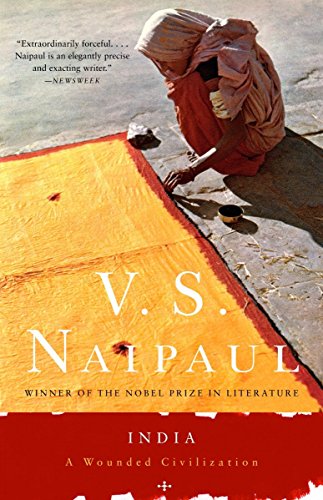 India: A Wounded Civil...
Best Price: $1.56
Buy New $9.25
(as of 01:10 UTC - Details)
India: A Wounded Civil...
Best Price: $1.56
Buy New $9.25
(as of 01:10 UTC - Details)
Another genre that can be very informative about economics is travel writing. Here is a passage from V. S. Naipaul‘s, India: A Wounded Civilization August 1975—October 1976. The true nature of how investment and knowledge lead to improved productivity, and then to more wealth is apparent in this poignant description of work in Old India.
The plateau around Poona is now in parts like a new country, a new continent. It provides uncluttered space, and space is what the factory-builders and the machine-makers say they need; they say they are building for the twenty-first century. Their confidence, in the general doubt, is staggering. But it is so in India: the doers are always enthusiastic. And industrial India is a world away from the India of bureaucrats and journalists and theoreticians. The men who make and use machines — and the Indian industrial revolution is increasingly Indian: more and more of the machines are made in India — glory in their new skills. Industry in India is not what industry is said to be in other parts of the world. It has its horrors; but, in spite of Gandhi, it does not — in the context of India — dehumanize. An industrial job in India is more than just a job. Men handling new machines, exercising technical skills that to them are new, can also discover themselves as men, as individuals.
They are the lucky few. Not many can be rescued from the nullity of the labour of pre-industrial India, where there are so many hands and so few tools, where a single task can be split into minute portions and labour can turn to absurdity. The street-sweeper in Jaipur City uses his fingers alone to lift dust from the street into his cart (the dust blowing away in the process, returning to the street). The woman brushing the causeway of the great dam in Rajasthan before the top layer of concrete is put on uses a tiny strip of rag held between her thumb and middle finger. Veiled, squatting, almost motionless, but present, earning her half-rupee, her five cents, she does with her finger dabs in a day what a child can do with a single push of a long-handled broom. She is not expected to do more; she is hardly a person. Old India requires few tools, few skills, and many hands.
 All the Collateral That's Fit To Print