


The Plague of Punitive Populism
August 8, 2009
“Wherever there’s a cop beatin’ up a guy, I’ll be there.”
~ Tom Joad in The Grapes of Wrath
In Virginia, police officers raid a baptismal party for two small boys. Without cause or provocation they assault the grandfather who owns the home, tasering him three times while children and other guests look on in horror.
When the pregnant daughter-in-law of the victim intervenes, she, too, is forced to perform the “electron dance.” The grandfather is charged with disorderly conduct and public intoxication, despite the fact that Virginia state statutes specify that such offenses cannot be committed on one’s own property.
The woman who came to the aid of the first victim was charged with “assaulting an officer,” since her brave effort to protect the grandfather from a criminal assault involved placing her unhallowed hands on the sanctified personage of a “law enforcement officer.” Such presumption simply cannot be tolerated.
A few weeks earlier in Webster, Texas, a pastor is tasered after a member of his congregation was pulled over by police in the church parking lot. Once “backup” arrives — the boldness of police, like that of feral wolves and droopy-drawered gang-bangers, is a function of operating in packs — the officers charge the church sanctuary, assaulting Pastor Jose Moran and pepper-spraying the worshipers who objected to the treatment of their pastor. Once again, the victim, rather than the assailants, finds himself charged with assault.
Once the confusion was cleared up, they arrested him anyway on various charges, including — no extra points for guessing correctly — “assaulting” the officers who attacked him. The police department issues a statement claiming that the attack with chemical and electro-shock weapons was justified because the confused man-child (a term I use with sympathy, not in derision) was “armed” with an umbrella.
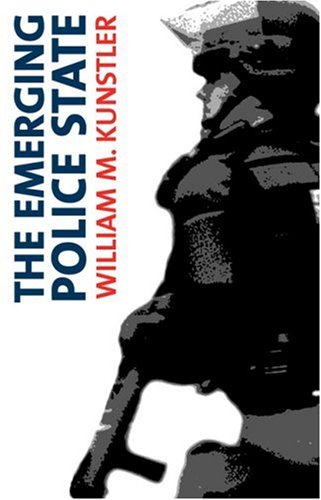 The Emerging Police St...
Best Price: $3.75
Buy New $16.95
(as of 06:25 UTC - Details)
The Emerging Police St...
Best Price: $3.75
Buy New $16.95
(as of 06:25 UTC - Details)

In Boise, Idaho, police swarm, gang-tackle, and handcuff a man involved in a domestic dispute.
When he complains about impending suffocation — a very acute threat, since many victims of lethal police violence die from positional asphyxiation — he is subjected to a Taser strike in his rectum by a still-unidentified officer who threatens to strike the victim’s genitals next. Subsequently one of the assailant’s superiors attempts to destroy the evidence by erasing an audio taped record of the event.
In Wisconsin Dells, two callow patrolmen — Officer Beavis and Officer Butt-Head — stumble upon a couple of off-duty National Guardsmen and decide to have some fun. The police accuse the victims of urinating in public and then demand that they lick from the ground a substance they are told is human urine. When a third police officer materializes, the victims speak of filing a complaint.
This prompts the threat of a bogus burglary charge and the promise that “nobody will believe you” if they actually file a protest. As it happens, the complaint is believed — most likely because it was made by two Iraq war veterans, rather than common citizens.
These are mere snapshots of the commonplace sadism that increasingly typifies contemporary American law enforcement. But this really isn’t so surprising for a country in which a bare majority, according to a recent global survey, opposes state torture.
That survey found that Americans are much likelier to support government-inflicted torture than citizens of Communist China, and marginally more indulgent of the practice than the residents of Muslim Indonesia and Muslim/socialist Egypt. Support for torture is also more widespread among Americans than among Iranians.
One might think that support for torture would be restrained by the influence of America’s church-going population. One would think that those Americans who worship the Man of Sorrows who was tortured to death by the occupation forces of a pagan imperial state would be among the most insistent opponents of the vile and indefensible practice.
One would be entirely wrong, since exactly the opposite is true: A survey taken earlier this year documented that a majority (54 percent) of people who attend church at least once a week supports torture.
Perhaps the most arresting discovery was that more than sixty percent of white, evangelical Protestants condone the practice. Torture advocates of this theological persuasion profess a “personal relationship” with Jesus Christ. That relationship must be, at best, a distant and superficial one.
 The End of America: Le...
Best Price: $0.10
Buy New $2.99
(as of 10:20 UTC - Details)
The End of America: Le...
Best Price: $0.10
Buy New $2.99
(as of 10:20 UTC - Details)
As the United States sinks into what will be a long and dreadful depression, and partisan politics takes on the character of a literal bloodsport, speculation is rampant about a possible civil war (which would not be the same thing as peaceful secession, which may prove to be the only sensible way to address our economic and political afflictions). If such a conflict were to come, it might actually start within the church-going segment of the population, pitting nominally Christian statists against those who believe in what the Epistle of James called the “perfect law of liberty.”
In dealing with the prospect of an internecine conflict among believers, it’s instructive to recall the events described in the 12th chapter of the Old Testament Book of Judges, in which the Gileadites and Ephramites were at war.
After the Gileadites routed their opponents in one battle, they devised a clever method of winnowing out concealed Ephramites from their midst. As it turns out, the Ephraimites for some reason couldn’t pronounce the word “shibboleth” correctly, rendering that term “sibbolet.” Accordingly, each man who approached a critical checkpoint was required to say “shibboleth,” with instant death being the penalty for tens of thousands who uttered malapropisms.
While I have no desire to put anyone to the sword, I suggest that liberty-minded Americans, whether or not they subscribe to the Christian faith, can learn much about themselves and those around them through what we could call the “Tom Joad Test.”
I’m not a fan of Steinbeck’s incurably wrong-headed economic views or his idiosyncratic collectivist politics in general, although I must admit a sneaking respect for anybody who attracts the hostile interest of the FBI solely on the strength of his published writings.
His creation Tom Joad isn’t among my favorite fictional characters. But there is substantial merit in Joad’s pledge to sympathize with those who are victims of Power.
 The Grapes of Wrath (C...
Best Price: $1.25
Buy New $6.95
(as of 09:15 UTC - Details)
The Grapes of Wrath (C...
Best Price: $1.25
Buy New $6.95
(as of 09:15 UTC - Details)
Early in The Grapes of Wrath, Joad — recently paroled after serving four years in prison for killing a man who stabbed him in a fight — becomes re-acquainted with Jim Casy, a fallen Oklahoma Pentecostal preacher who has embraced a populist version of Emerson’s “oversoul” concept: “Maybe all men got one big soul ever’body’s a part of.”
Thus was planted the seed that would sprout into Joad’s famous soliloquy, which included the pledge that “Wherever there’s a cop beatin’ up a guy, I’ll be there.”
So here, stated briefly, is the question that serves as the shibboleth/sibbolet dividing line in the “Tom Joad Test”:
When you see a cop — or, more likely, several of them — beating up on a prone individual, do you instinctively sympathize with the assailant(s) or the victim?
If it’s the former, you’re an authoritarian, irrespective of your partisan attachments or professed political philosophy.
If it’s the latter, you’re an instinctive libertarian, whether or not you are consistently guided by that impulse in your political decisions.
It may later be demonstrated that the figure on the receiving end of the beating had committed some horrible crime. However, such a disclosure wouldn’t invalidate the results of the Tom Joad Test, because that test reveals a subject’s default assumptions about the relationship between the individual and the state.
Do you assume that the state is entitled to the benefit of the doubt whenever its agents inflict violence on somebody, or do you believe that the individual — any individual — is innocent of wrongdoing until his guilt has been proven?
This could be considered a reverse application of Lenin’s famous political formula, kto kogo? — broadly translated as “Who does what to whom?” Lenin and his followers sought and acquired the power to be the “Who” in that formula, which meant that millions of those consigned to the “whom” category were imprisoned and slaughtered.
Ironically, many law-and-order conservatives come uncomfortably close to Lenin’s view of the state when they reflexively take the side of agents of state coercion — the “who” in the typical encounter between police officer and citizen. The American view of rights, however, is overwhelmingly weighted on behalf of the latter, even when the “who” is a winsome and well-dressed policeman, and the “whom” is a scruffy and unappealing individual.
One of the easiest and least intrusive ways to conduct the Tom Joad Test is to observe an individual’s reaction to the typical installment of the TV series COPS, which — in any of its iterations — is a kind of authoritarian pornography for the badge-licker population.
Several months ago, I took my family to a large and very nice Chinese buffet in Boise. Since the Grigg family is almost at brigade strength, we were ushered into the conference room, where we could have a long table all to ourselves. Unfortunately, the room was equipped with a television set, most likely because some secret Reversal of Freedom law dictates the presence of an infernal device of that kind in every room of a certain size. Even worse, a COPS marathon was underway.
As I grazed on sauted bok choy and exquisitely seasoned bean sprouts (delicious vegetarian items being a specialty of this particular restaurant), my appetite began to depart as the screen conveyed an endless repetition of the familiar storyline: Police spy pathetic, socially marginalized individual; police harass said pathetic individual, who had done nothing to harm anyone else; police find some excuse to arrest said individual, often throwing him to the ground and humiliating him in the process.
Despite the delicious fare in front of me, my mood turned sour and ominous mutterings began emanating from me like premonitory tremors anticipating an eruption. Similar outrage radiated from the faces of other nearby patrons.
Near the beginning of the third consecutive installment of COPS, we were treated to the unedifying sight of a police officer approaching a woman on a sidewalk and demanding that she show identification. She had done nothing to provoke the interest of the officer, and wasn’t inclined to comply with that unwarranted demand.
The officer replied in predictable fashion, beginning the familiar procedure of jacking her arm behind her to slap the cuffs on her wrists. To her considerable credit, the woman shrugged off that assault and put up a more than respectable fight, despite being roughly 50—75 lbs. smaller than her assailant.
Eventually, the cop — who had created this altercation ex nihilo — ended it by grabbing the small-boned woman in a headlock and slamming her face-first into the sidewalk.
That sight wrenched gasps from several people sitting at other tables. My reaction was characteristically measured and sedate.
 Liberty in Eclipse
Best Price: $10.58
Buy New $57.61
(as of 09:10 UTC - Details)
Liberty in Eclipse
Best Price: $10.58
Buy New $57.61
(as of 09:10 UTC - Details)
“You malignant BASTARD!” I exclaimed in a voice that was probably heard in Winnemucca.
Shooting a quick glance around, I noticed several food-laden forks suspended in mid-transit from well-stocked plate to gaping mouth, and numerous sets of eyes distended in shocked disbelief. I suggested to my wife, the lovely and brilliant Korrin, that we should leave. She didn’t resist the suggestion.
The success of COPS and its imitators, like the survey results dealing with torture, illustrates that there is a wide, deep, and resilient strain of punitive populism in American culture. I suspect that there is a smaller, but growing, sub-population of people who instinctively take the side of the person on the receiving end of the nightstick.
In light of the fact that nightsticks and various other implements of coercion will play an increasingly prominent role as the economic implosion accelerates, we’d better find each other, and radically increase our ranks — and do this as quickly as humanly possible.
The Best of William Norman Grigg
 Taxpayers vs. Tax-Eaters The Two Classes in Society