


The Food, the Fat, and the Ugly
August 9, 2002
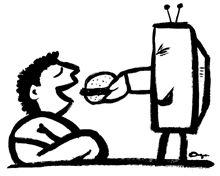 The latest outrage in America is the fight against fat and the "capitalist swines" that produce and market such sin. After all, fat taxes are in the offing as the ultimate spanking in the direction of those consumers who choose twinkies or potato chips over government-approved bird seed. The politically correct food fascists, from D.C. and elsewhere, are even trumpeting studies that prove American children to be fat instead of fit. And Caesar Barber, fatso extraordinaire, is going to make the junk food producers pay.
Mr. Barber, while naming Burger King, McDonald’s, Wendy’s, and KFC as defendants in his legal grievance against his own sagging waistline and wilting health, has rejuvenated the anti-capitalist outgrowth amongst the it-ain’t-our-fault crowd. This time, the malicious perpetrators appear to be the beastly marketing types who have the nerve to make their products appealing to the masses. And the consuming masses, along with Mr. Barber, can’t possibly be held responsible for their own actions.
Mr. Barber claims he is fat and unhealthy and it is a lifetime junk food habit that is to blame. Barber and his speculator lawyer, Samuel Hirsch, base this notion of no accountability on the fact that ignorant consumers need perpetual warning of the possible consequences of digesting fast food-type chow. Mr. Barber’s obesity, high blood pressure, diabetes, heart disease, and cholesterol are, according to Hirsch, the result of deception on the part of greedy moneymakers. Therefore, Hirsch seeks a class-action lawsuit with compensatory damages.
Are we not yet sick of these shyster lawyers and their court scams?
The Physicians Committee for Responsible Medicine is applauding this legal action, and in fact, its spokesman, Dr. Neal D. Barnard, holds the fast food industry accountable for America’s "diet-related epidemics." Even granting that fast food necessarily begets ill health, one must set aside the causal factors and instead focus instead on deliberate human action.
Humans, after all, act to make specific choices. These choices are purposeful in aiming at securing certain ends. The ends we humans drive at ultimately aim at happiness, because such a state has managed to alleviate some set of uncertainties in our lives. Human action, then, is at the core of economic decision-making. The act of eating is quite often an economic decision. Not only is cost an issue, but time preference — the degree of preferring present satisfaction to future satisfaction — is, quite typically, very high among those that are too lazy to take care of their immediate physical condition.
Eating when we are hungry is a happy thing. It may be blatant laziness or just plain happiness that makes individuals choose quick and easy food in the first place. Let’s admit it, even owing to him being too lethargic to steer away from easy food, every time Mr. Barber walks into a McDonalds, he has a choice between Big Macs and salads, or between fries and fruit yogurt. He likes the burgers and fries because they smell yummy and look juicy, while the salad or healthy yogurt looks bland and tasteless. So Mr. Barber chooses to stuff his face with that which he makes a direct choice to consume. He eats what makes him happy. The yogurt will not make him happy.
Am I missing something here?
Also, taking the time to prepare meals through the means of choosing a recipe, shopping for ingredients, making the meal, and cleaning up afterwards can often impose tremendous opportunity costs on an individual. They miss out on the opportunity to be doing something else they consider important. After all, the time spent preparing food can be time gloriously spent not exercising, for goodness sakes.
A guy like Mr. Barber purports that he has no responsibility whatsoever to inform himself on matters pertaining to his own body. Nor is he under any code of responsibility for weighing his high time preference against the likely consequences of negligent choices. The producers of fatty foods, according to his charges, shall be responsible for guiding individuals through the motions of decision-making.
However, it’s tough to fight the common sense notion of eating. We know we should not eat too many calories or too much in the way of fat or carbohydrates because they all cause fat to accumulate in the body, and fat causes blood pressure, cholesterol, and heart blockage problems, and those problems cause unhappiness. Death can be an unhappy thing, after all.
But it’s Mr. Barber who wanted the immediate happiness for all these years, and now that the price of instant gratification has come to bear upon him, he wants to turn the tables of responsibility onto the producers of fatty foods?
Previous court tomfoolery has shown us that hot McDonald’s coffee balanced on one’s lap can be traced back to corporate culpability, yet the notion of individual stupidity never entered that legal fray. As to Caesar Barber, I say that a man who ignores the wealth of information available to him and shrugs off the virtue of exercise has bought his own ticket to the flab farm.
And of course, the court and its associated costs is a public good which Mr. Barber can use to his heart’s content. He will incur little if any costs as the defendants and the taxpaying public foot the bill for yet another case of individual idiocy.
In a further attempt at the absurd, on a recent MSNBC interview, both Barber and his lawyer attempted to make his case a racism issue by charging that the fast food industry is aggressively marketing its evils toward minorities, specifically in minority neighborhoods. This, they hinted, was a plot to suck in all of the poor minorities that are, apparently, less capable of making buying decisions than non-minorities. But when major pizza chains and other food business do not locate in high-crime minority areas, the racism charges therein are rampant and unforgiving.
The charge of wickedness in advertising is preposterous and is rooted deeply in an anti-capitalistic mentality. The Leftist economist Kenneth Galbraith has said that advertising is the villain that creates artificial wants that heretofore did not exist. The Galbraithian view, one that is reasserting its popularity, is that all consumers actually have a tendency toward life at a bare subsistence level; that without businesses preying on consumer weaknesses, individuals don’t desire products that make them happy or affluent.
And Mr. Barber, I suppose, never truly desired the latest Wendy’s triple-decker or McDonald’s value meal. It was all coercive marketing that swayed his otherwise prudent sensibilities. Without such bullying, we are to deduce that he’d rather have shopped for and cooked some far healthier meals.
This legal mockery is just a small fraction of the war against free enterprise, and with it comes the usual blame games to excuse the lack of individual accountability in society nowadays. It appears that a person’s lack of physical activity, genetic make-up, and insatiable appetites for instant happiness can never be the culprit in a blame society.
 by Steven Yates