

Historians celebrate his predecessor Truman and his successor JFK as near-great. Yet, Eisenhower is ignored. A positive-passive president, he is called, at best an average president.
Yet, what did Ike accomplish? He took office in 1953 and in six months ended the no-win war in Korea. With a million illegal aliens here, he ordered them home in “Operation Wetback.” They went.
He built up U.S. armed forces to where we were invincible. When the Hungarian Revolution erupted, Ike refused to send troops beyond the bridge at Andau. America stayed out, and the revolution was snuffed out by Soviet tanks. But there was no war between America and the Soviet Union.
When the British, French and Israelis launched an invasion to retake Suez from Nasser, who had nationalized it, Ike ordered the Brits and French out, threatened to sink the pound if Prime Minister Eden balked, told Israel’s David Ben-Gurion to get out of Sinai or face the wrath of the man who had commanded D-Day. All obeyed.
Ike gave us peace and prosperity, balanced the budget, and went off to play golf at the all-men’s Burning Tree Country Club, where this writer was a summer caddy. Once, as I was walking out the long driveway at Burning Tree to walk to River Road, to hitch-hike back to D.C., the president’s limo approached.
I put out my thumb, and got Ike’s famous smile and a wave as he passed by. Ike was a leader who could say no. He was what we needed after the disastrous tenure of Harry Truman, who had left office with an approval rate of 23 percent.
Today, America is a country that cannot say no. The back-slapping of Republicans notwithstanding, we do not have a true or tough conservative in the Oval Office. There is no conservative party in Washington. And we shall pay a historic price for it.
Under President Bush, the U.S. government collects 16 percent of the GDP in taxes and spends 20 percent. We have a deficit of close to 4 percent of the economy.
Yet, as the Washington Post’s Robert Samuelson writes, Social Security, Medicare and Medicaid, which already consume 7 percent of GDP, will rise to 13 percent in 2030. I.e., the federal take will rise to 26 or 27 percent of our economy.
Thus, the problem. If the feds are taking in 16 to 17 percent of GDP, but spending 26 to 27 percent of GDP, how do we close the gap? Do we raise taxes 10 percent of GDP, or raise the deficit to 10 percent of GDP?
As Samuelson writes, just to close the coming gap in Social Security, Medicare and Medicaid would require a $700-billion-a-year tax hike. That would sink the economy.
Now, consider our foreign debt, the largest in history.
In 2004, the U.S. trade deficit will come in near $600 billion. In November, at $60 billion, it was running at $720 billion a year, with the merchandise trade deficit approaching $800 billion.
We are borrowing 6 percent to 7 percent of GDP abroad to finance our purchases abroad. Japan and China are lending us the hundreds of billions we need each year to cover our purchases of foreign goods. Why are our lenders so generous? Because it enables them to siphon our manufacturing base out of America, into Asia.
By putting us into bottomless debt and hooking us on their products, they are making us a dependent nation, dependent on them.
Why do we Americans not use our own savings, if we feel we must buy beyond our income? Because the average American saves nothing, about 1 percent of what he earns. Never before have our people been so deeply in family debt, on credit cards, mortgages and car loans.
From every standpoint, America is a nation over-extended, living beyond its means, mortgaging its future for the present.
Then, consider our military commitments. President Bush is expected to ask Congress for $100 billion in supplemental funds to pay for the Iraq and Afghan wars. As we do not have the money, we shall have to borrow to fight these wars.
 Beyond the fiscal cost, there is America’s strategic deficit. With 150,000 troops in Iraq, 40 percent of them Guard and Reserve, with 9,000 in Afghanistan, our 500,000-man Army is stretched to the limit. Our Navy is falling below one-half the 600 ships of Ronald Reagan’s Navy.
Yet, the Bush Doctrine calls for us to fight Iran and North Korea to keep them from going nuclear. The neocons want Syria attacked. Beltway elites are raising their fists at Russia and demanding Ukraine be brought into NATO. Meanwhile, China appears to be building its forces for the ultimate showdown with Taiwan.
America is a nation over-committed, over-extended in every way. And the IOUs are coming due.
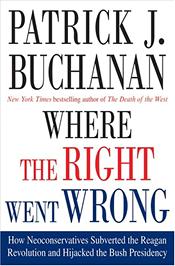
Patrick J. Buchanan [send him mail], former presidential candidate and White House aide, is editor of The American Conservative and the author of eight books, including A Republic Not An Empire and the upcoming Where the Right Went Wrong.

