


Two Ways to Deleverage an Economy
June 11, 2009
The dumb money is fairly easy to spot. It’s the money that always shows up late to the party, wearing yesterday’s fashions. It watches TV and thinks the reality shows show reality…it thinks Ben Bernanke is a great economist…that the SEC protects investors from fraud and misrepresentation…and that Tim Geithner makes sure the economy keeps running smoothly.
It’s the dumb money that thinks you can correct a generation-long period of credit growth in 24 months…with less than 10% unemployment…
Stocks have now been in a rally for three months. The longer this goes on, of course, the dumber money gets. People come to think the bounce is a permanent bull market.
Yesterday, not much happened. Stocks held steady. Oil too. Gold fell $8…closing at $952. And the dollar rose to $1.39 per euro.
But while the dumb money has its eyes on the stock market, the smart money is watching the economy.
Unemployment has risen to 9.4 million in the United States. Experts think the rate of job losses is slowing. But month after month, more and more people are not collecting wages. Instead, they’re coming to rely on handouts from the government. The press reports that one in every six Americans is now on some form of government life-support.
Same thing in the housing sector. Robert Shiller says the housing slump has already knocked prices down 32%…and has a long way to go. This alone guarantees a long period of adjustment. Bad decisions — usually those with huge debt bombs attached — will blow up…then they need to be cleaned up…and then, after the destruction, comes the constructive rebuilding. All that takes time…years.
People whose houses are going down in price…and whose incomes are falling…do not buy more stuff. Sales go down…profits go down…and dividends go down. Why would investors buy stocks when earnings and dividends are falling? Good question. Pull your shorts up, dear reader…pull your shorts up.
 House prices are still going down — but not as fast. Still, big resets, defaults and foreclosures are still on the way — in prime and Alt-A mortgages.
Meanwhile, when companies don’t sell…they don’t ship either.
The trucking industry says traffic is off 13% from a year before — the biggest drop in 13 years.
Airplanes are carrying 21% less cargo. And the commercial airline industry says it is losing $9 billion this year.
As for shipping…well, don’t even bring it up. Shipping has been in a catastrophic slump since last year — with cargo rates down 90%.
Obvious conclusion:
“Every smart trader I know is massively short the stock market,” says Jeff Clark.
The blogs are chattering about poor Lee Mozilo. He’s no Angelo, they say. The SEC claims he told investors that all was well in his company, Countrywide, while he was dumping shares.
We don’t know the details, so we wouldn’t rush to judgment. But our guess is that the SEC is trying to recover its reputation by putting on a few show trials. The SEC has a pack of watchdogs on the payroll. But somehow thieves stole every decent part in the junkyard without a single one of these mutts bothering to bark. Now, they’re indignant…and out for justice!
 Tomorrowu2019s Gold: A...
Best Price: $4.91
Buy New $513.99
(as of 07:35 UTC - Details)
Tomorrowu2019s Gold: A...
Best Price: $4.91
Buy New $513.99
(as of 07:35 UTC - Details)

Did Mozilo do something wrong? We don’t know. But the question would never have come up if it hadn’t been for the crisis in housing debt. As long as housing was going up, everyone was happy with Countrywide’s business model. Yet didn’t everyone know that the mortgage finance business was a dangerous place to be at the end of a housing bubble? Didn’t the SEC know it, too? If we recall correctly, Mozilo said so himself…
But the SEC watchdogs slept through the biggest heist in history. And now the people who lost face and lost fortunes are eager to pin the blame on someone other than themselves.
But that’s just part of the whole process of deleveraging. That’s how capitalism works. People lose money…then they lose jobs…and houses…and businesses go into chapter 11 and a few of their CEOs go to jail.
All that takes time. And betting against deleveraging is probably not a smart thing to do. Not until it’s over…which is not until the leverage built up in the bubble era has been removed. And with total debt levels at 370% of GDP…and the government adding even more debt…we’re a long way from there.
But what do you do, dear reader? Buy Treasuries in anticipation of another crash in stocks? Or mortgage your house, long-term fixed-rate, in anticipation of fed-caused inflation?
Ah, there’s the tough question. We know where the dumb money is…but where’s the smart money? Jeff Clark says it’s short stocks. But there’s some very smart money that is betting that the government will turn this around. They’re putting their money on inflation…or even hyperinflation. Our old friend, Marc Faber, for example, says he is sure the United States is headed for hyperinflation. If so, shorting stocks may not be such a shrewd move. Stocks could soar too — as investors try to buy anything and everything that didn’t have dollar signs on it.
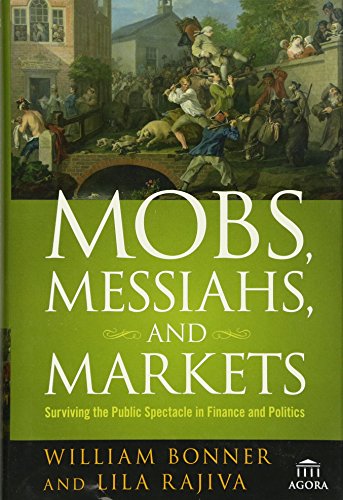 Mobs, Messiahs, and Ma...
Best Price: $0.25
Buy New $8.01
(as of 04:35 UTC - Details)
Mobs, Messiahs, and Ma...
Best Price: $0.25
Buy New $8.01
(as of 04:35 UTC - Details)
You see, there are two ways to deleverage an economy.
The obvious way is the traditional, honest way — in which people actually try to pay their debts. This causes the problems we see as falling asset prices, bankruptcies, joblessness and the other hallmarks of a Great Depression.
But the feds have their hearts set on preventing a depression. And they’re doing it the only way they can…by the old u201Chair of the dogu201D technique. The economy suffers from too much debt — so they’re going to give it more! Much more. The whole pooch! The whole kennel! Then, they round up every stray mongrel in town. What happens when they run out of dogs? Well…that’s a discussion for another day.
We have had many laughs following the feds and their war against capitalism. They’re gambling an amount nearly equal to the entire U.S. GDP to try to prevent people from getting what they have coming. In the process, they’re almost certain to make a mess of things.
The smart money is betting that they fail to stop deleveraging. But the very smart money is betting that they create a new, worse problem — inflation, maybe hyperinflation. Inflation reduces the real value of debt…but in a perverse and unpredictable way. Debtors don’t pay their bills; savers pay them. Inflation — like bailouts — rewards the least responsible players…those who have gotten themselves heavily in debt…and punishes those who have done the u201Crightu201D thing. As Germany saw in the ’20s, it de-stabilizes the whole society…leading to extremely unwelcome outcomes.
Bill Bonner [send him mail] is the author, with Addison Wiggin, of Financial Reckoning Day: Surviving the Soft Depression of The 21st Century and Empire of Debt: The Rise Of An Epic Financial Crisis and the co-author with Lila Rajiva of Mobs, Messiahs and Markets (Wiley, 2007).
 What Global Warming?