

Have you checked your stops, dear reader?
Remember back in November, we waited for the Obama Bounce? It was the one of the most reliable phenomena in the world of investing, we said. Then, we began to wonder. Month after month…no bounce.
It took a long time coming…then, finally, in March prices headed up. Since the 9th of March world stock markets are up 37% — about average for a post-crash bounce.
Now, it looks as though the bear market rally might have run its course. And yesterday, the Dow was down 184 points. We don’t know if that marks the end of it or not. But count us out. At this point, it is far too dangerous to be heavily invested in stocks.
Why? Because the Bubble Epoque is over. The bubble in the financial sector blew up last year. That marked the end of a half-century of building up debt. Most likely, now debt is going to be thrown off, shucked, dumped, paid down, worked out and defaulted on.
Without the financial sector puffing up assets, prices will tend to go down, not up. And without the financial sector adding debt…and giving American consumers the wherewithal to dig themselves deeper holes…the whole world economy needs to be restructured. Manufacturers in China can’t depend on the consumers of first and last resort in America anymore. People in the US are no longer buying what they don’t need with money they don’t have. Because no one will lend them money. And so, global commerce slumps. Ships wait at loading docks; where are the containers? Factories wait for orders and stores wait for customers; but where are the customers? The customers aren’t going to show up. Because if there is one thing Americans have learned from this crisis it’s that they must stop spending so much money. They’re facing what the Washington Post calls the “Baby Boomers’ Retirement Bummer.” They have no choice; they have to pay off debt, not add more of it.
We’re hearing that China is recovering. We don’t believe it. Who’s buying?
They say the US economy is close to a bottom, too. We don’t believe that either.
Wait…let’s ask Alan Greenspan. Here’s the Bloomberg report:
Former Federal Reserve Chairman Alan Greenspan said on Tuesday that “the seeds of a bottoming” in plunging U.S. home markets were becoming visible.
Speaking to a National Association of Realtors summit, Greenspan said there were reasons to believe that bulging inventories of unsold homes were dwindling and that should bring some stability to prices.
“It looks to me, judging from the balancing of household formation on one hand, conversions, mergers, demolitions…that we’re at the edge of a major liquidation in that excess of inventories which I suspect and I hope will be of such a pace that it will stabilize prices,” the former Fed chief said.
“So as I look at the housing market…we are finally beginning to see the seeds of a bottoming,” he added.
We can imagine seeds of a recovery. We can imagine signs of a bottoming. But we don’t know what the hell “seeds of a bottoming” is supposed to mean.
Do the seeds grow downward? And turn into a bottom? Then what happens?
But that confirms it for us. If the former Fed chief thinks he sees the “seeds of a bottoming,” a bottom must be nowhere in sight. And how could it be? You can’t hope to erase the errors of a 50-year debt build-up in a single year.
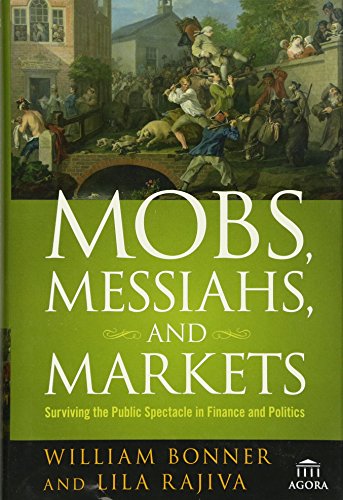 Mobs, Messiahs, and Ma...
Best Price: $0.25
Buy New $8.01
(as of 04:35 UTC - Details)
Mobs, Messiahs, and Ma...
Best Price: $0.25
Buy New $8.01
(as of 04:35 UTC - Details)

Just look at the auto industry. How long will it take to turn GM around…or to break it up…sell off the assets…and put the good pieces back to work? Many years. How long will it take to work off the housing inventory? Years. How long will it take China to retool her economy for domestic consumption? Years.
And how long will it take the American consumer to pay down his debt to a level where he is comfortable again? Well…forever… Just do the math. The savings rate has gone up to 5% of GDP. That’s $700 billion per year. Yet, the excess debt alone is estimated (by us) to be between $20 and $30 TRILLION. At that rate, it could take 40 years, or more, to pay it down.
But wait again…while consumers are paying down debt, the feds are borrowing more than ever. While consumers may pay off $700 billion of debt, the US government is borrowing $1.84 trillion — at this rate, Americans will never get out of the hole.
“The market seems to be looking as if this is going to be an average recession, but it’s not,” said Paul Krugman, Princeton University’s Nobel Prize-winning economist.
Nouriel Roubini also thinks the forecasts of a recovery are “too optimistic.”
They’re almost certainly right.
 Krugman goes on to warn that the run-up in stocks can’t be justified by the fundamentals: “It looks to me now as if the markets are now pricing in a rapid recovery, that they’re pricing in a V-shaped recession, which I consider extremely unlikely.”
Let’s review: stocks get expensive…then they become cheap. That’s just the way it works. Prices go up and down in long cycles. At the top of the cycle, they’re very expensive — over 20 times earnings. At the bottom, they’re very cheap, under 5 times earnings. At the top of the cycle you might need as many as 43 ounces of gold to buy the Dow stocks. At the bottom, one or two ounces will do the job.
At present, stocks are not cheap. In nominal terms, the Dow is 8 times higher than it was when the bull market began in August 1982. In terms of gold, it takes about 9 ounces today to buy the Dow. That’s a lot less than it took in 1998, when the Dow was 43 times the price of an ounce of gold. But it’s a lot more than you find at real bottoms. At the bottom of the cycle in 1982, you could buy the entire Dow for just one ounce of gold. And in terms of P/E ratios, you can buy a few stocks at very low price-to-earnings ratios today, but the majority are still above 15. When they get down to 5, we’ll talk.
There being no sign of a bottom in the stock market yet, nor even the seeds of a bottom, we’ll adjourn today’s session…and guess that the real bottom is still far ahead.
Time to sell the rally.
Bill Bonner [send him mail] is the author, with Addison Wiggin, of Financial Reckoning Day: Surviving the Soft Depression of The 21st Century and Empire of Debt: The Rise Of An Epic Financial Crisis and the co-author with Lila Rajiva of Mobs, Messiahs and Markets (Wiley, 2007).

