


Johnny Gaskins and the Lapdog Media
October 27, 2009
I have long contended that one of the reasons Americans have lost most of their freedoms has been the cravenness of the U.S. mainstream media. When I was a journalism student more than three decades ago, the J-school majors were told time and again that the media role primarily was to serve as a "watchdog" on government and not to become utterly entangled with those in power.
Unfortunately, the modern media also is the creation of the Progressive Era, a time in which the intellectual currents within the United States moved from the promotion of individual liberty to a "progressive" growth of state power. Government was seen not as a protector of liberty, but rather as an entity that both "protected" average citizens from the predations of private enterprise and provided goods and services through an expanded welfare system.
Intellectually, most journalists were and are "progressives," which means that in their view, a country "progresses" by having more and more activities that individuals and private organizations once performed now carried out by the state, and preferably the central state, or federal government. Thus, we see most mainstream media outlets endorsing government-run medical care, government-run economic systems, the Drug War, prosecution of "white-collar" offenders, and the growth of laws, and especially laws that have criminal penalties.
So, for all of the "watchdog" talk we receive from media personalities, what the media really has become is, at best, a lapdog of the state and, at worse, its publicity arm. Instead of questioning what government is doing, the media, both print and electronic, now serve as the cheerleaders of the state.
The Raleigh News & Observer is the epitome of the "progressive" newspaper. Its founder was a well-known North Carolina "progressive" (and like most "progressives," was a virulent racist, something that embarrasses that editorial staff), and today, the paper promotes "progressive" causes wherever it can. We see that unfortunate legacy in both the infamous Duke Lacrosse Non-Rape Case, and the recent conviction of Raleigh criminal defense attorney, Johnny Gaskins.
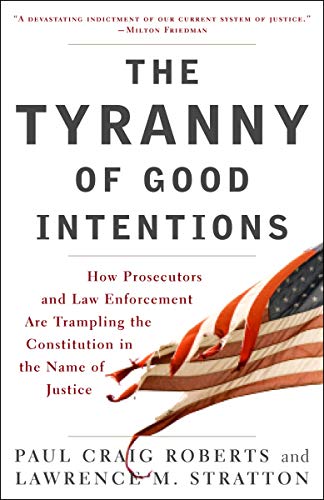 The Tyranny of Good In...
Best Price: $6.96
Buy New $8.95
(as of 07:10 UTC - Details)
The Tyranny of Good In...
Best Price: $6.96
Buy New $8.95
(as of 07:10 UTC - Details)

For example, the N&O was the newspaper that first gave us the utterly dishonest version of the lacrosse case. A hard-left staff writer (who now writes for a quasi-Marxist publication), Samiha Khanna, interviewed Crystal Mangum following the so-called "lacrosse party," and produced a story filled with falsehoods.
After publishing the article (no longer available) as a screaming-headline front-page story, the N&O then went after the Duke lacrosse players as though they were a gang of murderers. (In fact, the N&O was much harder on the lacrosse team than it ever has been against real-live murderers and rapists.) The lacrosse case fulfilled every "progressive" dream and every stereotype "progressives" might have of the "wealthy white male athlete," and the N&O’s editorial staff ran story after story presenting these young men as dangerous, swaggering thugs, and even distributed a "wanted" poster of the lacrosse team with a Sunday morning edition.
Within a few months, however, two N&O writers, Joe Neff and Ruth Sheehan (more about her later) realized that prosecutor Michael Nifong really had no case, and as Neff continued to dig, he found that this was no rape, but rather a massive case of police and prosecutorial misconduct. Sheehan, after being fooled at first and writing anti-lacrosse team columns, turned 180 degrees and called for Nifong to hand over the case to a special prosecutor, as she came to understand that this case was a fraud. She later wrote an apology column to the team, which was far different than another N&O columnist, Barry Saunders, who wrote a number of race-baiting columns against the lacrosse players.
In the lacrosse case, we saw the very worst, but also the very best, of the modern media. The N&O did both, and at least did not follow the example of the New York Times, which tried desperately to prop up the bogus charges, even going so far as to hint of a "magic towel" which could remove the DNA of Mangum but keep the DNA of the lacrosse players accused of raping her. (I wish I were kidding here, but I am not. Read the linked story, and while the writers don’t call it a "magic towel," nonetheless the article alleges it had those "magic" properties described.)
In the Gaskins conviction, about which I recently wrote, we see the N&O dichotomy once more. Sheehan wrote a column attacking the conviction and questioning why the "structuring" charges were brought against Gaskins in the first place. She wrote:
The feds have been investigating Gaskins for years. He’d successfully defended alleged drug dealers in federal court. So when the feds started poking around Gaskins’ finances, they no doubt thought they’d find evidence of money laundering.
They did not.
Instead, they found that Gaskins had earned $355,000 in cash over five years and had filed all the appropriate paperwork on it and had paid his taxes.
But Gaskins had grown paranoid, justifiably or not, over the years. The feds determined that Gaskins, after storing his fortune initially in a home safe (OK, so it wasn’t a mattress), was depositing it in increments of just below $10,000 — the threshold requiring the bank to report the deposits.
That’s a reporting threshold that is mainly used to help the IRS track down tax scofflaws. Except, of course, Gaskins had reported all of his earnings on forms that not only included the payments but also the source of the money and who paid it.
“He gave the government more information than the banks ever would,” said Dan Boyce, Gaskins’ lawyer.
She finishes with this missive:
Top to bottom, the case has been a massive waste of resources and an overzealous exercise of government muscle. But that’s not the worst of it.
People sometimes talk about victimless crimes. Here, the only victims are a troubled lawyer and his family, including his two teenaged children.
All thanks to what comes down to a technicality.
In other words, Sheehan "gets it." This case was a travesty, a charge that never should have been levied against this man, and a "technical" non-crime, and I could not have said it better than she did.
Unfortunately, the editorial staff of the paper has continued with what should be its motto, "The chief end of Americans is to glorify the state and obey it forever." In an unsigned editorial on the conviction, the editors demonstrate that they see government as the Great Teacher in Washington Making Sure that We Behave. This "progressive" abomination begins with:
Johnny Gaskins of Raleigh for many years was a successful and sought-after lawyer for people accused of crimes, often drug dealing. It was a rough crowd, and payments often were in cash. Then the tables turned, and Gaskins was the one caught in the prosecutors’ web. His crime? The money did it.
There are good reasons why the federal government has a rule requiring banks to report large cash deposits. If ordinary folks need to deposit $10,000 or more — say, the proceeds of selling a car or house — they bring a check. Cash can be a sign of illegal activity.
For reasons best known to himself, Gaskins accumulated a cash stash — money he had collected from clients who tended to do business that way. He declared the cash, more than $450,000, as income and paid his taxes. But when it came to depositing the money, he broke it down into bank deposits just under the $10,000 reporting threshold. That was a no-no, and he was tried and convicted.
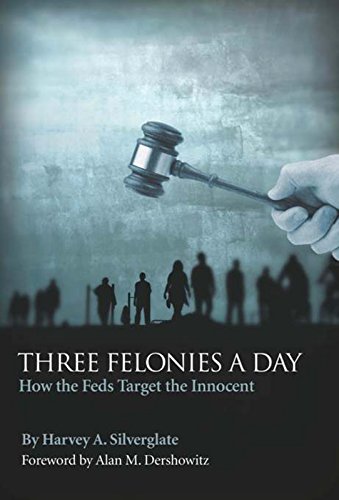 Three Felonies a Day: ...
Best Price: $10.99
Buy New $32.95
(as of 04:35 UTC - Details)
Three Felonies a Day: ...
Best Price: $10.99
Buy New $32.95
(as of 04:35 UTC - Details)
Apparently, it never occurred to these pathetic "progressives" that having cash in the house is not a crime, and it is not the business of a newspaper editor, the police, or anyone else as to why someone has a safe with cash in it. He already had proven that he had received the money legitimately.
The second paragraph contains a statement that can only bring a "Hello!" response: "Cash can be a sign of illegal activity." As Sheehan already had pointed out, the feds have investigated (and investigated) Gaskins and found he was not engaged in illegal activity.
But, the biggest howler is in the third paragraph: "That was a no-no, and he was tried and convicted." In other words, a rule with an arbitrary dollar amount carries the same weight of law as statutes against murder, rape, and robbery, as the Rule of Law is reduced to "try not to commit a u2018no, no.’"
Lest one think that the editors simply are stupid, think again. They have given away their "progressive" views in that one statement. Over the last several decades, federal criminal law have moved from the view of harm done to an individual or individuals to a view of law as a bunch of rules given us by the state to keep us in line. Attorney Paul Rosenzweig writes:
At its inception, criminal law was directed at conduct that society recognized as inherently wrongful and, in some sense, immoral. These acts were wrongs in and of themselves (malum in se), such as murder, rape, and robbery. In recent times the reach of the criminal law has been expanded so that it now addresses conduct that is wrongful not because of its intrinsic nature but because it is a prohibited wrong (malum prohibitum) — that is, a wrong created by a legislative body to serve some perceived public good. These essentially regulatory crimes have become known as "public welfare" offenses.
Thus, today the criminal law has strayed far from its historical roots. Where once the criminal law was an exclusively moral undertaking, it now has expanded to the point that it is principally utilitarian in nature. In some instances the law now makes criminal the failure to act in conformance with some imposed legal duty. In others the law criminalizes conduct undertaken without any culpable intent. (Emphasis mine)
The "structuring" law under which Gaskins was convicted is the epitome of malum prohibitum. Furthermore, it was and is an artificial crime that was created in order to provide prosecutors with leverage against people whom they suspected of engaging in illegal activity, like selling drugs or stolen items. It never was intended to be used as a "stand-alone" statute. Unfortunately, it has become that, and at the present time, Gaskins faces a longer term in prison than many murderers and rapists, yet Gaskins harmed no one.
However, that fact is not enough for these modern "progressives," who see the state as almighty:
Now, the federal court in its wisdom must decide whether Gaskins, 60, is to be sent up the river — a prison sentence could run as long as 35 years. Since a law was broken, punishment is in order.
This says it all. The editorial does not even address why Gaskins did what he did. As anyone even remotely familiar with how the federal criminal system works, an aggressive defense attorney always will be the target of prosecutors who have a smorgasbord of laws at their disposal in which to go after someone.
As I write in my earlier piece on this case:
…I can guarantee the readers that there was a motive that was not mentioned, but well should be: prosecutors would have tried to frame Gaskins had he deposited all of his money at once. That kind of a deposit — which prosecutors insist that he had to make in order to be legal — would have sent alerts to the police and prosecutors, who would have tried to make a drug case against him, claiming he actually had received that money illegally.
I wish I were joking, but I am not. Faced with the large cash deposits, federal prosecutors would have pursued drug cases against him, including trying to cut deals with imprisoned drug offenders promising them reduced sentences if they would agree to name Gaskins as a participant in their illegal activity. This is not a wild pipe dream; this is standard procedure by federal prosecutors, and few people can stand up against this kind of a frame because judges and juries are all-too-happy to go along with it.
I’m not disclosing secret information or exposing something of which only a few people in the federal system are aware; this is something widely-known by lawyers, prosecutors, judges — and journalists. Yes, the same journalists who write articles, make commentaries, and write editorials about those crooked businessmen are all-too-willing to look the other way when federal prosecutors engage in lying and more lying.
 How were the feds able to entice Martha Stewart to meet with investigators so that they could accuse her of lying to them? Prosecutors illegally leaked material to the media (committing a felony in the process) in order to negatively affect the stock price of Martha Stewart Living. The journalists who denounced Stewart had no problem at all enabling prosecutors to commit felonies, real-live crimes that harm people the law supposedly considers to be "innocent," which our "Fourth Estate" was happy to stuff down the Orwellian Memory Hole.
Thus, we see the end result of "progressive" journalism: People must obey all rules of the state, but those who enforce the rules are exempted, as long as they properly team with journalists to promote each other. The same people who prattle on about "playing by the rules" are quite happy to play by their own rules, and enable those entrusted with making and enforcing the laws of this land to do the same.
The Best of William L. Anderson
 The Wrong Stuff Did NASA Moon the Public?